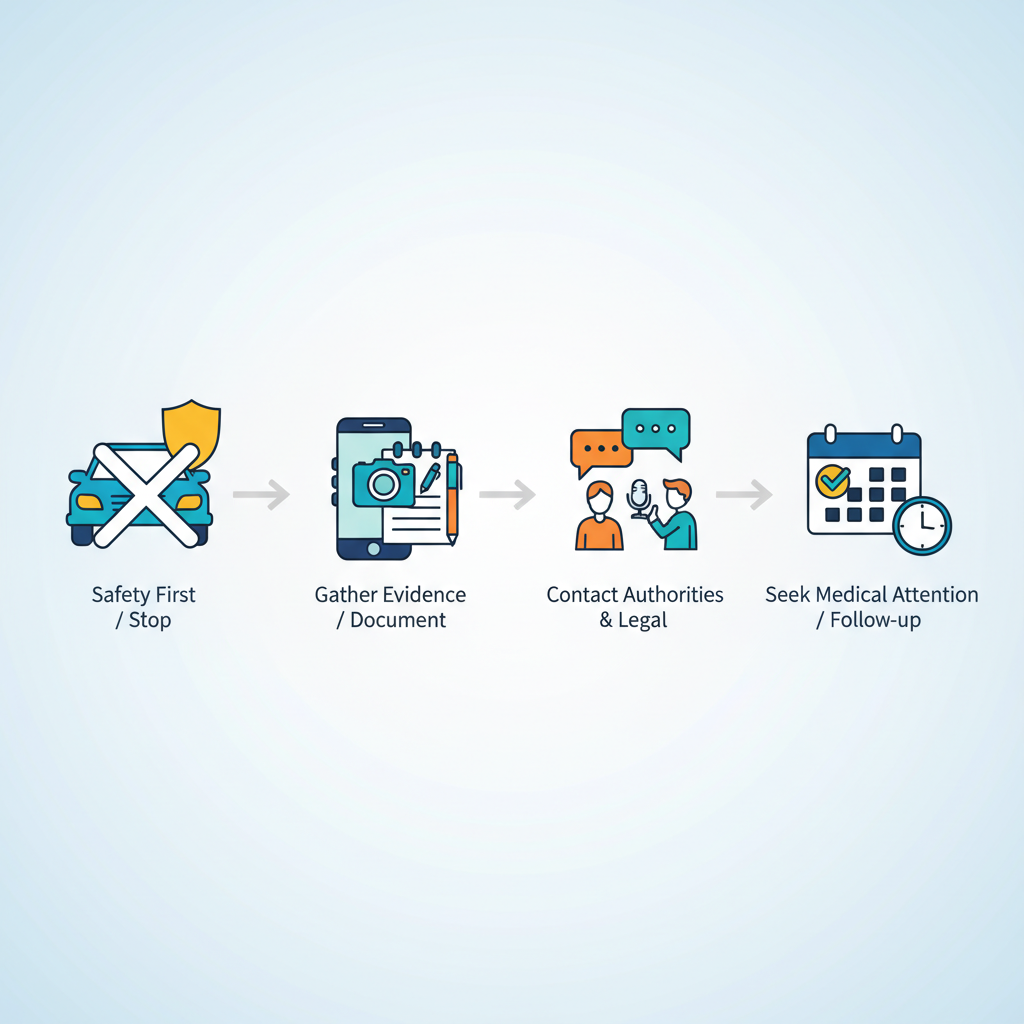
Immediate Steps After an Accident
Your first decisions set the tone for the California personal injury process and can significantly affect evidence, liability, and compensation.
- Prioritize safety and 911. Move out of traffic, call law enforcement and emergency medical services. A police report anchors facts and the accident claim timeline. In California car crashes involving injury, death, or apparent damage over $1,000, you must also file DMV Form SR-1 within 10 days.
- Get medical evaluation immediately. Even if symptoms seem mild, see a doctor within 24–48 hours. Delays invite insurers to argue your injuries aren’t related. Follow all treatment plans and keep copies of records, prescriptions, and referrals.
- Document the scene. Take wide shots and close‑ups of vehicles, hazards, skid marks, debris, license plates, and weather/lighting. For premises incidents, photograph the spill, uneven surface, or broken handrail and your shoes. For product injuries, keep the product, packaging, and receipt—don’t alter or repair it.
- Identify witnesses. Collect names, phone numbers, and emails. Ask nearby businesses to preserve surveillance video; many systems overwrite within days. Note responding officers’ names and report numbers.
- Exchange information without admitting fault. Share driver and insurance details, or the property owner/manager’s information. State facts only. California’s pure comparative negligence means careless statements can reduce your recovery.
- Notify insurers carefully. Tell your insurer promptly, but avoid recorded statements to the at‑fault carrier and don’t sign medical releases or early settlement papers before legal review. MedPay benefits under your policy may cover initial bills regardless of fault.
- Preserve evidence and communications. Save damaged clothing, car seats, helmets, medical devices, repair estimates, and all correspondence. Maintain a symptom and pain journal and track lost work time.
- Limit social media. Posts, photos, and fitness data are routinely used to challenge claims.
- Consult a personal injury attorney early. A lawyer can map out injury lawsuit steps, manage communications, calculate damages, and position your case for negotiation or trial. Deadlines are strict: most California claims must be filed within two years; claims against government entities often require a claim notice within six months.
Use these immediate steps as a practical personal injury settlement guide. They protect your rights, streamline the legal process after accident, and strengthen your position when filing personal injury claim.
Consulting a Personal Injury Attorney
After medical care, speak with an attorney as early as possible in the California personal injury process. Strict deadlines apply—generally two years from the date of injury, and as little as six months to present a claim if a city, county, or state agency is involved. Key evidence such as store surveillance, vehicle data recorders, and witness contact information can be lost within days, making early legal action critical.
At Weinberger Law Firm, an initial consultation focuses on four priorities:
- Liability and case evaluation: Review police reports, scene photos, witness statements, and applicable laws (including California’s pure comparative negligence) to assess fault and case value drivers.
- Evidence preservation: Send spoliation letters for video and vehicle data, secure medical records and bills, and, when needed, coordinate accident reconstruction or site inspections.
- Insurance strategy: Take over communications with adjusters, guard against harmful recorded statements, identify all policies (at‑fault liability, MedPay, UM/UIM), and address health insurer subrogation and medical liens.
- Damages and costs: Outline recoverable losses (medical expenses, lost income, pain and suffering, property damage) and explain contingency fees and litigation costs so there are no surprises.
Concrete examples help clarify the legal process after accident:
- Rear‑end collision on I‑80: After treatment and documentation, counsel prepares a demand package supported by medical evidence and wage proof; most negotiations occur 30–90 days after maximum medical improvement.
- Slip‑and‑fall in a grocery store: Prompt requests for incident reports and video are essential; if a public sidewalk defect is involved, a government claim must be filed within six months.
- Motorcycle crash with disputed lane positioning: Early expert analysis and helmet/camera footage can counter comparative fault arguments.
If settlement talks stall, injury lawsuit steps include filing personal injury claim in Sacramento County Superior Court, formal service, written discovery, depositions, expert disclosures, mediation, and, if needed, trial. This accident claim timeline can extend 12–24 months. Throughout, Weinberger Law Firm provides clear updates and negotiation leverage, serving as a practical personal injury settlement guide while preparing every case as if it will be tried.
Case Investigation and Evidence Gathering
The strength of your claim is built in the first days and weeks of the California personal injury process. Evidence can disappear quickly—video is overwritten, vehicles are repaired, and memories fade—so prompt, structured investigation is essential to the legal process after accident.
Key evidence we secure and preserve includes:
- Official reports: CHP 555 crash reports or local police incident reports; request corrections when needed.
- Scene documentation: photos/video at the same time of day, skid and yaw mark measurements, debris fields, lighting, signage, and road defects.
- Witness information: recorded statements and contact details; nearby business owners and residents often have critical vantage points.
- Video sources: dashcams, Ring/doorbell systems, bus footage, store CCTV (often retained only 7–30 days), and 911/body‑worn camera audio/video.
- Vehicle and electronic data: airbag control module/EDR “black box,” truck ELD logs, telematics, and ride‑share trip data.
- Premises records: incident reports, sweep/cleaning logs, prior complaints, maintenance and lighting logs, and lease/vendor contracts.
- Product evidence: preserve the product with chain of custody for expert testing; look for recall or design change history.
- Medical proof: EMT and ER records, diagnostic imaging, treating provider notes, and a focused medical chronology linking trauma to symptoms.
- Economic loss: wage verification, tax records, PTO usage, and caregiver costs.
- Insurance and coverage: liability limits, UM/UIM, Med Pay, and all potential responsible parties.
Concrete examples: in a trucking crash, we send spoliation letters for ELD data and bills of lading; in a grocery slip‑and‑fall, we subpoena sweep logs and cooler maintenance records; for a roadway defect, we investigate Caltrans work orders and prior incidents.
This phase typically occupies the early accident claim timeline (first 30–90 days). Once treatment stabilizes, we compile a demand package—medical bills valued under Howell v. Hamilton Meats, liens (Medi‑Cal/Medicare) addressed, and expert reports—to negotiate. If settlement stalls, injury lawsuit steps follow: filing personal injury claim within two years (Gov. Code claims against public entities generally due in six months), discovery, depositions, and trial. Thorough evidence gathering maximizes leverage in any personal injury settlement guide scenario.
Submitting a Demand Letter
A persuasive demand letter is the bridge between investigating your claim and serious settlement negotiations in the California personal injury process. It’s typically sent once your injuries are well documented—often after you reach maximum medical improvement—so the full scope of damages is clear. In catastrophic cases or when policy limits are obviously inadequate, a policy‑limits demand may be appropriate sooner.
A strong demand package usually includes:
- Liability summary: how the crash or incident happened, applicable laws, and why the insured is at fault (addressing any comparative negligence arguments).
- Evidence: police report, photos/video, witness statements, repair estimates, and, where relevant, event data recorder or premises inspection findings.
- Medical proof: diagnosis, treatment timeline, provider notes, imaging, prognoses, and future care needs.
- Economic losses: itemized medical bills, pharmacy costs, mileage to appointments, and verified lost wages or diminished earning capacity (pay stubs, employer letter, tax returns).
- Non‑economic harms: pain, limitations in daily activities, and impacts on family life, supported by treatment records and credible narratives.
- Insurance details: identification of all potentially applicable policies and a clear settlement demand, including release terms and a firm deadline.
In 2023, California standardized “time‑limited demands” to insurers. To preserve bad‑faith leverage and keep your accident claim timeline on track, the letter must contain required information and provide a reasonable acceptance window (generally 30–33 days, depending on delivery). An insurer may accept, counter, request clarification, or wrongfully deny—each outcome informs the next injury lawsuit steps.
Example: After a rear‑end collision with $18,500 in medical bills and six weeks off work, the demand might include PT notes, MRI results, an employer wage verification, and photos of vehicle damage. If the at‑fault driver has $100,000 limits and your documented losses and prognosis justify it, the letter can seek the full limits with a compliant response deadline.
If negotiations stall or the offer undervalues your case, the legal process after accident moves toward filing personal injury claim in court before the statute of limitations expires. Weinberger Law Firm prepares every demand as if trial is next, strengthening your position for a fair resolution in line with this personal injury settlement guide.
Negotiations with Insurance Companies
In the California personal injury process, negotiations with insurers begin once liability and damages are documented. Adjusters often call early for recorded statements and quick releases; politely decline until you understand the full scope of injuries and have counsel. The first substantive move is a demand package: a concise liability analysis, medical records and bills, wage documentation, photos, witness statements, and a settlement demand justified by evidence and the policy limits.
Key factors that drive value during negotiations:
- Medical treatment: ER care, diagnostics, specialist visits, surgeries, rehab, and projected future care
- Wage loss and earning capacity: pay stubs, employer letters, vocational assessments
- Pain, suffering, and loss of enjoyment: treatment duration, activity limits, and corroborating notes
- Liability strength: police report findings, video, witness credibility, and any comparative fault
- Policy limits and coverage: BI, MedPay, UM/UIM, and available third-party defendants
- Liens and subrogation: health insurer, Medicare/Medi-Cal, ERISA plans, and provider balances
A typical accident claim timeline looks like this:

- Filing personal injury claim and opening the claim number
- Ongoing medical treatment until maximum medical improvement (MMI)
- Demand sent after MMI; insurer reviews (often 30–45 days)
- Counteroffers and negotiations; adjuster may request clarifications or IME
- Settlement and lien resolution, or escalation to litigation
Insurers commonly argue preexisting conditions, treatment gaps, or shared fault. For example, after a rear-end crash with clear liability, the dispute may center on whether a herniated disc is acute or degenerative. In a slip-and-fall, they may challenge notice and hazard duration. Detailed medical opinions, time-stamped photos, incident reports, and expert input counter these tactics.
If negotiations stall, injury lawsuit steps include filing a complaint, written discovery, depositions, and mediation—often prompting more realistic offers. Be mindful of statutes: generally two years in California (six months to present a government claim).
As your personal injury settlement guide and advocate, Weinberger Law Firm handles communications, quantifies present and future damages, identifies all coverage, and negotiates lien reductions to maximize net recovery within the legal process after accident.
Filing a Personal Injury Lawsuit
If negotiations stall or the statute of limitations is approaching, the next phase in the California personal injury process is initiating a lawsuit to preserve your rights and leverage full discovery. Most injury claims must be filed within two years of the incident. Claims against a city, county, or state entity require an administrative claim within six months, and medical malpractice has shorter, nuanced deadlines.
Injury lawsuit steps typically include:
- Case evaluation and pre-suit demand: Compile medical records, bills, photos, witness statements, and insurance information. A detailed demand often resolves claims without litigation, but filing may be necessary to move the case forward.
- Drafting and filing the complaint: Your attorney selects the proper venue (for example, Sacramento County if the crash occurred there or the defendant resides there), states the legal theories, and identifies all parties. California permits “Doe” defendants so unknown parties can be added later when discovered.
- Service of process: After filing, defendants must be formally served—California courts expect service within 60 days. A defendant generally has 30 days to file an answer, demurrer, or motion to strike.
- Discovery: Both sides exchange evidence through written discovery, depositions, subpoenas for records, and defense medical examinations. This stage can surface critical liability facts and quantify damages.
- Motions and alternative dispute resolution: Courts commonly set mediation and a mandatory settlement conference. Parties may use Code of Civil Procedure section 998 offers to encourage settlement. Summary judgment motions may narrow or resolve issues.
- Trial: If unresolved, the case proceeds to jury trial for a verdict on fault and damages.
Accident claim timeline: straightforward car collisions may resolve in 12–18 months, while product liability or cases with multiple defendants can take longer. Government claims add an administrative step before suit.
Example: In a slip-and-fall where a store denies notice of a spill, depositions and inspection logs obtained in discovery can prove negligence. In a disputed freeway crash, subpoenaed dashcam footage may clarify fault. California’s pure comparative negligence allows recovery even if you are partially at fault, though your award is reduced by your percentage.
Settlement remains possible at any point. A focused personal injury settlement guide emphasizes documenting treatment, calculating wage loss, and presenting future medical needs to maximize recovery during the legal process after accident.
The Discovery Phase
After filing a personal injury claim, discovery is the structured exchange of information that allows both sides to evaluate the case on the merits. In the California personal injury process, this phase is where evidence is gathered, testimony is preserved, and the strengths and weaknesses of each side come into focus—often driving meaningful settlement talks.
Discovery generally opens once the defendant appears in the case and runs up to the pretrial cutoff (typically 30 days before the initial trial date, with separate deadlines for expert discovery). Key tools include:
- Interrogatories: Written questions about how the incident happened, injuries, medical history, and damages.
- Requests for Production: Demands for documents, photos, videos, medical bills/records, wage records, and insurance policies.
- Requests for Admission: Yes/no admissions to pin down undisputed facts and narrow issues.
- Depositions: Sworn, out-of-court testimony from parties, eyewitnesses, treating providers, and experts.
- Subpoenas: Records sought from non-parties like employers, hospitals, or phone carriers.
- Defense Medical Examination: A physical or mental exam limited to injuries placed at issue.
Concrete examples in a car crash case include seeking dashcam or surveillance footage, event data recorder (black box) downloads, cellphone use logs around the collision, pain management records, and payroll data to support lost earnings.
You have important rights during this stage. Discovery must be relevant and proportional; attorney–client and work-product materials are protected. California’s constitutional right to privacy limits overly broad medical or employment demands. Your lawyer can object, negotiate scope, seek protective orders, and move to compel if the other side withholds proper discovery. Requests for Admission can also shift costs at trial if obvious facts are unfairly denied.
Practical tips:
- Preserve evidence; don’t delete texts, photos, or social posts.
- Keep all medical and expense records organized.
- Be consistent with your symptom reporting and treatment.
- Prepare thoroughly for your deposition; answer truthfully and don’t guess.
In the accident claim timeline, discovery is one of the most pivotal injury lawsuit steps. A focused discovery plan by Weinberger Law Firm builds leverage for mediation or trial and helps maximize compensation within the legal process after accident.
Mediation and Settlement Discussions
Mediation is a common, confidential step in the California personal injury process, often scheduled after discovery and before trial. A neutral mediator facilitates negotiations between you, your lawyer, and the insurance carrier to explore resolution without the risks and costs of court. Mediation can be voluntary, court-ordered, or part of a voluntary settlement conference.
Preparation drives results. Before the session, Weinberger Law Firm compiles a mediation brief and demand package that clearly lays out liability and damages. This includes:
- Medical records and bills, prognosis, and future care estimates
- Wage loss documentation and vocational evidence
- Photos, scene reports, and witness statements
- Expert opinions (accident reconstruction, medical causation, life care plans)
- Lien summaries (Medi-Cal, Medicare, private health plans) and anticipated reductions
- A reasoned valuation range and any prior Code of Civil Procedure §998 offers
At the session, the insurer typically attends with an adjuster who has settlement authority. Negotiations proceed through offers, counteroffers, “brackets” (ranges), and sometimes a mediator’s proposal. For example, in a rear-end crash with $75,000 in medical expenses and $20,000 in wage loss, we would present pain-and-suffering analyses anchored in comparable verdicts and policy limits, then test movement using strategic brackets. Well-timed §998 offers can create fee-and-cost consequences that increase leverage if the case proceeds to trial.

If agreement is reached, the terms must be captured in a signed writing—ideally enforceable under Code of Civil Procedure §664.6—covering:
- Total settlement amount and payment timeline
- Release of claims, dismissal with prejudice, and indemnity for liens
- Confidentiality and no admission of liability
- Structure options (e.g., annuities) and court approval for minors or incapacitated adults
Funds are typically disbursed within weeks of signing and lien resolution. In many cases, compensation for physical injuries is not taxable, but you should confirm with a tax professional.
If mediation impasses, the accident claim timeline advances to pretrial motions, expert depositions, and trial—key injury lawsuit steps in the legal process after accident. Throughout, we reassess value, narrow issues, and preserve your best path to recovery after filing personal injury claim.
Preparing for Trial
Trial preparation is the point in the California personal injury process where strategy, evidence, and scheduling align to present your case clearly to a jury. Even if your matter settles, thorough trial readiness strengthens leverage and shortens the accident claim timeline.
Key injury lawsuit steps your attorney coordinates:
- Evidence and exhibits: Organize medical records and bills, treatment timelines, photos, 911/audio, crash data, scene diagrams, and repair estimates. Pre-mark exhibits and issue trial subpoenas to records custodians.
- Witnesses: Prepare you, eyewitnesses, and treating providers through mock direct and cross-examination. Map out availability and service of subpoenas.
- Experts: Disclose expert witnesses per California Code of Civil Procedure timelines and exchange summaries of opinions. Typical experts include accident reconstructionists, orthopedic surgeons, life-care planners, and economists.
- Motions in limine: Ask the court to exclude prejudicial or improper topics (e.g., unrelated prior injuries, insurance payments barred by the collateral source rule, or speculation about attorney involvement).
- Jury materials: File a trial brief, proposed CACI jury instructions, a concise statement of the case, and a special verdict form tailored to liability and damages issues (including comparative fault, if raised).
- Damages proof: Calculate past/future medical costs, lost wages, and loss of earning capacity with pay records, tax returns, employer declarations, and expert projections. Use “before-and-after” witnesses to establish pain and suffering.
- Depositions: Prepare designations of deposition excerpts for any unavailable witnesses and impeachment clips for cross-examination.
- Conferences and settlement: Attend the Mandatory Settlement Conference and trial readiness conference. Settlement discussions continue up to (and even during) trial.
What you can expect:
- Voir dire: Brief attorney-led questioning to seat a fair jury.
- Testifying: Tell the truth, don’t guess, answer only what is asked, and use exhibits to anchor your story.
- Logistics: Court schedules are strict; plan for full days and possible schedule changes.
While not a personal injury settlement guide, these steps show how filing personal injury claim paperwork evolves into courtroom presentation—a critical part of the legal process after accident. Weinberger Law Firm readies every case for trial to maximize outcome potential.
Trial and Verdict or Final Settlement
If your case does not resolve in pretrial negotiations, it may proceed to trial—the final phase of the California personal injury process. Settlement can still happen at any time, even on the morning of trial or during jury deliberations, but your attorney prepares as if a verdict will be required.
A typical civil jury trial in California follows a clear sequence:
- Pretrial motions (e.g., motions in limine to limit evidence)
- Jury selection (voir dire)
- Opening statements
- Plaintiff’s case-in-chief (witnesses, medical records, experts)
- Defense case
- Rebuttal evidence
- Jury instructions and closing arguments
- Jury deliberations and verdict (in most civil cases, 9 of 12 jurors must agree)
The burden of proof is “preponderance of the evidence,” meaning more likely than not. California is a pure comparative negligence state; the jury can assign each party a percentage of fault. For example, if total damages are $400,000 and you are found 20% at fault, your award becomes $320,000.
Damages the jury may consider include:
- Economic: past/future medical bills, lost income, diminished earning capacity, rehabilitation, and property damage
- Non-economic: pain, suffering, emotional distress, and loss of enjoyment of life
- Punitive damages: rare, reserved for egregious misconduct such as intoxicated or reckless conduct
After a verdict, the court enters judgment. The defense may file post-trial motions (e.g., new trial or judgment notwithstanding the verdict). In California, courts can conditionally grant a new trial unless the parties accept remittitur or additur. Either side may appeal, which can extend the accident claim timeline. Post-judgment interest generally accrues at 10% per year, and in some injury cases, Civil Code section 3291 can add interest from a rejected Code of Civil Procedure section 998 offer.
Even after a verdict, many cases settle to avoid the cost and delay of appeals. Your attorney will also address medical liens and reimbursements (e.g., health insurers, Medicare/Medi-Cal, hospital liens), negotiate reductions, and coordinate the distribution so your net recovery is maximized. Throughout these injury lawsuit steps, experienced counsel keeps you informed and positions your case for the strongest possible result, whether by final settlement or verdict.
Receiving Your Compensation
Once your case resolves by settlement or verdict, the final stages of the California personal injury process focus on safely delivering your funds and maximizing your net recovery. Here’s how the legal process after accident concludes financially.
- Sign the release and settlement agreement. This document ends the claim in exchange for payment. For minors or incapacitated adults, the court must approve a compromise before funds are released.
- Insurer issues payment. After receiving the signed release, the insurer typically cuts a check payable to you and your attorney within about 1–3 weeks. If your case ended in a verdict, post-judgment motions or an appeal can delay payment, though post-judgment interest may accrue.
- Deposit into client trust. Your check is placed in a regulated attorney trust (IOLTA) account. Banks usually clear funds within 3–10 business days before any disbursement.
- Resolve liens and outstanding bills. Health insurers (including Medicare/Medi-Cal), ERISA plans, workers’ compensation carriers, and hospitals may assert reimbursement rights. Obtaining final lien demands—especially from Medicare—can add time but is critical to protect you from future collection. Your legal team works to reduce these liens to increase your net.
- Deduct fees and costs. Attorney’s fees and case expenses are paid according to your fee agreement. You’ll receive an itemized closing statement showing the accident claim timeline from settlement to final accounting.
- Disbursement of your net. You can receive funds by check or wire. If a structured settlement is chosen, payments are scheduled over time; this must be arranged before signing the release to preserve tax advantages.
Taxes: In a personal injury settlement guide, it’s important to note that compensation for physical injuries is generally non-taxable under federal law. Punitive damages and interest are taxable. Always confirm with a tax professional.
Common delays: incorrect payee names on the check, provider billing errors, Medicare/Medi-Cal final demand processing, and court approvals for minors.
From filing personal injury claim to the final injury lawsuit steps, Weinberger Law Firm manages lien negotiations, documentation, and timing so you receive every dollar you’re owed as efficiently as possible.
Call to Action
Contact us today for a Free Case Consultation!