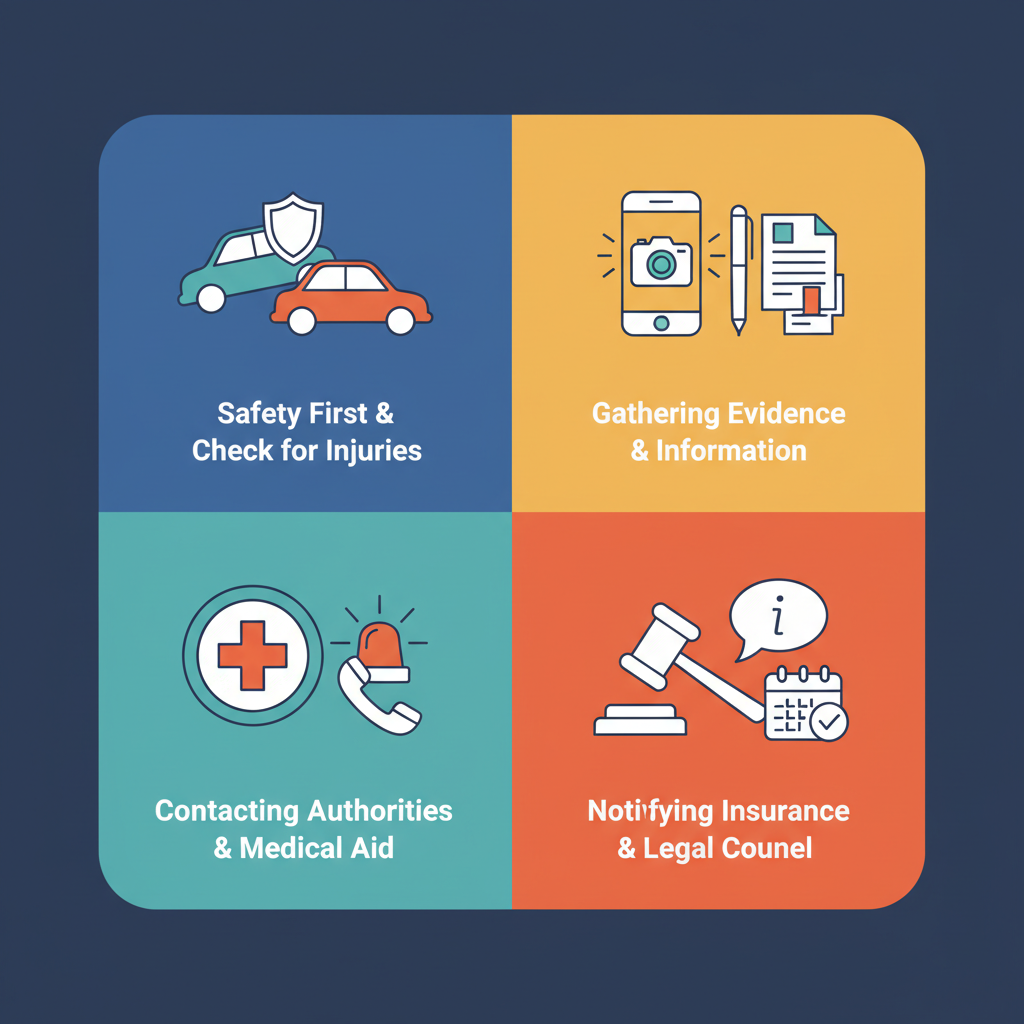
Immediate Steps After Being Hit
Your first priority is safety. If you can, move vehicles out of traffic, turn on hazard lights, and call 911. Check yourself and others for injuries and request medical help. In California, you must stop and exchange information after a collision; do not leave the scene.
Get evaluated by a medical professional the same day, even if you feel “fine.” Adrenaline can mask injuries like concussions, internal trauma, or soft-tissue damage. Follow all treatment recommendations and keep copies of visit notes, diagnoses, prescriptions, and bills—these records become key when seeking compensation after accident.
Document the scene thoroughly while it’s fresh:
- Photograph vehicle damage (close-ups and wide shots), license plates, the intersection, traffic signals, skid marks, debris, and road/weather conditions.
- Capture the other driver, passengers, and any visible injuries (with consent).
- Record the exact location, time, and direction of travel.
- Collect witness names, phone numbers, and brief statements.
- Look for nearby businesses or homes with cameras; note their locations for potential footage.
- Ask responding officers for the incident/report number and their badge names.
Exchange required details under California law: names, addresses, driver’s license numbers, vehicle information, and insurance. Keep your conversations factual—avoid apologizing or speculating about fault. If contacted by an insurer at the scene, politely decline recorded statements until you obtain car crash legal advice.
Complete essential personal injury claim steps promptly:
- Report the crash to your insurer, but avoid detailed or recorded statements to the other driver’s insurer before speaking with a California car accident lawyer.
- File a DMV SR-1 within 10 days if anyone was injured or property damage likely exceeds $1,000.
- Start a claim journal noting pain levels, missed work, and daily limitations.
- Save damaged items (car seats, helmets, glasses) and don’t repair your vehicle until it’s fully documented.
- Track all out-of-pocket costs, mileage to appointments, and lost wages.
Protect accident victim rights California with timely legal guidance. An experienced attorney can preserve evidence, identify all insurance sources (including UM/UIM or Med-Pay), and navigate deadlines—generally two years to file a personal injury claim (six months for government entities). If you’re unsure what to do after car accident, early consultation can help you avoid mistakes and position your case for fair compensation.
Gathering Essential Accident Evidence
In the first hours after a crash, evidence can make or break your claim. If you’re unsure what to do after car accident chaos, start by preserving the facts before they disappear.
At the scene:
- Call 911 and request an officer. Get the report or incident number and the officer’s name.
- Photograph everything: vehicle positions, all sides of each car, interior damage, airbags, skid marks, debris, paint transfers, license plates, driver’s licenses/insurance cards, nearby signage, traffic signals, road construction, lighting, weather, and surface conditions.
- Capture context shots and close-ups. Include a reference (coin/pen) for scale.
- Collect witnesses’ names, phone numbers, and emails. Ask for brief written statements or texts. California is an all-party consent state; only record audio/video of people with their permission.
- Note any admissions (“I didn’t see you,” “I was on my phone”) without discussing fault yourself.
Police and DMV paperwork in California:
- Request the full collision report (CHP 555 or local PD report) as soon as it’s available.
- If anyone was injured or property damage likely exceeds $1,000, file the DMV SR-1 within 10 days, even if a report was taken.
Medical documentation:
- Get evaluated immediately and list all symptoms, even mild ones. Follow through with treatment and keep all visit summaries.
- Photograph bruising, swelling, and abrasions over several days. Save torn or bloodied clothing.
- Start a recovery journal tracking pain levels, sleep issues, missed activities, and mental health impacts.
Digital and technical evidence:
- Back up dashcam footage. Canvass nearby homes and businesses for surveillance within 24–72 hours before footage is overwritten.
- Preserve your vehicle before repairs so its event data recorder (EDR) can be downloaded. A California car accident lawyer can send preservation (spoliation) letters to protect EDR, vehicle, and phone data.
- If distraction is suspected, note the exact crash time; your attorney can pursue phone records.
Financial proof:
- Keep repair estimates, tow/rental receipts, medication costs, and mileage to appointments.
- Document lost income with pay stubs, tax returns, and employer letters describing missed time and duties.
Special scenarios:
- Hit-and-run: document vehicle description, direction, and debris; promptly report for potential uninsured motorist coverage.
- Rideshare/commercial vehicles: preserve trip logs, maintenance, and driver records.
Weinberger Law Firm can execute these personal injury claim steps—securing records, issuing preservation notices, and coordinating experts—so you can focus on healing while seeking compensation after accident. For car crash legal advice and to protect accident victim rights California, involve counsel early to control the evidence timeline.
Reporting the Collision to Authorities
Reporting the crash promptly is one of the most important “what to do after car accident” steps. An official report preserves critical details, supports your insurance claim, and protects your accident victim rights in California. Even if the damage seems minor or you feel “okay,” report the collision and document what happened.
If anyone is hurt, call 911. On freeways and state highways, the California Highway Patrol (CHP) typically responds; on city streets, it’s the local police department; in unincorporated areas, the county sheriff. For non‑emergencies with no injuries or roadway hazards, call the non‑emergency line and ask whether to wait for an officer or file a counter report at the station.

At the scene and shortly after, take these steps:
- Call 911 for injuries, suspected DUI, blocked lanes, or significant damage. For hit-and-run, report immediately.
- Provide facts only: your license, registration, and insurance. Do not admit fault or speculate about speed or cause.
- Note injuries and symptoms (e.g., neck pain, dizziness), even if mild.
- Point out evidence to the officer: skid marks, vehicle positions, debris, nearby cameras, and witness contacts. Mention if the other driver admitted fault or was using a phone.
- Get the officer’s name, badge number, agency, and the incident or report number. Ask when and how you can obtain the report (often in 7–10 days).
- File the DMV Form SR‑1 within 10 days if anyone was injured or killed, or if property damage exceeds $1,000. This is required even if you weren’t at fault or a police report exists; failing to file can lead to license suspension. Your insurer can submit it, but you remain responsible.
- For hit-and-run, provide any partial plate, vehicle description, or direction of travel and ask about follow-up steps.
Example: Rear-ended on I‑80 near Sacramento with delayed back pain? Call 911 so CHP documents the crash. If no officer is available, go to a CHP office within 24 hours to file a counter report. That report often becomes key evidence in the personal injury claim steps and when seeking compensation after an accident.
Insurers heavily weigh police reports during liability decisions. If the report contains errors, a California car accident lawyer can help request a correction or add a supplemental statement, preserving your car crash legal advice strategy and strengthening your claim. Weinberger Law Firm can obtain the report for you, handle agency communications, and ensure your rights are protected from day one.
Understanding Your Legal Rights
If another driver hit you in California, you have enforceable rights to recover your losses. California is an at-fault, pure comparative negligence state. That means the driver who caused the crash (and their insurer) is responsible for your damages, and you can still recover even if you share some blame—your award is simply reduced by your percentage of fault. Understanding what to do after car accident moments helps protect these rights.
You may seek compensation for:
- Medical expenses now and in the future, including rehabilitation
- Lost wages and loss of earning capacity
- Pain, suffering, and emotional distress
- Property damage, rental car, and diminished value
- Out-of-pocket costs such as medications, travel to appointments, and childcare
Key rules to know:
- Deadlines: Generally 2 years to file a bodily injury claim and 3 years for property damage. Claims involving government entities (e.g., a city vehicle or unsafe roadway) require an administrative claim within 6 months.
- Statements: You are not required to give a recorded statement to the at-fault insurer. Provide only basic information and decline until you’ve received car crash legal advice.
- Choice of care and repairs: You can choose your own doctors and auto repair shop. Request and review the police report.
- Insurance nuances: Your MedPay may cover immediate bills regardless of fault. Uninsured/underinsured motorist coverage can fill gaps if the other driver lacks sufficient insurance. Health insurers (including Medicare/Medi-Cal) may assert liens; these can often be negotiated.
- Special limits: If you were driving without insurance, Proposition 213 may bar recovery of pain and suffering even if you weren’t at fault.
Practical personal injury claim steps:
- Photograph vehicle positions, damage, injuries, and road conditions; preserve dashcam footage.
- Collect witness names and contact details; note nearby businesses with cameras.
- Seek prompt medical evaluation and follow treatment; keep a symptom journal.
- Save all bills, repair estimates, and proof of missed work.
- File the DMV SR‑1 within 10 days if there was injury, death, or over $1,000 in damage.
When seeking compensation after accident losses, a California car accident lawyer can evaluate liability, calculate full damages, handle insurer negotiations, and file suit if needed—safeguarding accident victim rights California.
Interacting with Insurance Companies
Insurance contact is one of the most important “what to do after car accident” steps. Expect early calls from adjusters who want details and a quick resolution. Protect yourself by controlling the flow of information and documenting everything.
- Notify your own insurer promptly and cooperate, but stick to facts: date, location, vehicles, visible damage, known injuries. Don’t guess or speculate.
- Decline recorded statements to the at‑fault driver’s insurer until you’ve spoken with a California car accident lawyer. In California’s pure comparative negligence system, casual remarks can be used to shift fault onto you.
- Don’t admit fault or minimize injuries. Get a full medical evaluation first.
- Don’t sign broad medical releases. Provide only targeted records tied to the crash, preferably through counsel.
- Ask for the claim number and adjuster contact. Follow up in writing and keep a log of calls, emails, and offers.
Know your coverages and how they interact with a third‑party claim:
- Medical Payments (Med Pay) can cover initial treatment regardless of fault; your health insurer, Medi‑Cal, or Medicare may later seek reimbursement.
- Uninsured/Underinsured Motorist (UM/UIM) helps if the at‑fault driver has no or low limits. Policies require prompt notice—report quickly.
- Collision coverage can get your car repaired now; your insurer may recover from the other party later.
- Rental and loss‑of‑use are recoverable from the at‑fault insurer; third‑party diminished value claims are recognized in California.
Build your bodily injury claim methodically. Save photos, repair estimates, medical records, prescriptions, and wage loss proof. Typically, a demand goes out after you reach maximum medical improvement so it reflects future care, lost earnings, and pain and suffering. Be wary of “early” checks. Example: an adjuster offers $4,000 before your MRI reveals a herniated disc—cashing it likely ends your claim.
Deadlines matter. California generally allows two years to file for bodily injury and three years for property damage, with only six months to present claims against government entities. Policies also have short reporting windows.
For car crash legal advice tailored to accident victim rights California, involve Weinberger Law Firm early. We handle insurer communications, craft evidence‑backed demands, and negotiate aggressively, improving your chances of seeking compensation after accident while you focus on recovery.
When to Consult an Injury Attorney
After you’ve handled immediate safety needs and reported the crash, the most important “what to do after car accident” step is to speak with an attorney as soon as possible—ideally within days. Early guidance helps protect evidence, prevents costly mistakes with insurance, and positions your claim for full value.
Consult a California car accident lawyer promptly if any of the following apply:
- You have pain, concussion symptoms, or injuries needing medical care (even if delayed).
- Fault is disputed, there are multiple vehicles, or a commercial truck/rideshare was involved.
- The other driver was uninsured/underinsured, or it was a hit-and-run.
- An insurer asks for a recorded statement or broad medical authorizations.
- You receive a quick settlement offer before you know the extent of your injuries.
- A government vehicle or roadway hazard may be involved (special deadlines apply).
- Your car sustained major damage, air bags deployed, or there’s potential for long-term treatment.
Time limits in California are strict: generally two years for injury claims and three years for property damage, with only six months to file a government claim. An attorney can also send preservation letters to secure dashcam footage, nearby business surveillance, vehicle EDR (“black box”) data, and 911 recordings—critical proof that can disappear within days.
Clear car crash legal advice also covers insurance coordination. A lawyer helps you avoid statements that harm your case, manages medical liens (health insurance, Medicare/Medi-Cal), documents wage loss, and calculates future care and non-economic harms. For example, in a disputed intersection crash, counsel may use scene mapping and witness interviews to establish liability; in a rear-end collision with delayed neck pain, they ensure imaging and specialist referrals support causation and prognosis.
If you’re seeking compensation after accident injuries, a firm like Weinberger Law Firm in Sacramento guides you through personal injury claim steps—from investigation and claim filing to negotiation and, if needed, litigation. Just as important, you’ll understand accident victim rights California, including comparative negligence rules and the full range of damages available. Early consultation can be the difference between an insurer’s low offer and a recovery that truly covers your losses.
Potential Compensation for Your Damages
After a crash, compensation is meant to put you as close as possible to where you were before the collision. The amount and type of recovery depend on the facts, evidence, and who is at fault. California’s pure comparative negligence rule reduces your award by your percentage of fault, and uninsured drivers may be limited from recovering pain-and-suffering damages under Proposition 213 (with narrow exceptions, such as when the at-fault driver is convicted of DUI).
You may be able to recover:
- Medical care and rehabilitation: ER treatment, surgery, hospital stays, follow-up visits, physical therapy, chiropractic care, medications, medical devices, psychological counseling, and expected future care. Track mileage to appointments and copays.
- Lost income and earning capacity: Missed wages, overtime, bonuses, tips, and gig income. If injuries affect your future ability to work, an expert can calculate diminished earning capacity.
- Property and vehicle losses: Repair or replacement, towing, storage, rental reimbursement, loss of use, and diminished value if your car is worth less even after quality repairs.
- Out-of-pocket costs: Childcare during treatment, home health aides, household help, transportation, and home or vehicle modifications.
- Non-economic harm: Physical pain, emotional distress, inconvenience, loss of enjoyment of life, scarring, and disfigurement. A spouse may claim loss of consortium.
- Punitive damages: In rare cases involving egregious conduct (for example, a drunk driver), a court may award punitive damages to punish and deter.
Sources of payment can include the at-fault driver’s liability insurance, your MedPay coverage, and your own uninsured/underinsured motorist (UM/UIM) policy if the other driver lacks sufficient coverage.
Strong documentation drives value. As part of your personal injury claim steps and knowing what to do after car accident, save medical records and bills, repair estimates, pay stubs, tax returns, and receipts. Keep a daily journal describing pain levels, limitations, and missed activities—concrete examples help establish non-economic losses.
Be aware of liens and reimbursements: health insurers, Medicare, or Medi-Cal may seek repayment from your settlement. A California car accident lawyer can negotiate liens, evaluate future damages, and provide car crash legal advice tailored to accident victim rights California. Most physical-injury settlements are not taxable, but punitive damages and interest generally are; consult a tax professional.
Deadlines are strict: in most cases you have two years to file, and claims against government entities require a claim within six months. Acting promptly improves your chances of seeking compensation after accident and preserving all available damages.
Navigating California Personal Injury Law
California follows an at-fault system with pure comparative negligence. You can recover even if you’re partially responsible, but your compensation is reduced by your percentage of fault. Understanding this framework helps you avoid missteps that insurers may use to minimize your claim.
If you’re wondering what to do after car accident, focus on these California-specific steps:
- Call 911 and get a police report if anyone is hurt or vehicles are not drivable.
- Exchange names, contact, insurance, and license details; note the other vehicle’s VIN and plate.
- Photograph vehicle positions, damage, skid marks, traffic signals, and injuries. Ask nearby businesses for camera footage.
- Identify and save witness contact information.
- Seek medical care the same day; gaps in treatment can undermine your case.
- File the DMV SR-1 within 10 days if anyone was injured or damages likely exceed $1,000.
- Notify your insurer promptly but avoid recorded statements to the other driver’s carrier without a California car accident lawyer.
Key personal injury claim steps typically include liability investigation, documenting medical treatment, calculating losses, and sending a demand package with records, bills, wage proof, and expert opinions if needed. If negotiations stall, your attorney can file suit and proceed through discovery, mediation, and trial if necessary.
You may pursue compensation for:
- Economic losses: medical bills, rehab, lost income, diminished earning capacity, property damage, and out-of-pocket costs.
- Non-economic losses: pain, suffering, emotional distress, and loss of enjoyment.
- Punitive damages in rare cases of egregious conduct (e.g., DUI).
Important California nuances:
- Uninsured drivers may face limits on non-economic damages under Civil Code §3333.4 (Prop 213). Ask about exceptions.
- Claims against a city, county, or state require a government claim within six months before filing a lawsuit.
- The general statute of limitations is two years for bodily injury and three years for property damage.
- UM/UIM and Med-Pay on your policy can help when the at-fault driver is uninsured or underinsured.
For car crash legal advice tailored to accident victim rights California, consult an experienced attorney early. A lawyer can preserve evidence, manage insurers, and position you for seeking compensation after accident while you focus on recovery.
Call to Action
Contact us today for a Free Case Consultation!