
Table of Contents
- The Devastating Impact of Commercial Truck Accidents
- Your Rights After a Commercial Truck Fatality
- Why Choosing the Right Legal Team Matters
- Our Investigation Process for Truck Wrongful Death Cases
- Establishing Liability in Commercial Vehicle Accidents
- Calculating Full and Fair Compensation for Your Loss
- The Timeline and Statute of Limitations You Need to Know
- How We Handle Insurance Companies and Negotiations
- Preserving Critical Evidence from the Accident Scene
- What to Prepare for Your Free Consultation
- Moving Forward with Confidence and Support
- Frequently Asked Questions (FAQ)
The Devastating Impact of Commercial Truck Accidents
Commercial truck accidents are categorically different from car collisions. A loaded semi-truck can weigh 80,000 pounds or more, traveling at highway speeds. When that mass collides with a passenger vehicle, the force is often catastrophic. If you have lost someone in such an accident, you are facing not only profound grief but also immediate financial and legal pressures.
The impact extends beyond the scene. Families lose breadwinners, incur massive medical expenses from the final hours of care, and face funeral and burial costs. Many lose years of expected companionship, guidance, and support. The emotional toll is compounded by confusion about what steps to take next and whether you have any recourse.
You have rights after an accident involving a commercial vehicle. California law recognizes wrongful death claims, which allow surviving family members to seek compensation for their losses. Understanding these rights early is critical because time and evidence preservation matter enormously in truck accident cases.
What to do next: If you have not already done so, preserve any evidence from the accident scene, including photos, witness contact information, and the initial police report. These details become harder to recover as time passes.
Your Rights After a Commercial Truck Fatality
When a family member dies due to someone else’s negligence, California law grants specific people the right to file a wrongful death claim. Surviving spouses, children, and dependent parents are the primary beneficiaries, though other family members may have limited rights depending on the circumstances.
A wrongful death lawsuit is fundamentally different from a personal injury claim. The deceased person cannot bring the claim themselves, so surviving family members step forward to recover damages on their behalf. These damages can include the deceased’s medical expenses from the accident, lost wages the deceased would have earned, loss of companionship, pain and suffering, and punitive damages in cases of gross negligence.
You do not need to pay upfront legal fees to pursue this claim. We work on a contingency basis, meaning we only collect a fee if we recover compensation for you. This arrangement removes financial barriers and aligns our interests with yours: we succeed only when you do.
What to do next: Gather documents that show the deceased person’s income, employment history, and family relationships. These will support the economic damages portion of your claim.
Why Choosing the Right Legal Team Matters
Not all attorneys are equally equipped to handle commercial truck wrongful death cases. These cases are complex, involving federal trucking regulations, corporate defendants with substantial resources, and insurance companies motivated to minimize payouts. A team with deep experience in truck accident litigation understands the industry, knows where evidence is located, and has the track record to negotiate or litigate effectively.
We bring both compassion and aggressive advocacy to every case. We understand that you are grieving while simultaneously facing legal deadlines and insurance pressures. Our role is to shoulder the legal burden so you can focus on your family and healing. We investigate thoroughly, document meticulously, and present the facts with confidence.
The right legal team also protects you from common pitfalls. Insurance adjusters may contact you seeking statements, which can inadvertently harm your claim. We handle all communications with insurance companies so you do not accidentally compromise your position. We also ensure that the statute of limitations — the filing deadline — is never missed, a mistake that can erase your entire claim.
What to do next: When evaluating a firm, ask about their experience with commercial vehicle cases, their success rate, and how they handle client communication. Trust and expertise matter equally in wrongful death work.
Our Investigation Process for Truck Wrongful Death Cases
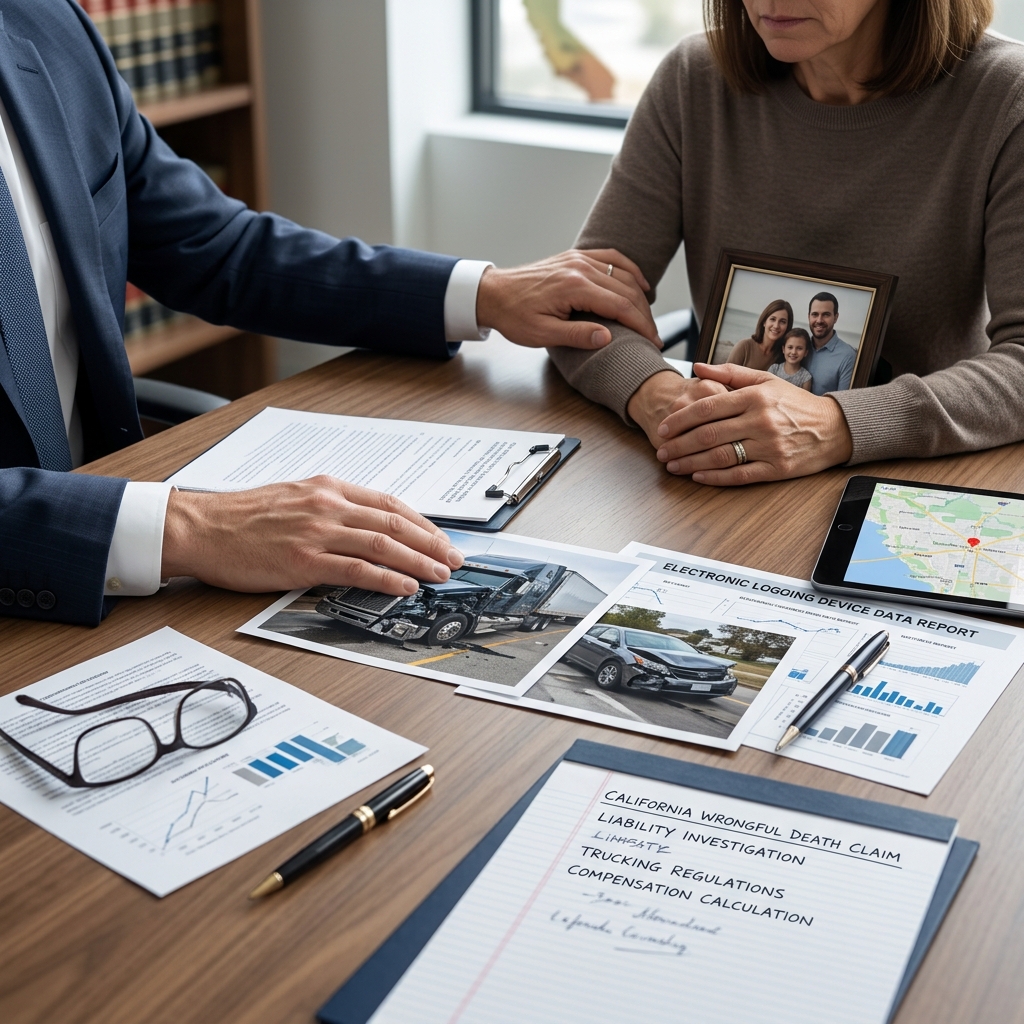
We investigate truck wrongful death cases comprehensively from day one. We will investigate all available evidence, including police reports, witness statements, traffic camera footage, the truck’s electronic logging device (ELD) data, maintenance records, and the driver’s qualification file. Many truck accidents involve multiple contributing factors: driver fatigue, inadequate training, mechanical failure, or violations of federal hours-of-service regulations.
Our investigators work quickly to preserve evidence. Commercial trucking companies and insurance carriers often move fast to secure, sanitize, or destroy evidence. We file preservation letters immediately and, when necessary, obtain court orders to prevent evidence destruction. We also conduct scene reconstruction with accident experts and biomechanical specialists to establish exactly what happened.
We also scrutinize the defendant’s corporate practices. Did the company adequately vet drivers? Did they enforce safety protocols? Were maintenance schedules followed? These questions often reveal patterns of negligence that go beyond the individual driver and strengthen your case.
What to do next: If you have any photos, videos, or notes from the accident scene, email them to us securely. Also provide names and contact information for anyone who witnessed the collision or spoke with you afterward.
Establishing Liability in Commercial Vehicle Accidents
Proving liability in a commercial truck wrongful death case requires showing that the defendant (or defendants) owed a duty, breached that duty, and caused your family member’s death as a result. In truck accidents, liability often extends beyond the driver to the trucking company, the cargo loader, the truck manufacturer, or the maintenance contractor.
For example, if the truck’s brakes failed due to inadequate maintenance, liability falls on whoever was responsible for inspections and repairs. If the driver fell asleep because the company pressured drivers to violate federal hours-of-service rules, the company shares liability. If the cargo was loaded improperly and shifted during transit, the loader bears responsibility. We pursue full and fair compensation by identifying and holding accountable every party whose actions contributed to the fatal accident.
Federal regulations govern trucking companies rigorously. The Federal Motor Carrier Safety Administration (FMCSA) sets standards for driver qualifications, vehicle maintenance, and hours of service. When companies violate these regulations and someone dies, that violation demonstrates negligence. We use regulatory violations as foundational evidence in establishing liability.
What to do next: Write down anything you remember about the accident circumstances: time of day, weather, road conditions, what the truck was carrying, and any communications you received from the trucking company or their insurer. These details help us build the liability picture.
Calculating Full and Fair Compensation for Your Loss
Wrongful death damages in California fall into two categories: economic and non-economic. Economic damages include medical bills and lost wages the deceased would have earned over their remaining work-life expectancy, plus funeral and burial costs. Non-economic damages cover loss of companionship, emotional distress, and loss of parental guidance (if the deceased was a parent).
Calculating these damages requires detailed forensic analysis. We work with economists and vocational experts to project the deceased person’s lifetime earnings, accounting for raises, promotions, and work history. We gather medical records to document treatment, expenses, and the final hours. We compile funeral invoices and probate documents. For non-economic damages, we document the family relationships, community involvement, and character to convey the depth of your loss to a jury if necessary.
In cases involving gross negligence or willful misconduct, California also allows punitive damages, which punish the defendant and deter future misconduct. A trucking company that knowingly hires unqualified drivers or ignores repeated safety violations may face punitive liability. We evaluate this possibility early and pursue it aggressively when the facts support it.
What to do next: Compile medical records from the final hospital or emergency visit, the death certificate, and funeral expense documentation. Also gather pay stubs, tax returns, or employment letters showing the deceased’s income and work history.
The Timeline and Statute of Limitations You Need to Know

Time is limited — act now. California’s statute of limitations for wrongful death claims is two years from the date of death. Missing this deadline is catastrophic: your claim is forever barred, and no compensation is possible. We prioritize immediate case evaluation and filing to ensure no deadline is missed.
Beyond the statute of limitations, other deadlines apply. If the defendant is a government entity, you must file a claim within six months. If the defendant is a large corporation, pre-suit settlement demands must follow specific procedural rules. Early filing also preserves evidence, as witnesses move away, memories fade, and physical evidence deteriorates.
We structure our early work to meet every deadline while building a strong case. Within weeks of engagement, we typically file preservation letters, initiate formal discovery (the legal process of obtaining the defendant’s documents and communications), and retain expert witnesses. This aggressive timeline protects your rights and signals to insurers that we are serious about litigation.
What to do next: Note the exact date of your family member’s death. Contact us within the next few weeks to ensure we file all necessary paperwork well before any deadline expires.
How We Handle Insurance Companies and Negotiations
Insurance companies have teams of adjusters, attorneys, and investigators working to minimize payouts. They understand settlement leverage and will often make low initial offers hoping families will accept out of desperation or exhaustion. We negotiate from strength, armed with thorough investigation, expert opinions, and litigation readiness.
Our approach is direct: we document liability comprehensively, demonstrate damages clearly, and present both a fair settlement demand and a credible threat of trial. Most cases settle after this process, often for substantially more than initial offers. When settlement is impossible, we move confidently to trial, where a jury hears the evidence and decides the verdict.
We also protect your privacy and emotional well-being during negotiations. We handle all correspondence, attend all meetings, and shield you from aggressive tactics. If an insurance adjuster contacts you directly, refer them to us immediately. Anything you say without counsel present can undermine your case.
What to do next: Do not sign any documents, give any statements, or accept any settlement offer from an insurance company without speaking to us first. Every communication you make can impact your legal position.
Preserving Critical Evidence from the Accident Scene
Evidence preservation is urgent in truck wrongful death cases. Traffic camera footage is often deleted after 30 days. Witness memories fade. Physical evidence is sometimes cleaned up or discarded. We preserve any evidence and get medical care immediately by filing preservation letters with all relevant parties, demanding they safeguard accident-scene evidence, vehicle components, electronic data, and corporate records.
Common critical evidence includes:
- Traffic camera or surveillance footage from nearby businesses, traffic signals, or other vehicles
- The truck’s electronic logging device (ELD) data, which records speed, braking, hours of service, and location
- The driver’s training and qualification file, including driving history and any prior incidents
- Maintenance logs and inspection records for the truck
- Cellular phone records and dashcam footage if available
- Witness statements gathered at the scene
We work fast to secure this evidence before it vanishes. We also photograph the accident scene ourselves, conduct scene reconstruction, and preserve the deceased person’s medical records. Every document and data point strengthens your case and increases settlement value.
What to do next: Photograph the accident scene and surrounding area if you have access. Provide us with any video, photos, or dashcam footage you possess. Forward any written communications from the trucking company, driver, or insurer without responding to them directly.
What to Prepare for Your Free Consultation

When you come in for your free consultation, bring any documents you have already gathered. These might include the police report, insurance correspondence, medical records, pay stubs, employment letters, or photos from the scene. We will ask detailed questions about your family member’s work history, income, family relationships, and the circumstances of the accident.
We also want to understand your goals and concerns. Some families prioritize maximum financial recovery. Others prioritize accountability and want to see the defendant held responsible in court. Still others seek operational changes in the trucking industry to prevent future deaths. We listen and tailor our strategy accordingly, always keeping your interests central.
Bring a list of questions too. We encourage you to ask about our experience, our fee arrangement, our expected timeline, and what you can expect at each stage. A good attorney should explain legal concepts in plain language and make you feel heard and supported from the first conversation.
What to do next: Schedule your free consultation by calling us or visiting our website. Bring any documents you have, and prepare to discuss your family member’s background, income, and the accident circumstances. There is no obligation, and we handle sensitive conversations with complete confidentiality.
Moving Forward with Confidence and Support
Pursuing a commercial truck wrongful death claim while grieving is difficult. You are balancing emotional pain, family needs, and complex legal processes. Our role is to handle the legal work so you do not have to. We pursue full and fair compensation, negotiate aggressively, and litigate confidently when necessary.
You do not face this alone. We have guided families through dozens of commercial truck wrongful death cases, and we understand both the legal landscape and the human dimensions of your loss. We will keep you informed at every stage, answer your questions directly, and advocate fiercely for the compensation your family deserves.
Contact us for a free consultation today. We work on a contingency basis, so there is no fee unless we recover for you. Time matters in these cases, and the sooner we engage, the better we protect your rights and your family’s future.
For further reading: California personal injury.
Contact us today for a Free Case Consultation!
Frequently Asked Questions (FAQ)
What should I do immediately after a commercial truck accident that resulted in a fatality?
First, prioritize your safety and ensure emergency services are called. Preserve any evidence at the scene by taking photos, collecting witness contact information, and documenting the truck’s license plate and company details. We strongly recommend not discussing the incident with insurance companies before contacting us, as statements made early can impact your case. Time is limited — act now and reach out for a free consultation so we can guide you through the next steps.
How long do we have to file a wrongful death claim in California?
California’s statute of limitations gives you two years from the date of death to file a wrongful death lawsuit. This deadline is strict, and missing it means losing your right to pursue compensation entirely. We will work quickly to investigate all available evidence and build a strong case within this timeframe. Contact us immediately to ensure we preserve your legal rights and meet all filing deadlines.
What types of compensation can we pursue in a commercial truck wrongful death case?
We pursue full and fair compensation covering medical bills incurred before death, lost wages and lost earning potential, funeral and burial expenses, pain and suffering endured by the deceased, and loss of companionship and support for surviving family members. Every case is unique, which is why we conduct a thorough case evaluation to identify all damages available to you. No fee unless we recover for you, so let us investigate what your family deserves.