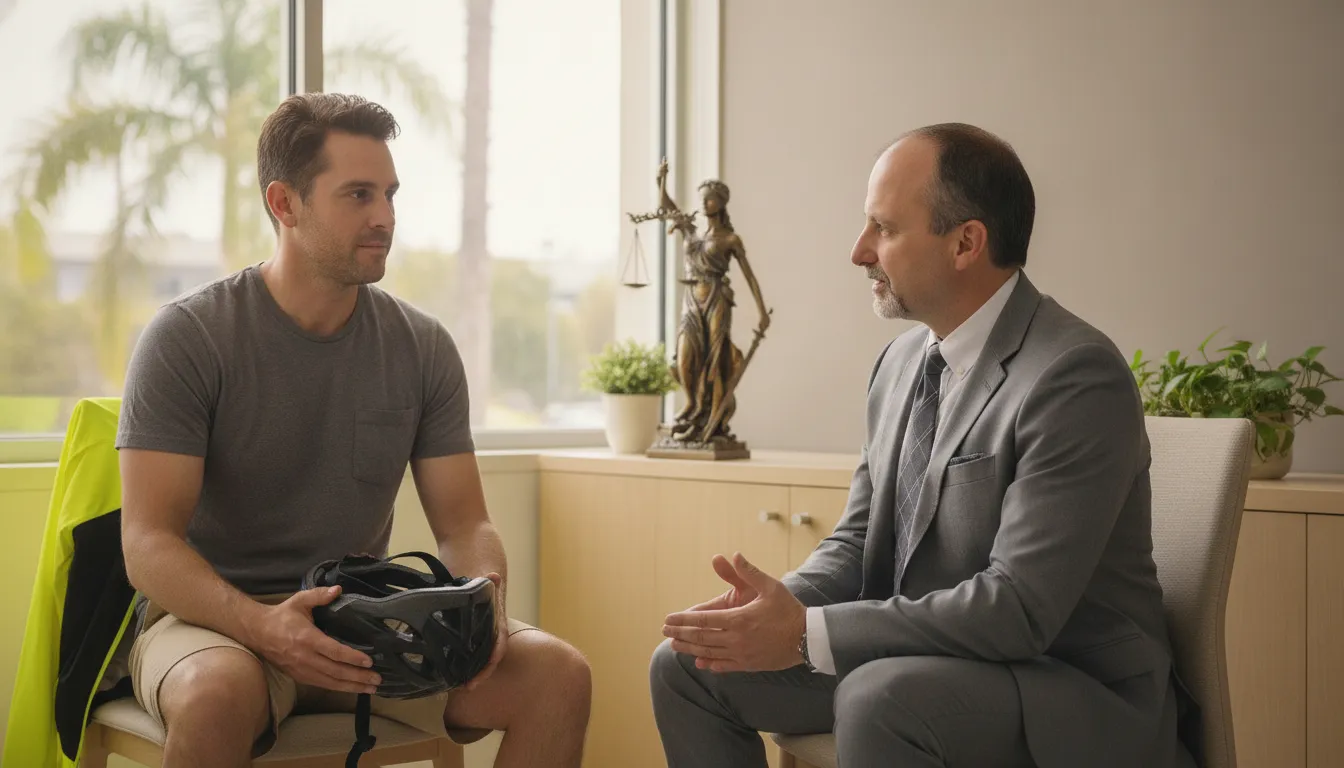
If a car hit you while bicycling in California, a California bicycle accident lawyer can explain how fault, injuries, and evidence may affect your claim. This guide covers practical next steps and links to the California premises liability and catastrophic injury rights guide for broader injury information.
Call Weinberger Law Firm at 916-357-6767 for a free consultation.
California law does not treat people on bicycles as strangers to the rules of the road. In many situations, cyclists have rights and obligations similar to vehicle drivers. Motorists must take reasonable care when passing or turning near them.
Fault after a bicycle collision depends on the evidence, including traffic conditions, driver conduct, roadway design, witness accounts, and each person’s actions before the crash. California’s Three Feet for Safety Act generally requires a driver passing a cyclist in the same direction to leave at least three feet when conditions allow.
Whether your crash occurred in Sacramento, Roseville, Folsom, or elsewhere in California, prompt medical care and careful evidence preservation can matter. The first question is often how the collision happened and what the available facts show about responsibility.
Who Is at Fault When a Car Hits a Cyclist in California?
Fault after a bicycle crash depends on what each person did before the impact. A driver may be responsible for failing to yield, turning across a cyclist’s path, driving while distracted, following too closely, or passing without enough room. California law also recognizes that a person riding a bicycle on a highway generally has the same rights and is subject to the same vehicle-law provisions that apply to a driver. The rule excludes provisions that cannot apply by their nature. See California Vehicle Code section 21200.
Driver negligence and the three-foot rule
When a motorist overtakes a bicycle traveling in the same direction, California’s Three Feet for Safety Act generally requires at least three feet of space. The required space is measured between the vehicle and the bicycle or cyclist. If traffic or road conditions prevent that distance, the driver must slow to a reasonable and prudent speed. The driver must wait to pass until doing so would not endanger the cyclist. The rule is set out in Vehicle Code section 21760. A violation may be important evidence, but liability still depends on the full circumstances of the crash.
Can a cyclist share fault?
A driver is not automatically the only potentially responsible party. Investigators may examine whether the cyclist was traveling against traffic, failed to obey a signal, moved unpredictably, or otherwise violated a rule that contributed to the collision. Those questions are fact-specific. A cyclist’s failure to wear a helmet, by itself, does not establish who caused a vehicle impact. And the relevance of any conduct depends on the injuries and claims being evaluated.
California cases may involve arguments that more than one person contributed to the harm. The effect of those arguments can be complicated, so review comparative fault in bicycle accidents for a focused explanation. Do not assume an insurer’s early percentage estimate is the final legal analysis.
Evidence can clarify what happened
Useful evidence may include the following:
- Photos and video: Capture the roadway, bicycle, vehicle, visible injuries, lane markings, and nearby traffic or business-camera footage when available.
- Witness information: Preserve names and statements while the details of the collision are still fresh.
- Official records: Keep the police or collision report and any related traffic records.
- Medical records: Save treatment notes, bills, discharge instructions, and follow-up recommendations.
- Physical evidence: Preserve the bicycle, helmet, clothing, and damaged equipment before repairing or discarding them.
- Driver communications: Keep messages, admissions, insurance information, and other relevant communications.
A careful review should compare this evidence with the road layout, lighting, traffic conditions, vehicle positioning, and each person’s account before reaching a conclusion about fault.
What Injuries Do California Bicycle Accident Victims Typically Suffer?
A collision with a motor vehicle can cause serious physical harm even when the cyclist remains conscious and appears stable immediately afterward. Injuries may involve the head and brain, especially when the rider strikes the vehicle, roadway, or another object. The CDC reports that bicyclists make roughly 120,000 emergency department visits each year for nonfatal crash-related injuries in the United States. CDC bicycle safety information also explains that helmets reduce the risk of head and brain injuries during a crash.
Do not try to determine the seriousness of an injury based only on how you feel at the scene. Seek appropriate medical evaluation after a collision, follow the provider’s instructions, and describe all symptoms accurately. A medical professional can evaluate your condition and advise you about follow-up care. This article cannot diagnose an injury, and symptoms or treatment needs can vary substantially from one person to another.
Why prompt medical records matter
Medical records create a contemporaneous record of what happened after the crash. They can show when you sought care, what symptoms you reported, what the provider observed, and what treatment or follow-up was recommended. Keep copies of bills, discharge instructions, prescriptions, referrals, and appointment information. If symptoms affect your ability to work, maintain a record of missed time, reduced duties, and related communications.
Those records help connect the injuries identified after the collision with the losses you are documenting, which may include medical bills, lost wages, and pain and suffering. Preserve the bicycle, helmet, clothing, photographs, and other physical evidence rather than repairing or discarding them before they can be evaluated. A careful record can also help clarify how the crash affected daily activities. If an insurer asks for a statement or medical authorization, consider getting legal guidance before signing or agreeing to anything. The significance of an injury depends on the medical evidence and the particular facts of the collision.
How California Bicycle Laws Affect Your Accident Claim
California law generally gives bicyclists on a highway the rights and responsibilities of vehicle drivers, except for provisions that cannot apply by their nature. California Vehicle Code section 21200 can therefore matter when a driver argues that a cyclist did not belong in the roadway or did not have comparable traffic rights. The rule does not decide every accident by itself. Investigators still need to determine what each road user did before the collision.
California also has a specific passing rule. Under the Three Feet for Safety Act, a motorist passing a bicycle traveling in the same direction must leave at least three feet between the vehicle and the bicycle or its operator. If traffic or roadway conditions make that distance impossible, the driver must slow to a reasonable and prudent speed and pass only when doing so would not endanger the cyclist. A close pass, sideswipe, or collision may make this statute relevant, but its application depends on the evidence and circumstances.
What roadway evidence can show
Photos and video of the roadway can help preserve lane markings, bike-lane boundaries, traffic controls, sight lines, lighting, surface conditions, and the location of vehicle and bicycle damage. Witness accounts, nearby security footage, vehicle data, the collision report, and medical records may also help establish the sequence of events. Evidence can be especially important when the parties describe the same maneuver differently.
Cyclist conduct may also be examined. Traffic signals, direction of travel, lane position, visibility, and other facts can affect how responsibility is evaluated. That does not automatically eliminate a claim, and a driver cannot avoid responsibility simply by asserting that a cyclist made a mistake. California accident claims can involve disputed or shared fault, so the legal analysis should be tied to the specific facts rather than a broad assumption about who had the right of way.
For a broader overview, review the California premises liability and catastrophic injury rights guide. Preserve available evidence promptly, seek appropriate medical care, and consider legal guidance before giving a detailed statement to an insurer. This discussion is general information, not a determination of fault or an individualized legal opinion.
How Much Is a Bicycle Accident Settlement Worth in California?
There is no typical bicycle accident settlement figure that can be promised. The value of a claim depends on the evidence, who caused the crash, the available insurance coverage, the nature of the injuries, and how the injuries affect the cyclist’s life. A careful evaluation looks at documented losses rather than relying on a number from someone else’s case.
Common damage categories and the proof used to evaluate them include the following.
| Damage category | Proof that may help establish the loss |
|---|---|
| Medical bills and treatment | Medical records, itemized bills, prescriptions, treatment plans, and documentation connecting care to the collision. |
| Lost wages | Pay records, employer statements, time-off documentation, and other proof of missed work or reduced income. |
| Pain and suffering | Treatment records, symptom notes, testimony about daily limitations, and evidence of how the injuries affected normal activities. |
| Bicycle and property damage | Photographs, repair estimates, receipts, purchase records, and evidence preserving the bicycle and damaged gear. |
| Future needs | Qualified medical opinions, rehabilitation plans, work-capacity information, and evidence of continuing limitations or care. |
Keeping records early can make the evaluation more complete. Learn how to build a bicycle injury claim by documenting the crash, preserving physical evidence, and tracking accident-related losses. The available damages and proof required will depend on the specific facts of the California collision.
How a California Bicycle Accident Lawyer Can Help After a Crash
A bicycle crash can leave you managing medical care, missed work, damaged equipment, and questions about what to tell an insurer. An attorney can help preserve evidence that may clarify how the collision happened, including photographs, witness information, vehicle damage, bicycle damage, medical records, and available roadway or traffic evidence. Prompt investigation matters because physical conditions and memories can change.
Legal guidance can also help you communicate carefully with insurance companies. An adjuster may ask for a recorded statement, medical authorization, or settlement discussion before the full extent of an injury is understood. A lawyer can review those requests, explain what information is relevant, and help protect a claim without making promises about its result. The analysis remains specific to the crash, the available evidence, the injuries, and the losses involved.
Weinberger Law Firm investigates accident circumstances, gathers evidence, communicates with insurers, and pursues compensation for injury-related losses. Those losses may include medical bills, lost wages, pain and suffering, and other damages supported by the facts of the case. You can learn more about the firm’s Sacramento bicycle accident attorney services while considering what help may fit your situation.
The firm represents injured cyclists throughout California, with offices and local operations serving Sacramento, Roseville, and Folsom, as well as Placer and El Dorado counties. Weinberger Law Firm offers a free consultation, and its contingency-fee model means clients pay nothing upfront and only pay if the firm recovers compensation. Deadlines and available claims depend on the facts, so consider seeking legal guidance after addressing immediate medical needs.
Call Weinberger Law Firm at 916-357-6767 for a free consultation.
Frequently Asked Questions
What should I do after a car hits me while I am biking in California?
Get emergency medical care when needed, report the collision, and preserve evidence such as photographs, witness information, the driver’s details, and damaged equipment. Keep records of treatment, missed work, and other crash-related losses. Avoid guessing about fault or giving a recorded statement to an insurer before you understand your rights.
Do bicyclists have the same rights as drivers in California?
Generally, yes. California Vehicle Code section 21200 gives a person riding a bicycle on a highway the rights and obligations applicable to a vehicle driver. The rule excludes provisions that cannot apply by their nature. The specific facts, roadway, traffic conditions, and each person’s conduct still matter. California Vehicle Code section 21200 explains the rule.
What is California’s Three Feet for Safety Act?
California Vehicle Code section 21760 generally requires a driver passing a bicycle in the same direction to leave at least three feet between the vehicle and the bicycle or rider. If traffic or roadway conditions make that distance impossible, the driver must slow to a reasonable and prudent speed. The driver must pass only when doing so would not endanger the cyclist. Section 21760 contains the passing requirements.
Can I bring a claim if I may have contributed to the bicycle crash?
Possibly. A cyclist’s actions do not automatically eliminate a claim, but the evidence may affect how responsibility is evaluated. Investigators may review traffic signals, vehicle speed, lane position, visibility, witness accounts, photographs, and available video. Because fault and deadlines depend on the facts, promptly discuss the collision with a California personal injury attorney after addressing your medical needs.
Schedule a Free Consultation About Your Bicycle Accident
After a collision with a car, understanding your options can help you make informed decisions about medical care, evidence, and an insurance claim. A conversation with an experienced bicycle accident attorney can help you evaluate how the facts may apply to your situation without pressure or promises about the outcome.
Call Weinberger Law Firm at 916-357-6767 for a free consultation.