Introduction to Premises Liability
Premises liability holds property owners and occupiers responsible when unsafe conditions on their property cause injuries. Under California law, businesses, landlords, property managers, homeowners, and even public entities must use reasonable care to maintain their premises, conduct inspections, fix hazards, and warn visitors of dangers they cannot immediately correct. In premises liability cases California courts look at whether a hazard was foreseeable and whether the owner acted reasonably under the circumstances.
To recover compensation, an injured person generally must prove: a duty of care, a dangerous condition on the property, that the owner knew or should have known about it (notice), failure to repair or warn, and that the hazard caused the injury and damages. These claims include more than slip and fall claims; they can also involve negligent security, falling objects, dog-related incidents, or an injury on private property at a rental home. Claims against government entities have additional notice requirements.
Common dangerous property conditions include:
- Spilled liquids or tracked-in rain left on floors without timely cleanup
- Broken stairs, loose handrails, or uneven flooring
- Poor lighting in hallways, stairwells, or parking lots
- Loose cables, curled rugs, or debris creating trip hazards
- Unsecured swimming pools or broken gates allowing dog escapes
- Inadequate security measures leading to foreseeable assaults
Evidence often makes or breaks these cases. If you’re hurt, report the incident to the property owner or manager, take photos or video of the area and your injuries, collect witness names, preserve your footwear in slip cases, and seek prompt medical care. Ask that any surveillance footage be preserved. Avoid giving recorded statements to insurers before speaking with a premises liability attorney. Deadlines matter: most claims have a two-year statute of limitations in California, while claims against public entities usually require a government claim within six months.
Recovery can include medical expenses, lost income, pain and suffering, and future care costs. California’s pure comparative negligence rule may reduce—but does not bar—compensation if you were partly at fault. A skilled premises liability attorney can evaluate liability, secure inspection and maintenance records, establish notice, negotiate with insurers, and, if needed, litigate to maximize your recovery.
Defining Premises Liability Law
In premises liability cases California courts apply a general negligence standard: property owners and those who control property must use reasonable care to keep their premises safe, regularly inspect for hazards, fix problems, or warn visitors when a fix isn’t feasible. This duty can extend to owners, tenants, landlords, property managers, contractors, and businesses that control the area where the injury occurred, including private homes, apartments, stores, parking lots, and public spaces.
Dangerous property conditions that commonly lead to claims include:
- Wet floors, spills, food debris, or recently mopped surfaces without warnings
- Uneven sidewalks, potholes, loose tiles or carpets, and broken stairs or railings
- Inadequate lighting, lack of handrails, or building code violations
- Falling merchandise or fixtures, unstable displays, and ceiling leaks
- Negligent security that enables foreseeable assaults or thefts
- Unsafe pools, decks, balconies, or construction zones
- Dog bites and animal-related hazards
To secure compensation, an injured person must generally show:
- Duty and breach: property owner negligence in failing to maintain, inspect, repair, or warn
- Notice: the owner knew, or should have known, about the hazard (actual or constructive notice)
- Causation: the dangerous condition caused the injury
- Damages: medical bills, lost income, pain and suffering, and other losses
Notice is crucial in slip and fall claims involving transient hazards. Constructive notice may be proven with evidence such as how long the spill was present, lack of reasonable inspection intervals, missing cleanup logs, or surveillance footage.
Fault is often shared. California’s pure comparative negligence reduces damages by the injured person’s percentage of fault but does not bar recovery. “Open and obvious” conditions may limit recovery, yet owners may still be liable when the risk remains foreseeable despite its visibility.
Special rules apply to public property. Claims against government entities require a written claim within six months before filing suit. Most other premises claims carry a two‑year statute of limitations.
After an injury on private property, promptly document the scene, report the incident, preserve shoes and clothing, and seek medical care. A premises liability attorney can assess control of the property, notice, and insurance coverage, and position your case for fair compensation.
Common Types of Premises Accidents
In premises liability cases California, a wide range of incidents can arise when dangerous property conditions cause harm. These accidents occur in places like grocery stores, apartment complexes, office buildings, parking lots, hotels, short‑term rentals, and private homes.
Common scenarios include:
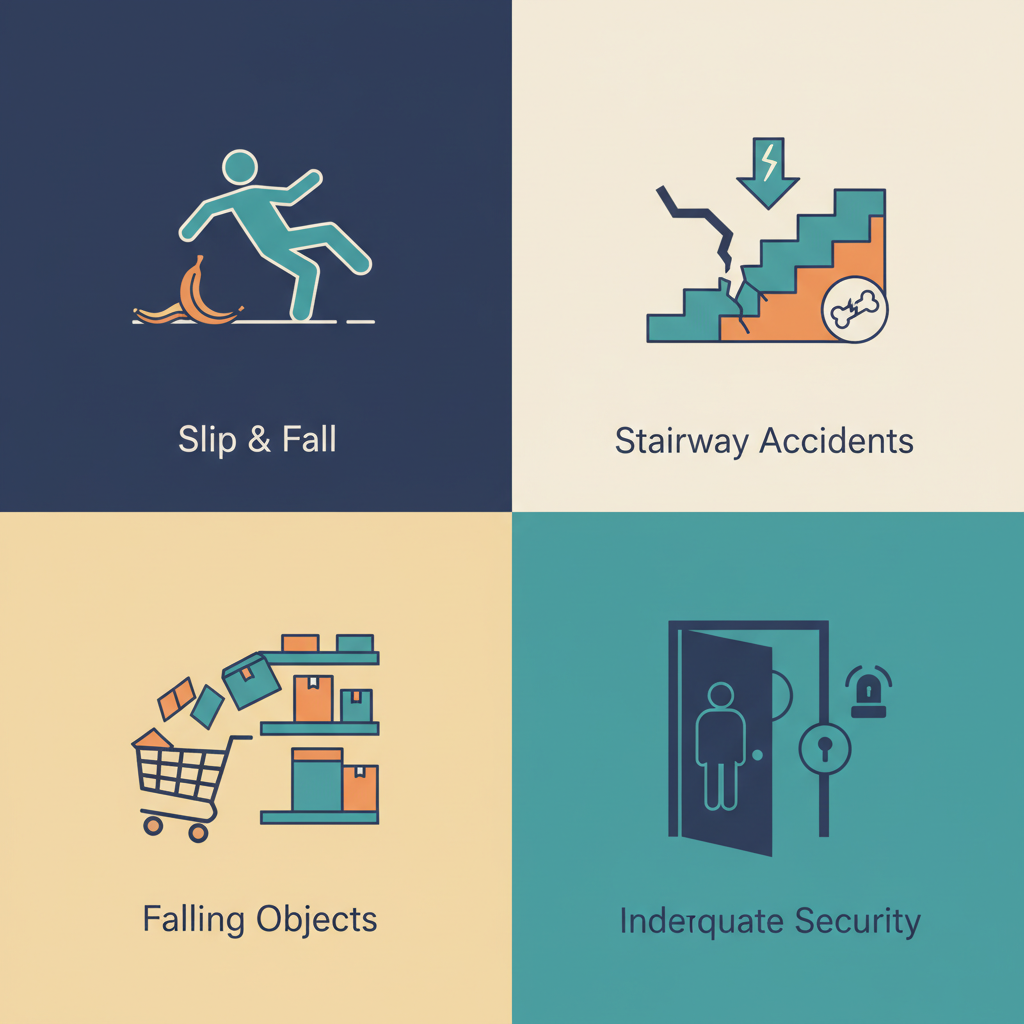
- Slip and fall claims: Wet floors from mopping or spills, loose mats, uneven tiles, and slick entryways without warning signs. Example: A supermarket fails to clean a produce spill for 30 minutes, leading to a hip fracture.
- Trip hazards: Raised sidewalk edges, torn carpeting, cluttered aisles, or exposed cables. Example: A retail store leaves inventory in a walkway, causing a customer to fall.
- Stairs, handrails, and balconies: Broken steps, missing handrails, poor lighting, or rotted deck boards. Example: A short‑term rental’s balcony railing gives way due to lack of maintenance.
- Parking lots and exterior walkways: Potholes, oil slicks, inadequate lighting, or lack of snow/ice remediation in mountain areas. Example: A poorly lit lot contributes to a fall or an assault.
- Negligent security: Assaults or robberies in apartments, bars, or hotels where locks, gates, cameras, or security patrols are inadequate despite prior incidents. This is a form of property owner negligence tied to foreseeability.
- Elevators, escalators, and building systems: Sudden stops, door malfunctions, or entrapments due to missed inspections; electrical hazards, gas leaks, or carbon monoxide from neglected equipment.
- Falling merchandise: Overstocked or improperly secured shelving in big‑box stores that sends heavy items onto shoppers.
- Swimming pools and recreational areas: Lack of fencing, broken latches, missing anti‑entrapment drain covers, or absent lifeguards where reasonably required, leading to drownings or entrapments—especially involving children.
- Dog bites and animal attacks: Injury on private property caused by a tenant’s or owner’s dog. California imposes strict liability on owners for bites, and landlords may be liable if they knew of a dangerous animal and failed to act.
- Construction and renovation zones: Open trenches, unsecured ladders, or missing barriers that expose visitors to falls or struck‑by injuries.
Documenting the hazard, incident reports, witness details, and medical care helps link the condition to your injuries. A premises liability attorney can investigate notice (maintenance logs, prior complaints, surveillance) to establish responsibility and protect your right to compensation.
Key Elements of a Valid Claim
In premises liability cases California law requires you to prove specific elements to hold an owner or occupier responsible for an injury on private property. The core questions are whether the defendant owed you a duty of care, whether a dangerous condition existed, whether the defendant knew or should have known about it, whether they failed to fix or warn, and whether that failure caused your harm.
A valid claim typically includes:
- Control of the property: The defendant owned, leased, occupied, or controlled the premises (e.g., a landlord, property manager, or retailer).
- Dangerous condition: A hazardous condition presented an unreasonable risk of harm—such as a spill, broken stair, loose handrail, uneven flooring, inadequate lighting, torn carpeting, or lack of security in a high-crime area.
- Notice: The defendant had actual notice (knew about the hazard) or constructive notice (should have known through reasonable inspections). For slip and fall claims, evidence that a spill was on the floor long enough without inspection can establish constructive notice.
- Failure to act: The defendant did not repair the condition, cordon it off, or post a clear warning within a reasonable time. Building code violations can support property owner negligence.
- Causation and damages: The condition was a substantial factor in causing your injuries, and you suffered compensable losses (medical bills, lost wages, pain and suffering).
Evidence matters. Useful proof includes photos or video of the scene, witness statements, incident reports, surveillance footage, maintenance and inspection logs, prior complaints, weather records, footwear and clothing preserved in their post-incident condition, and medical documentation linking the mechanism of injury to the hazard.
Comparative fault applies in California. If you were distracted, ignored warning signs, or wore unsafe footwear, your recovery may be reduced by your percentage of fault, but you are not barred from recovery.

Different property types can change the analysis. Owners and occupiers owe a duty of reasonable care to lawful visitors. Trespassers may receive limited protections. Claims against public entities have additional notice requirements and shorter deadlines.
Deadlines are strict. Most claims must be filed within two years; claims against government entities require a written claim within six months. A premises liability attorney can help preserve evidence early and build the strongest case for compensation.
Proving Negligence and Damages
To succeed in premises liability cases California law requires proof of both negligence and damages. That typically means showing:
- The defendant owned, leased, occupied, or controlled the property.
- Property owner negligence: they failed to use reasonable care to discover, fix, or warn about dangerous property conditions.
- Notice: the owner had actual notice (knew about the hazard) or constructive notice (should have discovered it through reasonable inspections).
- Causation: the hazard was a substantial factor in causing your injuries.
- Damages: you sustained compensable losses.
Notice is often the battleground in slip and fall claims. Actual notice can be prior complaints about a broken stair or emails to a landlord. Constructive notice may be inferred if a puddle, spill, or loose mat existed long enough that reasonable inspections would have found it. In a grocery spill case, the absence of recent floor checks or cleaning logs can support constructive notice.
Useful evidence includes:
- Maintenance and inspection records, cleaning schedules, sweep logs
- Surveillance video and incident reports
- Photos of the scene, measurements, and weather data
- Witness statements and prior complaints about the same hazard
- Code violations or safety standards and expert inspections
Concrete examples:
- A supermarket spill left uncleaned for 45 minutes leads to a fall.
- A broken apartment stair reported two weeks earlier collapses underfoot, causing an injury on private property.
- A dimly lit parking lot with a history of assaults lacks security patrols or cameras, supporting negligent security.
Defenses you may face include arguments that the danger was open and obvious, you ignored warning cones, wore unsafe footwear, or were distracted. California’s pure comparative negligence law reduces—rather than bars—recovery by your percentage of fault.
Proving damages requires detailed documentation. Collect medical records and bills, proof of lost wages and benefits, and evidence of future care needs or reduced earning capacity. Non-economic losses (pain, suffering, and loss of enjoyment of life) are supported by treatment notes, daily symptom journals, and testimony from family or colleagues. In serious cases, a life care planner or economist may quantify long-term costs.
A skilled premises liability attorney can move quickly to preserve video before it’s overwritten, obtain critical records, and line up experts to tie the dangerous condition to your injuries and maximize your compensation.
Steps to Take After an Injury
What you do in the hours and days after an injury on private property can make or break a claim. Focus on health first, then protect the evidence that proves property owner negligence.
- Get medical care immediately. Tell providers exactly how you were hurt so records link your injuries to the event. Follow all treatment plans.
- Report the incident to the owner, manager, or security and request a written incident report. Ask for a copy before you leave or document who you spoke with and when.
- Document the scene. Take clear photos or video of dangerous property conditions from multiple angles, including:
– Wet floors without warning signs – Torn carpeting, broken tiles, uneven pavement – Broken stairs or loose handrails – Poor lighting or obstructed walkways – Weather conditions, spills, debris, or cords – Your visible injuries and the footwear you wore
- Identify witnesses. Collect names, phone numbers, and short statements about what they saw, such as how long a spill was on the floor or whether staff were warned.
- Preserve evidence. Keep the clothing and shoes you wore (unwashed) in a bag. Save receipts, appointment cards, and any correspondence. Do not fix, clean, or discard items.
- Ask that evidence be preserved. Surveillance footage and maintenance logs can disappear quickly. A premises liability attorney can send a preservation letter to secure videos, sweep logs, and prior complaint records.
- Avoid recorded statements and social media posts. Do not give the property’s insurer a recorded statement or sign releases without legal advice. Casual comments can be used to argue comparative fault in slip and fall claims.
- Track your damages. Maintain a file with medical bills, mileage to appointments, lost wage documentation, out-of-pocket costs, and a brief pain journal.
- Know the deadlines. In California, most injury claims must be filed within two years. Claims against a city, county, or state agency generally require a government claim within six months.
Consult an experienced premises liability attorney early. They can investigate notice (what the owner knew or should have known), prove causation, and negotiate with insurers. Quick action strengthens premises liability cases California and helps maximize recovery.
Calculating Your Potential Compensation
In premises liability cases California, the value of your claim is driven by the losses you can prove and the degree of fault assigned to each party. Compensation generally includes both economic and noneconomic damages, with additional recovery possible in rare cases involving egregious property owner negligence.
Economic damages (past and future) commonly include:
- Emergency care, hospitalization, surgery, physical therapy, and medication
- Assistive devices, home or vehicle modifications, and in‑home care
- Lost wages, overtime, bonuses, and sick/PTO use
- Diminished earning capacity if injuries limit your future work
- Out‑of‑pocket costs (transportation to treatment, childcare, bandages, etc.)
- Property damage (phones, glasses) from the incident
Noneconomic damages account for:
- Pain and suffering from the injury and treatment
- Emotional distress, anxiety, sleep problems, or PTSD
- Loss of enjoyment of life and activity limitations
- Scarring or disfigurement
- Loss of consortium for a spouse in severe cases
Evidence drives these numbers. Strong slip and fall claims or other injuries arising from dangerous property conditions are supported by incident reports, surveillance footage, photos, witness statements, maintenance and cleaning logs, code or safety violations, and expert opinions. Medical records and physician reports tie the condition to the event and outline future care. Vocational and life‑care planners calculate long‑term costs; economists project wage loss and discount future expenses to present value. A premises liability attorney will also analyze all available insurance, including med‑pay benefits and umbrella coverage, to avoid leaving money on the table.
California’s pure comparative negligence reduces your recovery by your percentage of fault (for example, looking at a phone while walking). Under California’s Prop 51, multiple defendants—such as a property owner, tenant, or manager—can be jointly liable for 100% of your economic damages, but each is only responsible for their share of noneconomic damages. Policy limits and whether the injury on private property occurred at a residence or a business can affect available recovery.
Example: A grocery store spill with no warning signs causes a hip fracture. Medical bills total $68,000, with $12,000 in projected therapy and a $9,500 wage loss. Pain and suffering is supported by surgery, months of limited mobility, and lasting stiffness. If the shopper is found 20% at fault, the total award is reduced accordingly.
An experienced premises liability attorney can quantify each category, negotiate medical liens to increase your net recovery, and present the evidence needed to maximize compensation.
Statute of Limitations for Claims
California law sets strict filing deadlines that can make or break premises liability claims. In most premises liability cases California sets a two-year statute of limitations from the date of injury to file a lawsuit (for example, after a slip and fall in a grocery store due to a wet floor or a trip on a broken stair in an apartment complex). Waiting beyond this window usually bars recovery, even when property owner negligence is clear.
If you did not discover your injury right away, the “discovery rule” may apply. You generally have two years from the date you discovered, or reasonably should have discovered, that dangerous property conditions caused your harm—such as delayed symptoms from carbon monoxide exposure in a rental or a deck collapse that reveals hidden rot weeks later.
Claims involving public entities have much shorter deadlines under California’s Government Claims Act. Before suing a city, county, school district, or other public agency for an injury on public property (e.g., a sidewalk trip hazard or a fall at a public pool), you must:
- File a written government claim within 6 months of the injury, and
- If the claim is rejected, file a civil lawsuit typically within 6 months of the rejection notice.
Special rules apply if you never receive a written rejection, but the safest approach is to act immediately.
There are limited tolling rules:
- Minors: The two-year period is generally paused until age 18 for injuries on private property. This tolling does not automatically extend government claim deadlines, though a late-claim application may be possible within one year.
- Incapacity or the defendant’s concealment may pause deadlines in specific circumstances.
Complex liability scenarios can also affect timing. If a defective product (like a faulty escalator) combines with property owner negligence, you still face personal-injury deadlines, but identifying all at-fault parties early is critical. California allows “Doe” defendants when an owner or manager is unknown at filing, but you must file on time and amend promptly once identities are learned.
Because evidence such as surveillance video and maintenance logs can disappear quickly, consult a premises liability attorney as soon as possible. Early action helps preserve proof, meet all statutes and claim-presentment rules, and position your slip and fall claims or other injury on private property for maximum recovery.
How a Lawyer Can Help
An experienced premises liability attorney can move quickly to secure the proof needed to win premises liability cases California. From the start, counsel evaluates duty, breach, causation, and damages, then builds a liability theory grounded in property owner negligence and the specific dangerous property conditions that caused the harm.
Key ways a lawyer helps:
- Preserve critical evidence: Send preservation letters before surveillance video is overwritten, collect incident reports, “sweep” and inspection logs, maintenance and repair records, and vendor contracts. Conduct prompt site inspections, take measurements, and photograph transient hazards (spills, debris, lighting levels) relevant to slip and fall claims and other incidents.
- Prove notice and safety violations: Establish actual or constructive notice through inspection schedules, staffing, and store policies. Use experts in human factors, building codes, flooring slip resistance (coefficient of friction), and lighting to show how hazards should have been prevented or corrected.
- Counter common defenses: Address comparative negligence, “open and obvious” arguments, and California’s trivial defect doctrine with evidence of foreseeability, inadequate warnings, or code noncompliance. In negligent security cases, demonstrate prior similar incidents and inadequate lighting or access control.
- Calculate and document damages: Compile medical records, future care projections, wage loss and earning capacity analyses, and pain-and-suffering evidence. Coordinate medical liens, MedPay, and health insurer subrogation to maximize net recovery.
- Navigate insurers: Handle recorded statements, fight low offers, and present a well-supported demand package that ties the mechanism of injury to the condition on the property.
- Protect deadlines: California’s statute of limitations is generally two years for an injury on private property. Claims against a public entity require a government claim within six months before a lawsuit can be filed.
- Litigate when needed: If negotiation fails, file suit, take depositions, retain qualified experts, and prepare for trial to pressure fair settlement.
Concrete examples include a grocery spill causing a hip fracture where video and sweep logs prove delayed clean-up; a broken apartment stair tread violating building code; or a dimly lit parking lot assault tied to a history of incidents. In each, targeted investigation and expert testimony turn disputed facts into a compelling case for compensation.
Protecting Your Legal Rights
If you suffer an injury on private property, the steps you take in the first hours and days can determine the outcome of premises liability cases California. Preserving evidence and meeting deadlines are critical to proving property owner negligence and maximizing compensation.
Take these actions immediately:
- Get medical care and follow treatment orders. Describe how you were hurt so medical records reflect mechanism of injury (e.g., slipped on wet tile, fell due to broken handrail).
- Report the incident to the owner or manager. Ask them to create an incident report and request a copy or note the report number.
- Document the scene. Photograph the dangerous property conditions from multiple angles, noting lighting, weather, warning cones/signs (or lack of them), spill size/track marks, and the exact location.
- Preserve key evidence. Keep your footwear and clothing unwashed in sealed bags; save receipts showing you were on-site; retain any correspondence from the business or insurer.
- Identify witnesses. Collect names, phone numbers, and brief statements while memories are fresh.
- Act quickly to preserve video. Many systems overwrite footage within days. A premises liability attorney can send a spoliation letter to secure surveillance and inspection logs.
- Be cautious with insurers. Do not provide recorded statements or sign medical releases before you understand your rights.
To win slip and fall claims, you must show the owner knew or should have known about the hazard and failed to fix it or warn in time. Examples include:
- A grocery spill with no cleanup or warning despite employees nearby
- A dim stairwell with a loose tread or missing handrail
- Uneven flooring or curled mats at a store entrance
Inspection logs, staffing levels, and how long the condition existed help prove notice.
California follows pure comparative negligence, so even if you were partially at fault, you can still recover damages reduced by your percentage of responsibility. Avoid admitting fault and let evidence speak.
Deadlines matter. In most premises cases, you have two years to file suit. Claims against government entities (e.g., a cracked city sidewalk) require an administrative claim within six months, with strict follow-up timelines after rejection.
An experienced premises liability attorney can investigate, secure video and maintenance records, retain safety experts, negotiate with insurers, and, if needed, file suit to pursue medical costs, lost income, pain and suffering, and future care. Early legal help protects your rights while you focus on recovery.
Call to Action
Contact us today for a Free Case Consultation!