
Table of Contents
- Why Medical Expense Documentation Matters in Your Injury Claim
- Understanding Your Right to Full Compensation for Medical Costs
- Essential Medical Records You Must Preserve After an Accident
- Government and Non-Profit Financial Assistance Programs in California
- How We Evaluate and Document Your Medical Expenses
- Negotiating with Insurance Companies Over Medical Bills
- Protecting Yourself from Medical Debt While Your Case Proceeds
- Our Comprehensive Approach to Maximizing Medical Damage Recovery
- What Sets Our Medical Expense Investigation Apart
- Time-Sensitive Steps: Act Now to Preserve Your Rights
- Frequently Asked Questions (FAQ)
Why Medical Expense Documentation Matters in Your Injury Claim
If you’ve been injured in an accident caused by someone else’s negligence, the mounting medical bills can feel overwhelming. Beyond the physical pain and emotional stress, you’re likely facing substantial costs for emergency care, ongoing treatment, diagnostic tests, and rehabilitation. You have rights after an accident, and those rights include the ability to pursue full compensation for every legitimate medical expense you’ve incurred.
At Weinberger Law Firm, we understand that accident victims need clear guidance on managing medical costs and understanding what financial recovery is possible. We’ve helped countless clients in Sacramento and throughout California navigate the complex process of documenting, preserving, and presenting medical expenses to insurance companies and in court. This guide walks you through the resources, documentation strategies, and legal protections available to you.
Medical expenses are the foundation of most personal injury claims. Insurance adjusters and judges evaluate your case partly through the lens of documented, reasonable medical treatment tied directly to your accident. Without proper documentation, you risk undervaluing your claim or losing key evidence that proves your injuries required the care you received.
The documentation process serves multiple purposes. First, it establishes a clear causal link between the accident and your medical needs. A hospital emergency room record showing you arrived within hours of a car crash and received imaging for a spinal injury carries far more weight than a vague statement that your back hurts. Second, it demonstrates that each treatment was medically necessary and reasonably priced for your location and condition. Third, thorough records show the full scope of your recovery timeline, which affects both current and future damages calculations.
Insurance companies scrutinize medical bills closely. They look for overcharges, unnecessary procedures, or gaps in treatment that might suggest your injuries weren’t as serious as claimed. We will investigate all available evidence to build an ironclad record of your expenses and medical necessity. The stronger your documentation, the stronger your negotiating position.
What to do next: After receiving any medical care following your accident, request detailed bills and records from every provider. Don’t discard anything, even explanation of benefits (EOB) statements from your insurance.
Understanding Your Right to Full Compensation for Medical Costs
California law entitles you to recover all reasonable and necessary medical expenses caused by another party’s negligence. This includes past medical bills already paid, ongoing treatment costs, and reasonably anticipated future medical care related to your injury. The law doesn’t limit your recovery to your insurance coverage or your current ability to pay.
The term “reasonable and necessary” has a specific meaning in California injury law. A treatment is reasonable if a competent medical provider would recommend it for someone with your injury. It’s necessary if it’s required to address the condition caused by the accident. Emergency surgery following a motorcycle accident is clearly necessary. Six months of physical therapy prescribed by your orthopedic surgeon is reasonable and necessary. A cosmetic procedure unrelated to functional recovery is not.
You can recover multiple categories of medical costs. These include emergency room and hospital stay charges, physician office visits and consultations, diagnostic testing (X-rays, MRI, CT scans), surgical procedures, medications, medical equipment (crutches, back braces, mobility aids), physical therapy and rehabilitation, mental health counseling for accident-related trauma, and ongoing specialist care. Future medical expenses must be proven through expert testimony about your likely long-term care needs.
Insurance companies often attempt to minimize medical expense claims by arguing certain treatments were excessive, experimental, or unrelated to the accident. We pursue full and fair compensation by working with medical experts who can testify about the necessity and appropriateness of every treatment you received.
What to do next: List all medical providers you’ve seen since the accident, including dates and type of care. Calculate the total from bills and insurance statements you have.
Essential Medical Records You Must Preserve After an Accident
Preserve any evidence and get medical care immediately after an accident, and then systematically organize your medical records. The records you save now become the backbone of your claim evidence later.
Start with emergency care documentation. If you went to an emergency room or urgent care facility, preserve the intake notes, vital signs recorded, imaging results, and discharge summaries. These create a contemporaneous record made by medical professionals with no stake in your case, which gives them credibility. If you were transported by ambulance, keep the ambulance run report showing the address where you were picked up, your condition upon pickup, and treatment provided during transport.
Collect ongoing treatment records from every provider you see afterward. For primary care physicians, request office notes documenting your symptoms, the provider’s examination findings, any treatment recommended or provided, and notes about your functional limitations. For specialists like orthopedic surgeons, neurologists, or physical medicine and rehabilitation doctors, keep the initial consultation notes (which often explain why the referral was necessary) and progress notes from each visit. Physical therapy records should detail which exercises were prescribed, your pain and functional status at each session, and the therapist’s assessment of your progress.
Keep all billing documents and insurance paperwork. Save itemized bills from each provider showing dates of service and what was billed. Save explanation of benefits (EOB) statements from your health insurance. If you paid out-of-pocket, keep receipts and payment confirmations. These documents establish what was spent and allow us to identify billing inconsistencies or overcharges that might be negotiated downward.
Organize records by date and provider. Use a folder system (digital or physical) with clear labels. This organization matters when we evaluate your case and when we present damages to an insurance company. Disorganized records suggest disorganization in your claim, while orderly documentation conveys thoroughness and credibility.
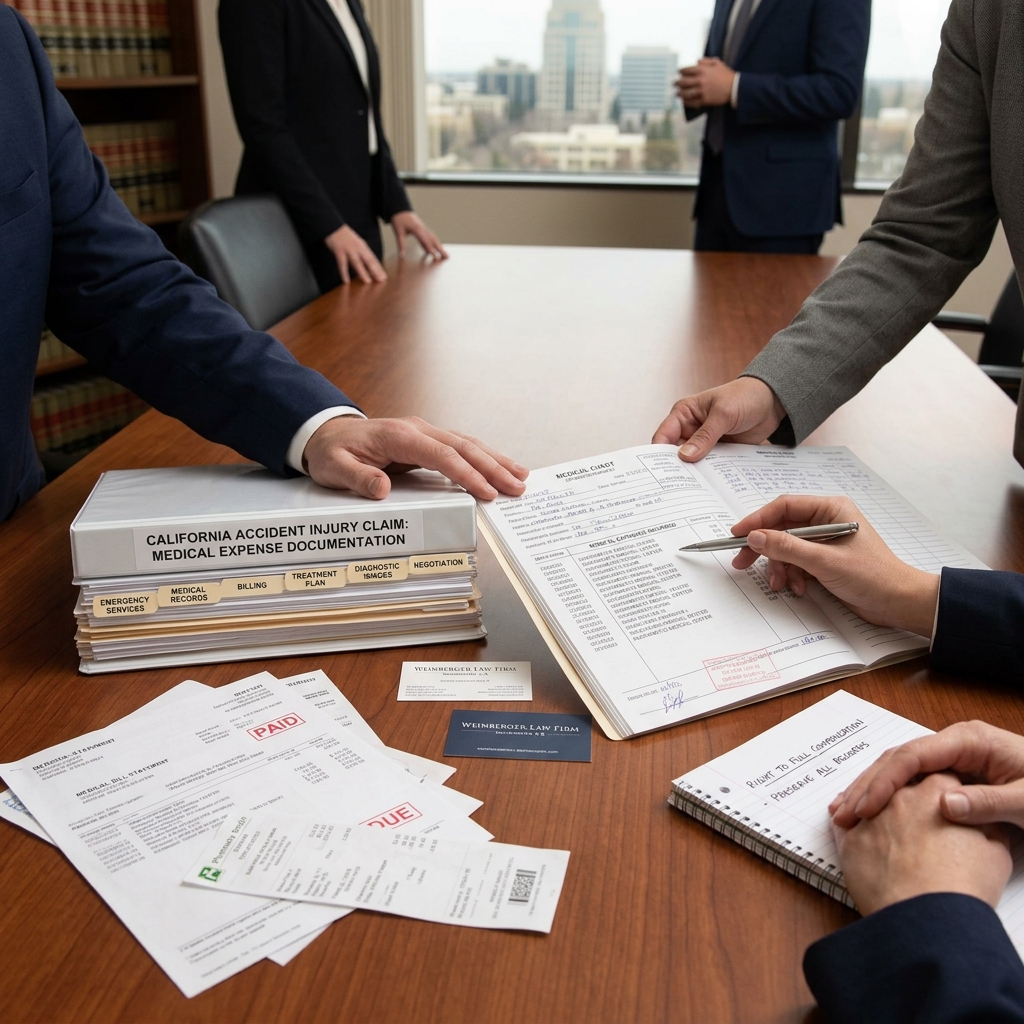
What to do next: Create a master list of every provider you’ve visited. Call each one today and request complete medical records. Many will mail them free of charge within 10 business days.
Government and Non-Profit Financial Assistance Programs in California
While your personal injury claim develops, you may qualify for government or non-profit assistance to help manage medical bills and living expenses. These programs don’t replace your claim recovery, but they can ease immediate financial pressure.
California’s Medicaid program (called Medi-Cal) covers emergency and ongoing medical services for low-income individuals and families. If you don’t have health insurance or yours has been disrupted by your accident, apply for Medi-Cal coverage. The state processes applications relatively quickly, and coverage is retroactive, meaning it can cover services you received before approval. Visit the California Department of Health Care Services website to apply online or find your county’s office.
Supplemental Security Income (SSI) and State Disability Insurance (SDI) provide temporary income replacement if your injuries prevent you from working. SDI is available if you worked for a California employer and paid into the state disability program. The benefit amount is typically 55-60% of your wages, up to a maximum set by the state. You must apply within a specific timeframe after your injury, so time is limited — act now if you’re unable to work. Apply through California’s Employment Development Department.
The Victims of Crime Program provides financial assistance for victims of violent crimes, including assault-related injuries. If your injury resulted from criminal activity, you may be eligible for medical expense reimbursement, temporary financial assistance, and mental health counseling. Apply through your county’s District Attorney’s Victims Services office.
Non-profit organizations like the American Red Cross, local community action agencies, and disease-specific foundations (for example, if your accident aggravated a pre-existing condition) sometimes provide emergency financial assistance. These typically have fewer restrictions than government programs and faster turnaround times.
What to do next: Contact your county’s social services office to inquire about programs you might qualify for. Bring documentation of your income and medical expenses.
How We Evaluate and Document Your Medical Expenses
When you bring your case to us, we conduct a thorough evaluation of every medical expense you’ve incurred. This isn’t a simple adding-up exercise; it’s a strategic analysis of what you can realistically recover and what might be challenged.
We review the medical necessity of every treatment. We examine the medical records to ensure the provider documented a legitimate diagnosis, explained why treatment was medically required, and tracked your response to care. A note saying “patient reports back pain” is weaker documentation than “physical examination reveals restricted lumbar flexion and positive straight-leg raise test; MRI demonstrates L4-L5 disc herniation; conservative treatment recommended as first-line.” We identify documentation gaps that we may need to fill through follow-up correspondence with your providers.
We verify that charges are reasonable for your location and the services rendered. A simple office visit in Sacramento should cost roughly $150-300; a charge of $800 for the same visit suggests billing inflation that we’ll question. We compare charges against Medicare rates and insurance company benchmarks. If a provider has systematically overbilled, we’ll negotiate those charges downward as part of our settlement discussions.
We calculate different damage categories separately. Medical expenses incurred to date are past damages, calculated with specificity. Future medical expenses (like ongoing physical therapy or eventual spinal surgery) are projected based on expert medical testimony. We also document future loss of wages if your injury affects your work capacity long-term. These categories matter because insurance companies negotiate them differently.
We determine what’s included and excluded. Pre-existing conditions complicate calculations; if you had chronic back pain before the accident, your current treatment costs might be partially attributable to the prior condition rather than the accident. We work with medical experts to apportion expenses fairly. Conversely, if the accident aggravated a pre-existing condition, that aggravation is fully recoverable.
What to do next: Gather all medical bills and EOB statements in one place. We’ll request medical records directly from your providers with your authorization.
Negotiating with Insurance Companies Over Medical Bills
Insurance companies employ adjusters trained to minimize medical expense claims. They use several tactics: questioning whether certain treatments were necessary, claiming charges are excessive compared to “market rates,” suggesting you saw providers too frequently or for too long, and disputing whether the accident actually caused the injury you’re treating.
We enter negotiations with comprehensive documentation that makes these challenges difficult to sustain. When an adjuster claims a charge is excessive, we present comparable charges from other providers in your area. When they argue treatment was unnecessary, we present the medical provider’s notes explaining the medical rationale. When they suggest overcautious billing, we cite the provider’s standard of care and outcomes data showing your treatment path was conservative and evidence-based.
Negotiation strategy matters. We don’t simply hand an insurance company a list of expenses and wait for payment. We build the case methodically, starting with indisputable facts (the emergency room bill, the imaging study) and moving toward more complex claims (ongoing specialist care, mental health counseling). We frame medical expenses within the larger context of your injury severity and recovery timeline. A broken leg with surgery followed by six months of physical therapy tells a clear story of reasonable medical management.
We also understand that insurance companies have budget constraints and settlement authority limits. An adjuster authorized to settle for $50,000 can’t approve a $500,000 medical bill total. Knowing this, we present a credible, sustainable damage figure based on documented expenses and reasonable projections. We make clear what’s negotiable (perhaps some provider charges) and what isn’t (documented medical necessity).
Sometimes negotiation reaches an impasse. At that point, we’re prepared to litigate. The threat of litigation, backed by solid documentation, often motivates insurance companies to settle medical bills at reasonable levels rather than risk a jury verdict.

What to do next: Don’t contact the insurance company directly about medical bills. Let us handle that conversation; anything you say can be used against you.
Protecting Yourself from Medical Debt While Your Case Proceeds
One of the hardest parts of recovery is managing medical debt while waiting for your case to settle or go to trial. Most cases take several months to resolve; some take a year or longer. During this time, bills continue arriving and debt collectors may contact you.
If you’re unable to pay medical bills, communicate with providers directly. Most hospitals and larger medical practices have financial assistance or hardship programs. Explain your situation: you were injured in an accident caused by someone else’s negligence, you have a pending claim, and you expect recovery but need time. Many providers will defer payment or offer payment plans that incur no interest if you’re facing hardship. This is far preferable to collection agency involvement.
Do not ignore medical bills or let them go to collections. A medical debt in collections harms your credit score and creates additional complications in your case. Debt collectors have aggressive tactics, and defending yourself against spurious collection claims costs time and money. Communication and negotiation with the original provider is almost always better than dealing with collections.
Consider negotiating bill reductions with providers upfront. Many hospitals and providers will reduce charges by 20-30% if you pay in full or commit to a specific payment plan before the bill goes to collections. This reduces the amount you owe while your case proceeds and reduces the overhead costs they incur in collection efforts.
Protect your credit. If bills must go unpaid temporarily, request that the provider not report the debt to credit agencies until your case is resolved. Many will honor this request if you communicate in good faith and make at least nominal payments.
Don’t use credit cards or take out loans to pay medical bills incurred from your accident. Your case should recover those expenses; borrowing money to cover them costs you interest and complicates your finances. Work with providers on payment plans instead.
What to do next: Contact each medical provider’s billing department and ask about financial hardship programs and payment plan options.
Our Comprehensive Approach to Maximizing Medical Damage Recovery
We view medical expense recovery as an integrated part of your overall case strategy, not as an isolated calculation. Every element of your case—liability evidence, medical documentation, causation, and damages—works together to maximize your recovery.
Our investigation begins immediately after you engage us. We request your complete medical records and bills. We also obtain the accident scene evidence: police reports, photographs, witness statements, and any available video footage. This evidence establishes liability (that the defendant was at fault) and causation (that the accident caused your injury), which strengthens medical damage claims.
We work with medical experts to validate and strengthen your medical case. A treating physician’s notes alone may not fully explain why certain expensive treatments were necessary. An expert medical report interpreting those notes, comparing your case to similar injury patterns, and opining that your treatment was conservative and appropriate carries substantial weight. We retain experts in your injury type (orthopedic surgeons for fractures, neurologists for head injuries, etc.) who can testify if needed.
We track and document ongoing treatment proactively. Rather than waiting for your case to settle to compile medical expenses, we maintain an updated expense log throughout the case. We regularly request updated billing records and medical notes from all your providers. This ensures nothing falls through the cracks and we have current information to present to insurance companies during settlement negotiations.
We anticipate future medical needs and cost them out. If your treating physician indicates you’ll need surgery in six months or ongoing specialist care for two years, we retain a medical economist to project those costs. These future damages often exceed past medical expenses, and they require careful presentation and expert support.
We negotiate aggressively. Our experience negotiating with hundreds of insurance companies gives us insight into what settlements are realistic for similar injuries. We know which insurance companies pay fairly on medical damages and which ones consistently low-ball. We know the pressure points that motivate settlement: clear documentation, expert support, threat of litigation, and a credible damage number.
What to do next: Bring all your medical documents to our office for a free initial consultation. We’ll evaluate your case and explain exactly how we’ll pursue maximum compensation.
What Sets Our Medical Expense Investigation Apart
Our approach to medical expense investigation differs from generalist personal injury attorneys who treat all cases similarly. We specialize in accident injury claims, which means we understand the nuances of medical documentation, causation issues, and settlement values specific to personal injury work.
First, we have established relationships with medical providers throughout Sacramento and California. These relationships allow us to request expedited records production, clarify ambiguous documentation, and occasionally negotiate provider charge reductions directly. Providers trust us because we’ve worked with them on multiple cases and we treat them professionally.
Second, we have a network of medical experts we call upon regularly. When we need an orthopedic surgeon to review records and opine on necessity of treatment, or a neurologist to assess cognitive effects of a head injury, or an economist to project lifetime care costs, we know trusted experts who provide credible, compelling testimony. This matters because insurance companies take expert opinions seriously.

Third, we use specialized case management software to track medical expenses, dates, providers, and treatment progression. This allows us to spot inconsistencies (gaps in treatment that might suggest your injury wasn’t as serious as claimed, or duplicate charges, or billing errors). It also allows us to present information to insurance companies in clear, organized formats that facilitate settlement discussions.
Fourth, we stay current on California personal injury law and medical practices. Injury law evolves through case law and statute; medical practices evolve through research and clinical experience. Attorneys who don’t stay current may miss opportunities to recover emerging damage categories (like mental health treatment for accident-related PTSD) or fail to anticipate insurance company defenses.
Fifth, we understand that medical expense recovery is part of total damages calculation. You can also recover lost wages, pain and suffering, loss of enjoyment of life, and in serious cases, punitive damages. We don’t silently focus on medical bills while ignoring these other categories. We build a comprehensive case that addresses every damage element.
What to do next: Compare our comprehensive approach to other injury attorneys’ approaches. Call us for a free consultation to see the difference our specialization makes.
Time-Sensitive Steps: Act Now to Preserve Your Rights
Time is limited — act now. California’s statute of limitations — the deadline to file a personal injury claim — is generally two years from the date of your accident. This timeline moves faster than you might expect, especially if investigation and medical documentation take time.
Statutes of limitations vary by case type. A car accident claim must be filed within two years. A premises liability claim (injury on someone’s property) generally has two years. Some cases have longer timelines, but many don’t, so you shouldn’t assume you have years to decide.
Beyond the filing deadline, evidence degrades with time. Witness memories fade. Video footage from traffic cameras is often overwritten after 30-90 days. Medical records may be difficult to locate years later. Insurance company records similarly don’t exist forever. The sooner you begin documenting and preserving evidence, the stronger your case becomes.
Don’t wait for your medical treatment to be completely finished before contacting us. Many clients believe they should wait until they’re “healed” to pursue a claim. This is a costly mistake. We can investigate your case, demand that the defendant and insurance companies preserve evidence, and begin settlement discussions while you’re still receiving treatment. Your treatment timeline can extend into your settlement or trial, and future medical costs are fully recoverable.
Take these steps right now:
- Preserve any evidence from the accident scene: photographs, video, physical items that might show your injuries or property damage
- Document medical treatment: collect every bill, record, and prescription
- Get medical care if you haven’t already; some injuries don’t become apparent immediately
- Write down what happened while it’s fresh, including how you’ve been affected
- List contact information for anyone who witnessed the accident
- Stop posting about your accident or injuries on social media; insurance companies monitor this
What to do next: Contact Weinberger Law Firm today for a free consultation. We’ll review your accident, explain your rights, and outline exactly how we’ll pursue medical expense recovery and full compensation. No fee unless we recover for you. You have rights after an accident — let us help you exercise them and secure the compensation you deserve. Call us now or visit our website to schedule your free initial consultation.
For further reading: Motorcycle accident injury filing.
Contact us today for a Free Case Consultation!
Frequently Asked Questions (FAQ)
What medical records should we preserve after an accident?
You have rights to full compensation for your medical expenses, and we need complete documentation to prove them. Preserve all medical bills, emergency room records, hospital discharge summaries, prescription receipts, physical therapy invoices, and any communications with healthcare providers. Keep receipts for medical equipment, transportation to appointments, and out-of-pocket expenses related to your treatment. We will use these records to build a comprehensive picture of your damages when negotiating with insurance companies.
How do we handle medical debt while your injury claim is pending?
We understand medical bills create immediate financial stress, which is why we help you explore assistance programs available in California for accident victims. Our team identifies government resources, non-profit programs, and hospital financial assistance options that may reduce or defer your medical expenses during the claims process. We also negotiate with insurance companies and pursue compensation specifically for these bills so you’re not left covering costs out of pocket. Time is limited, so contact us for a free consultation to discuss your options.
Why does thorough medical expense documentation matter in your injury claim?
Insurance companies often dispute or minimize medical bills, which directly reduces the compensation you receive. We investigate and document every medical expense to demonstrate the full extent of your damages, from emergency treatment through ongoing care. Our detailed approach supports stronger negotiations and ensures we pursue compensation for both documented bills and future medical needs related to your injury.