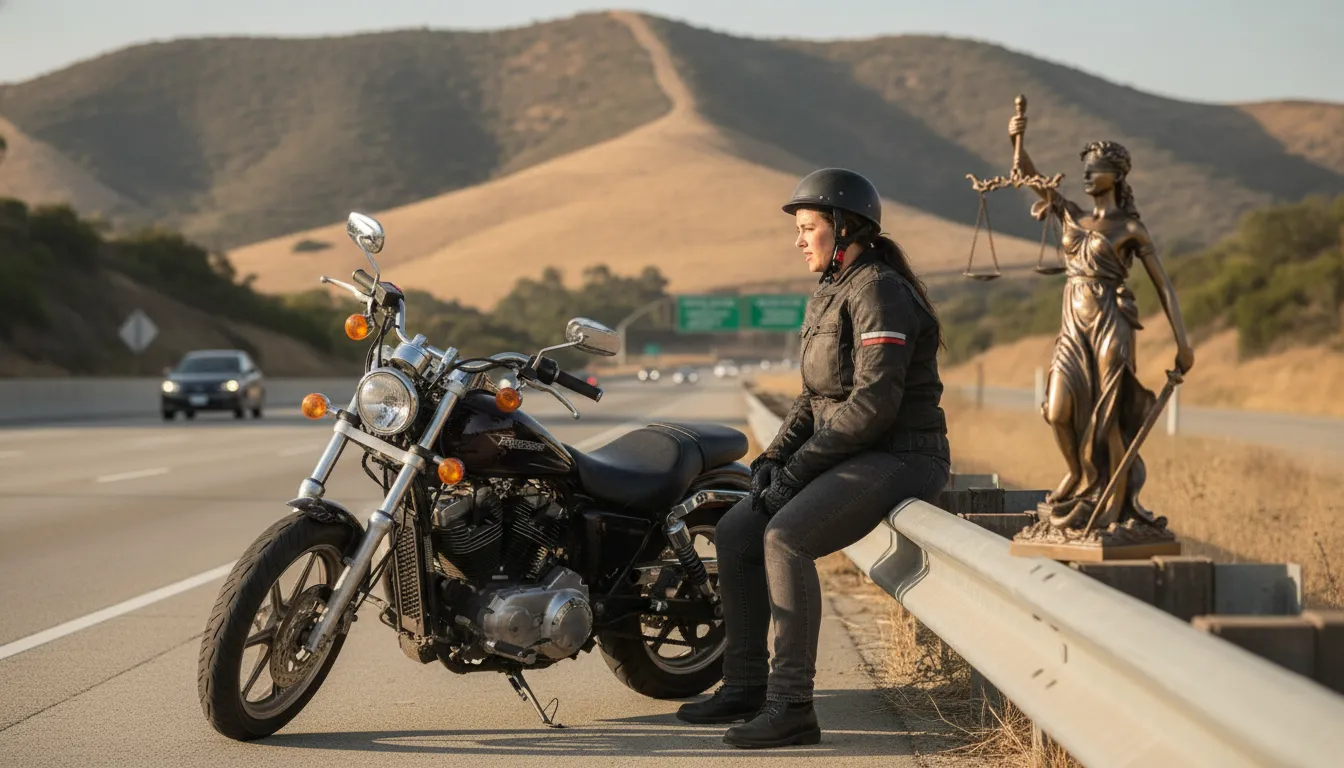
A motorcycle crash between lanes can leave an injured rider facing serious injuries, disputed facts, and an insurer looking for reasons to shift blame. California law requires a closer look than simply asking whether the rider was lane splitting. For the broader claims process, see California’s motor vehicle accident claims guide.
California Lane Splitting Laws and Motorcycle Accident Liability involve two separate questions: whether the riding conduct was permitted and whether either person acted negligently. A rider is not automatically barred from seeking compensation, but speed, spacing, visibility, traffic conditions, and an unsafe lane change can all affect fault.
Call Weinberger Law Firm at 916-357-6767 for a free consultation.
The first step is understanding what California law actually permits, and how that rule differs from safety guidance and the facts used to evaluate a collision.
How California Lane Splitting Laws Shape Motorcycle Accident Liability
Yes. California law permits lane splitting, but that does not mean every maneuver between lanes is safe or that a rider is automatically protected after a crash. Lane splitting generally means riding a motorcycle between rows of stopped or moving vehicles traveling in the same direction. It commonly occurs when traffic is congested, and it uses the space between ordinary traffic lanes rather than a separate lane reserved for motorcycles.
California Vehicle Code section 21658.1 defines lane splitting as driving a motorcycle between rows of stopped or moving vehicles in the same lane. This includes divided and undivided streets, roads, or highways. The statute also authorizes the California Highway Patrol to develop safety guidelines for the practice. You can read the full text of California Vehicle Code section 21658.1 through the California Legislature.
What the law does and does not mean
Section 21658.1 answers the basic legality question: lane splitting is not, by itself, an illegal traffic maneuver in California. It does not create a guarantee that a rider can recover compensation after a collision. It also does not excuse conduct that is unsafe under the circumstances. Speed, visibility, the movement of surrounding vehicles, available space, and the rider’s ability to react can all matter when evaluating what happened.
That distinction is important in a motorcycle accident liability case. A driver may be responsible if the driver moves into the motorcycle’s path without reasonably observing nearby traffic. A rider may also face an argument about negligence if the rider travels too fast for the conditions, weaves unpredictably, or leaves too little room to respond. In some collisions, the evidence may support responsibility on both sides. The fact that lane splitting was lawful does not automatically establish that the driver caused the crash. A rider’s use of lane splitting does not automatically establish rider fault, either.
Insurance companies sometimes treat the phrase “lane splitting” as if it settles the liability question. It does not. A careful review should consider the traffic conditions, each person’s actions, the point of impact, witness accounts, available video, and other evidence showing how the collision occurred. California Lane Splitting Laws and Motorcycle Accident Liability are related, but they are not the same legal question. Legality addresses whether the maneuver is permitted. Negligence and causation address whose conduct contributed to the injuries and losses.
What CHP Guidelines Say About Safe Lane Splitting
The California Highway Patrol offers practical safety recommendations for riders who travel between lanes of traffic. These recommendations are useful benchmarks, but they are not the same as automatic legal rules. The CHP guidelines do not create a guaranteed safe harbor, and going outside a recommendation does not by itself decide who caused a collision.
The 10 mph speed-difference recommendation
The CHP advises motorcyclists not to travel more than 10 miles per hour faster than surrounding traffic while lane splitting. A smaller speed difference generally gives a rider more time to identify a vehicle drifting across the lane line. It also gives the rider more time to respond to changing traffic and avoid a door, mirror, or other obstruction. The recommendation is about managing risk, not establishing a universal speed limit for every lane-splitting situation.
For example, a rider traveling 35 mph beside vehicles moving 25 mph may be within the recommended differential. But that fact alone does not show the maneuver was safe. Visibility, available space, traffic behavior, road design, and the rider’s ability to react still matter. A collision investigation should examine the complete setting rather than focus on one number.
Why traffic moving at 30 mph changes the analysis
The CHP also cautions riders to avoid lane splitting when surrounding traffic is moving at 30 miles per hour or faster. Faster traffic leaves less time to recognize a sudden lane change or respond to a vehicle that moves into the rider’s path. It can also make the speed difference between the motorcycle and nearby vehicles more consequential.
Again, this is safety guidance rather than an automatic finding of negligence. A rider who was lane splitting above that recommendation is not automatically barred from pursuing a claim. Conversely, staying within the recommendation does not automatically make the rider free from responsibility. Evidence may show that either party, or both, acted unreasonably under the circumstances.
Conditions that affect a rider’s judgment
Safe judgment depends on more than traffic speed. Riders should consider whether both lanes are moving predictably, whether drivers can see the motorcycle, how much space exists between vehicles, and whether the roadway presents hazards. Blind spots, congestion that changes abruptly, poor visibility, uneven pavement, debris, wet conditions, and limited escape routes can all affect the reasonableness of continuing between lanes.
The firm’s broader California motor vehicle accident claims guide explains how these observations fit into a larger injury claim involving cars, trucks, and motorcycles. Reviewing the lane-splitting facts alongside the broader claim framework helps keep the focus on both liability and the losses caused by the crash.
The CHP’s recommendations are published in its lane-splitting safety guidance. After a crash, the relevant legal question is not simply whether a rider followed every recommendation. It is whether the available evidence shows negligent conduct by the rider, another driver, or both. Helmet use may also become part of the evidence and damages analysis, which is separate from whether lane splitting itself was lawful. Learn more about California motorcycle helmet laws. For a discussion of how California’s rules and safety guidance have evolved, see what changed for California motorcyclists.
Does Lane Splitting Affect Your Motorcycle Accident Claim?
Lane splitting does not automatically decide who is responsible for a California motorcycle crash. The analysis focuses on what each person did, whether that conduct was negligent, and how it contributed to the collision. A rider’s decision to split lanes may be part of the evidence, but it does not erase a driver’s duty to operate a vehicle safely.
Comparative negligence can reduce, but not necessarily eliminate, recovery
California follows a comparative negligence approach. If an injured rider is found partly responsible, the rider’s compensation can be reduced by that percentage of responsibility. Partial fault does not automatically prevent recovery. California Civil Jury Instruction CACI No. 405, Comparative Fault of Plaintiff, explains that a plaintiff’s recovery is reduced in proportion to the plaintiff’s share of responsibility. The comparative-fault principle is explained in California Civil Jury Instruction CACI No. 405.
For example, an insurer might argue that a rider’s speed, position, visibility, or failure to leave enough room contributed to the crash. Those arguments must be tested against the full circumstances, including traffic speed, surrounding vehicles, road conditions, the rider’s actions, and the other driver’s conduct. Lane splitting that was legal under California law is not automatically negligent, and lane splitting that did not follow a safety recommendation is not automatically proof of fault.
The driver’s lane-change duty still matters
Drivers must account for nearby traffic before moving into another lane. California Vehicle Code section 22107 provides: “No person shall turn a vehicle from a direct course or move right or left upon a roadway until such movement can be made with reasonable safety. And then only after the appropriate signal has been given.” Read the exact statute at the California Legislature’s Vehicle Code section 22107 page.
That duty can be important when a driver moves suddenly into the motorcycle’s path, fails to signal, does not check adequately, or is distracted. The rider’s conduct and the driver’s conduct may both be relevant. Evidence such as vehicle damage, photographs, traffic-camera or helmet-camera video, witness accounts, the police report, and medical records can help reconstruct what happened.
An insurance adjuster’s proposed fault percentage is not a final legal determination. It is a position in the claim process and should be evaluated against the evidence and applicable law. For a broader discussion of losses that may be part of a claim, review California motorcycle accident damages. Because every collision is fact-specific, an injured rider should obtain advice based on the actual crash before accepting an insurer’s allocation of blame.
How Fault Is Determined in a California Lane-Splitting Accident
Fault is not decided solely by whether a motorcycle was lane splitting. California law permits the practice in appropriate circumstances, but a rider can still be negligent if the riding was unsafe. A driver can also be responsible for failing to notice a motorcycle, signaling poorly, or moving into the rider’s path without adequate care. The analysis is fact-specific and considers what each person did, what each person could reasonably see, and whether those actions contributed to the collision.
For example, California Vehicle Code section 22107 addresses turning or moving right or left upon a roadway. A driver must make that movement only when it can be made with reasonable safety and after giving an appropriate signal when required. That rule may matter when a vehicle crosses into the motorcycle’s path, but investigators still need to examine the surrounding circumstances.
| Analysis | Conduct that may be examined | Evidence that may support it |
|---|---|---|
| Rider conduct | Speed, visibility, spacing between vehicles, lane position, and whether the rider had time or room to react. | Traffic or helmet-camera video, photographs, vehicle damage patterns, witness accounts, and the police report. |
| Driver conduct | Sudden or unsafe lane movement, failure to check surrounding traffic, inadequate signaling, distraction, or failure to account for a motorcycle between lanes. | Dashcam or surveillance video, witness statements, scene photographs, vehicle damage, phone-related evidence when lawfully available, and the collision report. |
| Shared fault | Conduct by both parties may have contributed to the crash. A rider’s lane-splitting conduct does not automatically excuse an unsafe movement by a driver, and a driver’s error does not eliminate questions about the rider’s conduct. | Consistent witness testimony, video, physical evidence, medical records documenting the injuries, and a reconstruction of the collision sequence. |
California follows comparative negligence principles. Under California comparative-negligence principles, a person whose negligence contributed to an injury may still pursue damages, although recovery may be reduced according to the person’s share of responsibility. The specific allocation depends on the evidence rather than a preset rule for lane-splitting crashes. Photos, video, witness information, medical records, and damage patterns should therefore be preserved promptly, before details or evidence disappear.
Can You Still Sue If You Were Lane Splitting When You Were Hit?
Yes. Lane splitting does not automatically prevent an injured motorcyclist from pursuing a claim. The outcome depends on what each person did before the collision, the available evidence, and how responsibility is assigned under California law. Even when a rider’s conduct is questioned, an unsafe lane change, distraction, failure to look, or another driver’s negligence may still have caused the crash.
Protect evidence before it disappears
Photograph the scene, motorcycle damage, vehicle damage, lane positions, road surface, traffic conditions, and visible injuries if you can do so safely. Save helmet-camera or phone video, identify witnesses, and obtain the collision report when available. Keep records of medical visits, prescriptions, missed work, repair estimates, and other losses. These details can help show speed, visibility, spacing, and whether a driver moved into your path without taking reasonable care.
Seek medical attention promptly, even if pain seems manageable after the crash. Some motorcycle injuries become more apparent later, and medical records help connect treatment to the collision. Follow medical instructions and tell providers about all symptoms. For a practical checklist, review these steps after a motorcycle accident. If you want to understand how this issue fits within a broader car, truck, or motorcycle case, review the firm’s complete California motor vehicle accident claims guide.
Be careful with insurance communications
Report the collision to your own insurer as required by your policy and exchange necessary information with the other driver. However, be cautious before giving another insurer a recorded statement, signing a release, or accepting an early settlement. Questions about lane-splitting speed, traffic conditions, and your view of the vehicles may later be used in a fault analysis. You can ask for time to review the request and obtain legal guidance before making a recorded statement.
Comparative fault does not necessarily end the claim
California generally applies comparative negligence. A rider’s recovery may be reduced by the rider’s assigned share of responsibility, but partial fault does not automatically eliminate the claim. The analysis is fact-specific. It may consider the rider’s speed and spacing, the driver’s lane-change conduct, visibility, distraction, road conditions, and the evidence from the scene. Legality and negligence are separate questions: a lawful lane-splitting maneuver is not an automatic safe harbor. And being lane splitting is not automatic proof that the rider caused the crash.
Watch the filing deadline
California’s general deadline for a personal injury lawsuit is two years under California Code of Civil Procedure section 335.1. Read the official statute at California Code of Civil Procedure section 335.1. Exceptions can change how a deadline is calculated, so do not assume the standard period applies to your situation. Weinberger Law Firm represents injured motorcyclists throughout California, including Roseville, Sacramento, and Folsom. A timely consultation can help preserve options while the facts are still available.
Call Weinberger Law Firm at 916-357-6767 for a free consultation.
Frequently Asked Questions
Is lane splitting legal in California?
Yes. California Vehicle Code section 21658.1 permits a motorcycle to ride between rows of stopped or moving vehicles traveling in the same direction. Legal permission does not make every maneuver safe or prevent a rider or driver from being found negligent. See the California Vehicle Code for the statutory language.
Who is at fault if a motorcycle is lane splitting?
Either party, or both, may be responsible. Investigators examine the rider’s speed, visibility, spacing, and movements, along with whether the driver checked for the motorcycle, signaled, and changed lanes safely. The facts and available evidence determine liability, not the rider’s use of lane splitting alone.
What if I was outside the CHP lane-splitting recommendations?
That fact may be considered, but it is not automatically a finding of negligence. The California Highway Patrol recommends avoiding a speed difference greater than 10 miles per hour and avoiding lane splitting when surrounding traffic is moving at 30 miles per hour or faster. Those recommendations are safety guidance, not enforceable lane-splitting traffic violations. See the CHP guidance.
Can I recover damages if I was partly at fault?
Potentially. California’s comparative-fault approach can reduce recovery to reflect the rider’s assigned share of responsibility, but partial fault does not automatically eliminate a claim. The evidence may still show that another driver’s unsafe lane change or other negligence contributed to the collision.
What evidence should I preserve after a lane-splitting crash?
Seek medical care, photograph the scene and damage, save helmet or camera footage, identify witnesses, and keep the police report, medical records, and insurance correspondence. Report the crash to your own insurer, but consider legal guidance before giving a recorded statement to another party’s insurer. Prompt action also helps preserve evidence that may disappear.
Ready to Discuss Your Motorcycle Accident?
Understanding how lane splitting may affect liability can be difficult after a crash, especially while you are managing injuries and insurance communications. A conversation with an experienced California personal injury lawyer can help you understand the issues that may apply to your situation. Call Weinberger Law Firm at 916-357-6767 for a free consultation. The firm represents injury victims on a contingency basis, so you pay nothing upfront and only pay if it recovers compensation.