
Table of Contents
- How Time Limits Affect Your Premises Liability Case
- Understanding California’s Statute of Limitations for Premises Liability
- The Two-Year Filing Window: Why Time Matters
- When the Clock Starts: Key Dates and Triggering Events
- Common Exceptions That Extend Your Deadline
- Why Delaying Action Weakens Your Case
- The Critical Steps We Take Within Your Timeframe
- Preserving Evidence Before the Deadline Passes
- How We Handle Complex Timeline Situations
- Moving Forward: Your Free Consultation and Next Steps
- Frequently Asked Questions (FAQ)
How Time Limits Affect Your Premises Liability Case
If you were injured on someone else’s property due to negligence or unsafe conditions, you have rights after an accident. However, California law imposes a strict filing deadline — the statute of limitations — that you must meet to pursue compensation. Missing this deadline means losing your right to sue, regardless of how strong your case may be. We want you to understand exactly what this deadline is, when it begins, and what actions you must take now to protect your claim.
Time is limited — act now. In premises liability cases, the statute of limitations is not a suggestion; it is a legal barrier that courts enforce without exception. Once the deadline passes, you cannot file a lawsuit, no matter how serious your injuries or how clear the property owner’s negligence. This makes understanding and respecting the timeline one of the most critical steps in your recovery process.
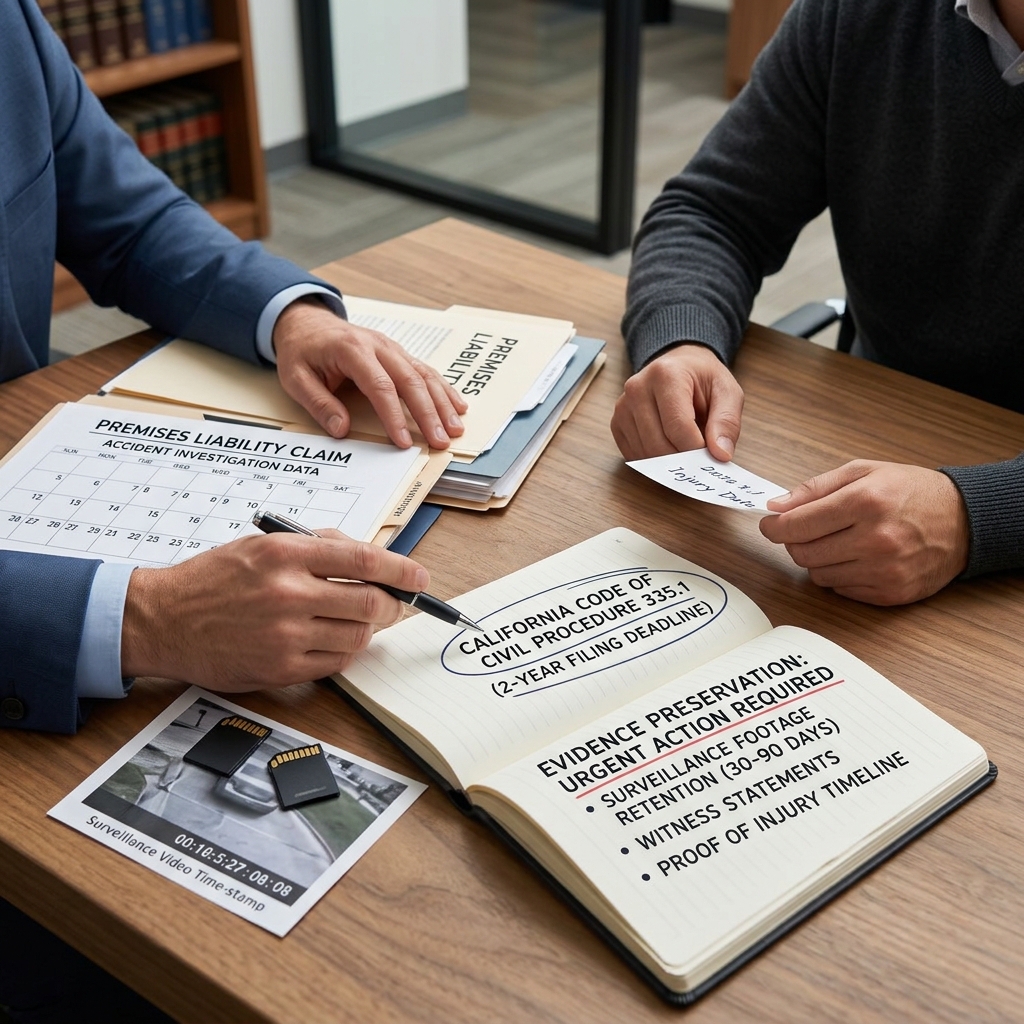
The impact of time limits extends beyond the filing deadline itself. Evidence degrades, witness memories fade, and surveillance footage is often automatically deleted after 30 to 90 days. Medical records become harder to obtain, and the longer you wait, the more difficult it becomes to establish a clear connection between the unsafe condition and your injury. We will investigate all available evidence, but that investigation must begin immediately to capture details while they are still fresh and available.
Your immediate action right now is to document everything you remember about the incident and preserve any evidence at the scene. Note the exact date, time, and location of your injury, photograph the hazardous condition if possible, and write down the names and contact information of any witnesses present.
Understanding California’s Statute of Limitations for Premises Liability
California Code of Civil Procedure Section 335.1 sets the statute of limitations for premises liability claims at two years from the date of injury. This two-year window applies to personal injury cases involving negligence, including slip-and-fall accidents, inadequate security, swimming pool injuries, and other premises-related incidents. Unlike some other states, California does not extend this period for most circumstances, making it essential that you act decisively within this narrow timeframe.
The two-year rule is straightforward, but knowing the exact date your clock starts is crucial. We help our clients identify the precise triggering event so there is no ambiguity about when your deadline actually falls. Understanding this date is the first step toward protecting your right to compensation.
The Two-Year Filing Window: Why Time Matters
Two years sounds like plenty of time, but medical recovery, insurance negotiations, and case investigation consume months quickly. Many injured people delay seeking legal help while they focus on healing or while hoping the property owner’s insurance will settle voluntarily. By the time they realize they need an attorney, they may have only weeks or even days remaining before the deadline.
During this two-year window, we must complete several critical tasks: investigate the incident, gather medical records, preserve evidence, identify liable parties, obtain insurance information, and prepare a demand package for negotiation or litigation. Rushing these steps weakens your position and reduces the compensation we can pursue. Starting early gives us the breathing room to be thorough and strategic.
If you were injured within the past few months, you likely have time on your side, but do not let that create complacency. Contact us for a free consultation today so we can assess your case, confirm your exact deadline, and begin gathering evidence while it is still accessible.

When the Clock Starts: Key Dates and Triggering Events
The statute of limitations clock begins on the date you suffered your injury, not the date you discovered it was caused by negligence. If you slipped and fell on a wet floor on March 15, 2024, your two-year deadline is March 15, 2026, regardless of when you realized the property owner was responsible for the hazard.
This rule generally favors injured people, but it creates urgency if you delay seeking help. You cannot extend the deadline by claiming you did not know the property owner was negligent. The law assumes that a reasonable person would recognize they were injured and would seek legal counsel without excessive delay.
In rare cases, the “discovery rule” may apply if your injury was not immediately apparent. For example, if you fell but did not realize you had internal injuries until weeks later, the clock might start from the date you discovered the injury rather than the fall itself. These exceptions are narrow and require careful legal analysis. We will evaluate your specific circumstances to confirm the exact date your deadline applies.
Common Exceptions That Extend Your Deadline
While California’s two-year statute of limitations is rigid, several narrow exceptions may extend your filing deadline.
Minority: If you were under 18 years old when injured, the statute of limitations does not begin until you turn 18. This protection gives minors time to mature and pursue claims as adults.
Incapacity: If you were legally incapacitated at the time of injury (severe mental illness, dementia, or unconsciousness), the clock may not start until your capacity is restored or a court appoints a guardian.
Defendant Out of State: If the property owner or liable party left California immediately after the incident and remained absent, California may toll (pause) the statute of limitations. However, this exception is applied very narrowly and only in specific circumstances.
Fraud or Concealment: In extremely rare cases where the property owner actively concealed the hazard or their negligence, the deadline may extend. Again, this exception requires strong evidence and careful legal analysis.
For most injured people, none of these exceptions apply, and the standard two-year deadline governs. We will review your case thoroughly to determine whether any exception might extend your deadline, but you should not rely on hope — you should act within the standard two-year window to be safe.
Why Delaying Action Weakens Your Case
Every week you delay costs you evidence, credibility, and leverage in negotiations. Surveillance footage from the property owner’s cameras is typically recorded over a 30 to 90-day cycle. Once it is recorded over, it is gone forever. Witness memories fade, and people move away or become harder to locate. Medical records become less detailed, and your timeline for connecting the injury to the incident grows murkier.
Insurance companies know that delayed claims often come with weaker evidence. When we contact them quickly on your behalf, we signal that you are serious, organized, and will pursue litigation if necessary. This demonstrates leverage that often leads to stronger settlement offers.
Additionally, you may incur additional medical costs, lost wages, and emotional suffering while waiting to resolve your claim. The sooner we begin negotiations, the sooner we can pursue full and fair compensation and help you move forward.
The Critical Steps We Take Within Your Timeframe
Once you retain our firm, we work systematically to build a strong case before any deadline pressure.
Immediate Investigation: We preserve evidence, interview witnesses, photograph the scene, and obtain the property owner’s incident reports and safety records.
Medical Documentation: We gather your medical records, establish the severity of your injuries, and calculate current and future medical expenses.
Liability Analysis: We determine who is legally responsible for the unsafe condition, including whether the property owner knew or should have known about the hazard.
Demand Preparation: We compile a comprehensive demand package showing liability, damages, and the strength of your case.
Negotiation and Litigation Readiness: We present our findings to the insurance company and negotiate aggressively. If settlement talks stall, we prepare your case for trial.
Throughout this process, we keep you informed and involve you in key decisions. No fee unless we recover for you — our contingency fee structure means your financial risk is zero if we do not succeed.
Preserving Evidence Before the Deadline Passes
Evidence preservation is not solely our responsibility; you play a critical role immediately after your injury. Preserve any evidence and get medical care — document, preserve, and present the facts that support your claim.
If you fell due to a hazardous condition, photograph or describe it in detail. Obtain the names and phone numbers of anyone who witnessed your fall. Request a copy of any incident report the property owner completed. If you received medical care at an emergency room or clinic, ask for copies of those records right away. Save all receipts for medical treatment, medications, and related expenses.
If surveillance cameras are visible on the property, you have a strong reason to contact us immediately. We can send a preservation letter to the property owner, legally requiring them to preserve all video footage, access logs, and maintenance records. This letter creates a legal obligation that prevents them from destroying evidence.
How We Handle Complex Timeline Situations
Some cases present complications. If you are unsure of your exact injury date, we can work backward from medical records to establish it. If you have pre-existing conditions and the injury aggravated them, we distinguish between the pre-existing condition and the new harm caused by the incident. If multiple incidents occurred at the same location, we identify which one caused your injury and confirm its date.

We also handle situations where you worked with another attorney previously or where your case was dismissed. These scenarios may affect your deadline, so we evaluate the complete history to ensure we file within the correct window.
When circumstances are complex, we err on the side of caution and file suit well before the deadline rather than cutting it close. This protects you and gives us flexibility to negotiate from a position of strength.
Moving Forward: Your Free Consultation and Next Steps
If you were injured on someone else’s property in California, contact us for a free consultation today. We will review your incident, confirm your exact filing deadline, answer your questions, and explain your legal options.
During your consultation, bring any documents you have: incident reports, medical records, photos, witness names, and insurance information. If you do not have these yet, do not worry — we will guide you on what to gather next.
Time is limited — act now. Even if your injury occurred months ago, calling today ensures we can assess your case and begin protecting your rights. We serve Sacramento and throughout California, and we are ready to help you understand your options and pursue the compensation you deserve.
For more information about Sacramento premises liability help and California personal injury deadlines, visit our California premises liability lawyer page or call us today.
Contact us today for a Free Case Consultation!
Frequently Asked Questions (FAQ)
What is the time limit for filing a premises liability lawsuit in California?
We advise our clients that California’s statute of limitations gives you two years from the date of your injury to file a premises liability claim. This deadline is strict, and once it passes, we lose the ability to pursue your case in court. Time is limited, so we recommend contacting us as soon as possible to ensure your claim is properly documented and filed before the window closes.
When does the two-year clock start ticking on my premises liability case?
We typically see the clock begin on the date you were injured due to unsafe conditions on someone else’s property. However, there are situations where the timeline may be different, such as when you discover your injury later or if you were a minor at the time of the accident. We investigate all available evidence to pinpoint exactly when your filing deadline occurs, as getting this detail right is crucial to protecting your rights.
What should I do immediately after a premises liability injury to strengthen my case?
We recommend that you preserve any evidence at the scene, get medical care documented right away, and gather contact information from witnesses. The sooner you preserve these facts and contact us for a free consultation, the stronger your position becomes. We handle the investigation and negotiation with insurance companies while you focus on your recovery, and remember, we only get paid if we recover compensation for you.