
Table of Contents
- Why Insurance Companies Undervalue Motorcycle Claims
- Understanding Your Rights After a Motorcycle Accident
- We Investigate All Available Evidence for Your Case
- How We Negotiate with Insurance Companies on Your Behalf
- Calculating Your Full and Fair Compensation
- Common Settlement Mistakes We Help You Avoid
- The Timeline Matters: Statute of Limitations for Motorcycle Claims
- Building a Stronger Case Through Documentation and Preservation
- Settlement vs. Litigation: When We Take Your Case to Trial
- What to Expect During the Negotiation Process
- Your Free Consultation: Next Steps to Protect Your Rights
- Frequently Asked Questions (FAQ)
Why Insurance Companies Undervalue Motorcycle Claims
If you were injured in a motorcycle accident, you have rights. You’re also likely facing medical bills, lost wages, and physical recovery while navigating insurance claims. At Weinberger Law Firm, we understand this is one of the most stressful periods of your life. We help injured riders in Sacramento and across California secure fair compensation from insurance companies that often try to minimize what you deserve.
Motorcycle accident settlements require a different approach than car accident claims. Insurers apply different standards, riders face stronger bias, and the negotiation process demands detailed evidence and confident advocacy. We pursue full and fair compensation by investigating all available evidence, negotiating strategically with insurers, and litigating when necessary.
Insurance companies approach motorcycle claims with built-in skepticism. Riders are statistically viewed as higher-risk, and some adjusters harbor unconscious bias that influences their settlement offers. We’ve seen claims lowballed by 40-60% when handled without legal representation.
Several factors drive this undervaluation:
- Motorcycles are classified as inherently riskier than cars, so insurers assume you may share fault
- Bias stereotypes riders as reckless, even when the other driver caused the accident
- Medical injuries from motorcycle accidents are often severe, making insurers want to limit exposure
- Many riders attempt to settle alone and accept the first offer, signaling weakness
- Limited visibility of motorcycles means fewer witnesses and traffic footage, reducing claims strength
When you have legal counsel, insurers know you understand your rights and have evidence prepared. This shifts the negotiation dynamic immediately. We document injuries, preserve evidence, and present the facts confidently, which changes how insurers value your claim.
Understanding Your Rights After a Motorcycle Accident
California law protects you as an injured party, but your rights depend on proving negligence: the other driver owed you a duty of care, breached that duty, and caused your injuries and damages. You have the right to recover medical bills, lost wages, pain and suffering, and other economic and non-economic damages.
Your rights include:
- The right to file a personal injury claim regardless of your motorcycle model or driving history
- The right to recover full compensation for all documented damages, not just medical costs
- The right to negotiate and reject lowball offers without penalty
- The right to legal representation at no cost unless we recover for you
- The right to pursue litigation if the insurer refuses fair settlement
Time is limited. California’s statute of limitations gives you two years from the accident date to file a lawsuit. We recommend acting within the first few months to preserve evidence, collect witness statements, and gather medical documentation while details are fresh.
We Investigate All Available Evidence for Your Case
Thorough investigation separates strong settlements from inadequate ones. We identify and secure evidence that insurers cannot easily dismiss or reinterpret.
Our investigation process includes:
- Police report review and follow-up with investigating officers for clarifications
- Scene photography and measurements to establish sight lines and road conditions
- Traffic camera footage from nearby businesses, intersections, and municipal systems
- Medical records linking your injuries directly to the motorcycle accident
- Witness interviews to establish liability and corroborate your account
- Expert consultation for accident reconstruction when negligence is contested
- Prior claims history on the at-fault driver to show a pattern of unsafe behavior
Evidence preservation is critical. Motorcycles and helmets can be analyzed for impact points. Clothing may contain paint transfer or fabric evidence. We work with investigators who know what to look for and how to preserve it legally. Waiting weeks or months allows evidence to disappear or deteriorate, weakening your negotiating position.
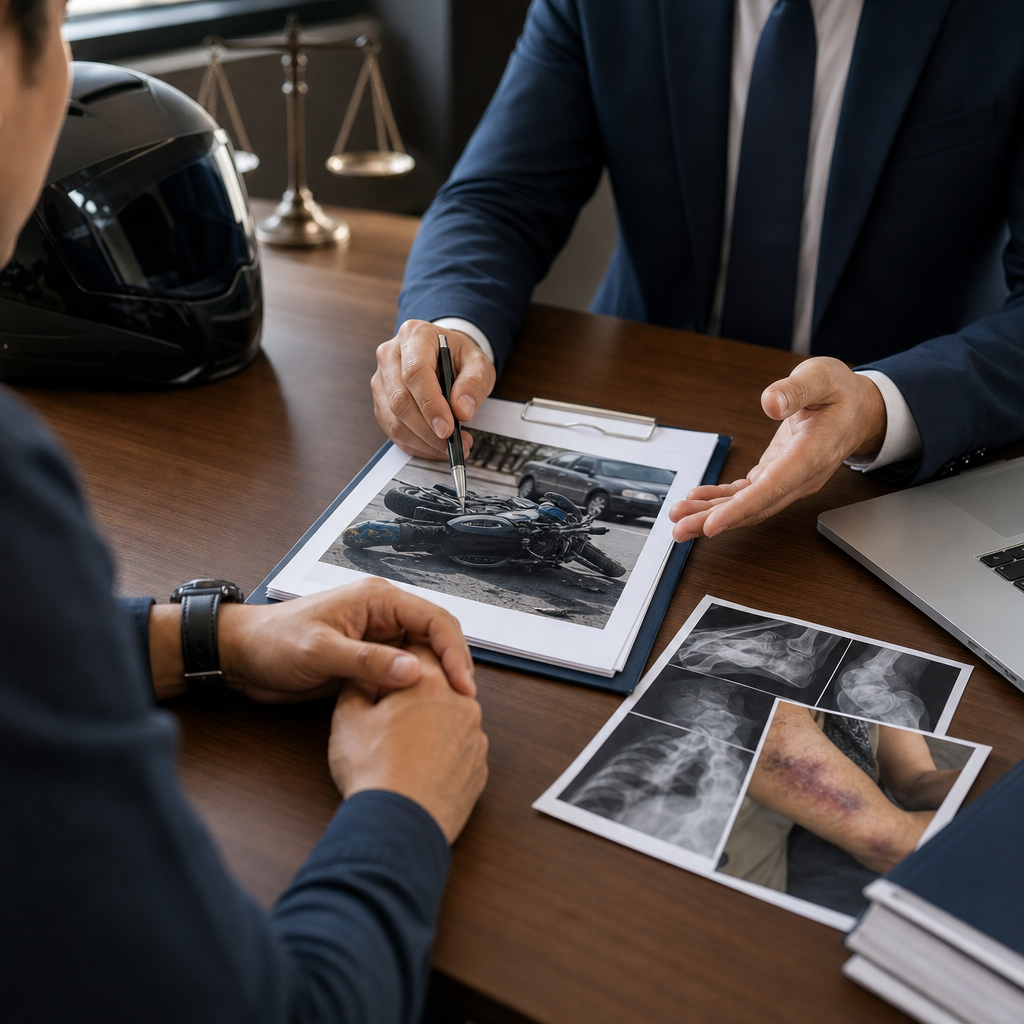
How We Negotiate with Insurance Companies on Your Behalf
We handle [negotiating with insurers] as a strategic process, not a one-time conversation. Our approach combines detailed documentation with confident advocacy.
First, we prepare a demand package that includes:
- A comprehensive narrative of how the accident occurred and the other driver’s negligence
- Medical reports and bills documenting your injuries and treatment
- Proof of lost wages and ongoing economic impact
- Expert opinions on accident causation and injury severity
- Photographs and video evidence of scene conditions and vehicle damage
- Witness statements supporting your version of events
We present this package to the insurer’s claims adjuster with a specific settlement demand. Rather than accept their counteroffer, we explain why our valuation is supported by evidence and California law. If they remain unreasonable, we indicate our readiness to litigate, which signals you’re serious and not bluffing.
Negotiation often involves 3-5 back-and-forth exchanges before reaching settlement. We know when to hold firm and when to move strategically toward a fair resolution. Insurance adjusters respond to confidence, evidence, and professional pressure—and we apply all three.
Calculating Your Full and Fair Compensation
Your compensation includes economic damages (provable financial losses) and non-economic damages (pain, suffering, lost quality of life). Many injured riders underestimate non-economic damages because they’re less tangible than medical bills.
Economic damages cover:
- All medical bills (emergency care, surgery, hospitalization, therapy)
- Ongoing or future medical treatment related to the accident
- Lost wages during recovery and any permanent income reduction
- Transportation and out-of-pocket costs for medical care
- Property damage to your motorcycle and gear
Non-economic damages address:
- Physical pain and suffering during recovery
- Emotional distress and anxiety related to the accident
- Loss of enjoyment of activities and hobbies
- Reduced quality of life or permanent disability
- Scarring or disfigurement with lasting impact
We calculate damages using medical evidence, wage records, and comparable settlements. California allows multipliers (typically 2-5x medical bills) for pain and suffering based on injury severity and recovery time. A serious motorcycle accident with 12+ months of treatment may support a 4-5x multiplier, while minor injuries may justify 1.5-2x.
Common Settlement Mistakes We Help You Avoid
Injured riders often make preventable errors that reduce their compensation significantly. We prevent these missteps.
The most costly mistakes include:
- Accepting the insurer’s first offer without negotiation (typically 30-50% below fair value)
- Signing medical authorization forms that allow insurers to review your full medical history, not just accident-related care
- Posting about the accident on social media, giving insurers ammunition to claim you’re not seriously injured
- Missing the statute of limitations deadline while trying to handle the claim yourself
- Talking to the other driver’s insurer without legal counsel, accidentally admitting fault or minimizing injuries
- Agreeing to surveillance or recorded statements that can be used against you later
- Settling before all medical treatment is complete, missing future complications
We advise you on every communication with insurers and review all documents before you sign. This protection alone often increases settlement value by 20-40%.
The Timeline Matters: Statute of Limitations for Motorcycle Claims
California gives you exactly two years from the accident date to file a lawsuit if settlement negotiations fail. This deadline is absolute—miss it, and you lose all legal rights regardless of the strength of your case.

We recommend these timeline actions:
Days 1-7: Report the accident to both the insurer and police if not already done. Seek medical care immediately, even for minor injuries (documentation creates a record).
Weeks 1-4: Preserve evidence, document the scene, and identify witnesses. Request the police report.
Months 1-3: Collect medical records, bills, and wage loss documentation. Begin investigating the other driver’s negligence and insurance limits.
Months 3-12: Prepare the demand package and present it to the insurer. Negotiate in good faith.
Month 18-24: If settlement stalls, we prepare litigation and file suit before the deadline expires.
Starting the legal process early doesn’t rush settlement—it strengthens your negotiating position by showing the insurer you’re serious and organized. Contact us promptly so we can guide you through these critical windows.
Building a Stronger Case Through Documentation and Preservation
Strong documentation is your negotiating foundation. Insurers make offers based on what you can prove, not what happened.
Document and preserve the facts:
- Medical records: Keep copies of all visit notes, imaging reports, treatment plans, and bills
- Photographs: Scene images showing road conditions, traffic signals, lighting, and vehicle positions (take these immediately if safe)
- Witness information: Get names, phone numbers, and email addresses from anyone who saw the accident
- Accident reconstruction: Hire an expert if liability is contested; their report carries significant weight
- Communication records: Save all emails and texts with the insurer and other parties
- Journal entries: Write down your symptoms, pain levels, and how the injury affects daily life
- Receipts: Save all out-of-pocket expenses related to medical care and recovery
Preserve physical evidence too. Your helmet, jacket, and motorcycle may contain impact evidence. Don’t repair the motorcycle until an expert or insurance adjuster inspects it. We guide you on secure storage and chain-of-custody procedures.
Settlement vs. Litigation: When We Take Your Case to Trial
Most motorcycle cases settle out of court, but some require litigation. We prepare every case as if it will go to trial, giving us leverage in negotiation and readiness if settlement fails.
We recommend litigation when:
- The insurer’s offer is far below fair value despite strong evidence
- The at-fault driver’s liability is disputed and expert testimony is needed
- Your injuries are severe and non-economic damages are substantial (pain and suffering multipliers increase in court)
- The insurer refuses to negotiate reasonably or acts in bad faith
- The at-fault driver’s insurance limits are insufficient, requiring a claim against your own underinsured motorist coverage
Litigation takes 1-2 years but often results in higher verdicts than settlements. Trial juries see motorcycle accidents firsthand and understand the severity of injuries. We’ve recovered significantly more at trial than the insurer’s last settlement offer in cases where we pursued litigation.
Going to trial does carry risk, cost, and delay. We advise you on this decision transparently, presenting both the litigation path and settlement options so you can decide what’s best for your situation.
What to Expect During the Negotiation Process
Understanding the negotiation timeline reduces stress and helps you stay patient when progress feels slow.

The typical process unfolds like this:
Phase 1: Demand (Weeks 1-2): We send a detailed demand letter with supporting evidence and a specific dollar amount. The insurer has 30 days to respond.
Phase 2: Initial Response (Weeks 4-6): The insurer replies with a counteroffer, usually 40-60% below our demand. They’ll cite policy limits or dispute liability.
Phase 3: Negotiation (Weeks 6-16): We respond with evidence addressing their concerns, clarify liability, and explain why our valuation is justified. Multiple exchanges occur.
Phase 4: Settlement or Escalation (Weeks 16-24): If the insurer moves toward our demand, we finalize terms. If they remain unreasonable, we file suit.
During this time, we keep you informed of every development. You’ll understand why we’re holding firm on certain points and when we’re moving strategically toward resolution. We encourage your input but advise you based on our experience—sometimes patience brings better results than quick settlement.
Your Free Consultation: Next Steps to Protect Your Rights
You don’t have to navigate motorcycle insurance settlement negotiation alone. We offer a free consultation to review your accident, assess your claim, and explain your options—with no obligation.
During your consultation, we’ll discuss:
- The facts of your accident and any disputed liability issues
- Your injuries and current medical status
- Insurance coverage available to you
- Realistic compensation range based on similar cases
- Timeline and costs for pursuing your claim
- How we represent clients on a contingency basis (no fee unless we recover for you)
To get started, contact us today. Time is limited—act now to preserve evidence and protect your rights. We’re here to secure the full and fair compensation you deserve after a motorcycle accident.