
Table of Contents
- How Comparative Fault Rules Apply to Bicycle Accidents
- Understanding California’s Pure Comparative Negligence System
- Common Causes of Bicycle Accidents and Liability Questions
- Why Preserving Evidence Matters in Your Bicycle Case
- How Insurance Companies Challenge Bicycle Accident Claims
- Our Investigation Process for Shared Fault Scenarios
- Calculating Your Compensation Under Comparative Fault Laws
- The Critical Importance of Acting Before Deadlines Pass
- Why You Need Experienced Representation for Bicycle Cases
- Contact Weinberger Law Firm for Your Free Consultation
- Frequently Asked Questions (FAQ)
How Comparative Fault Rules Apply to Bicycle Accidents
If you were injured in a bicycle accident, you have rights after an accident—even if someone suggests shared fault played a role. California’s comparative negligence rules mean you can still recover compensation, but the process requires careful navigation and evidence preservation. We understand that bicycle accidents often leave you facing medical bills, lost wages, and uncertainty about liability. Our job is to help you understand how California law applies to your situation and to pursue full and fair compensation for your injuries.
Comparative fault in bicycle accidents works differently than many people expect. California allows you to recover damages even if you bear some responsibility for the accident, as long as you are not more than 50 percent at fault. This means a driver who strikes you in an intersection while you both had partial negligence doesn’t get a free pass—and you don’t lose your right to compensation.
In practice, this plays out in scenarios like these: A motorist makes a left turn in front of you while you’re riding through a green light, but you weren’t wearing visible reflectors at dusk. A delivery truck door opens into your path, and you swerve into traffic, but the truck driver failed to check for cyclists. In each case, a judge or jury examines the actions of both parties to determine who bears responsibility.
The percentage of fault assigned directly reduces your compensation. If you recover $100,000 in damages but are found 20 percent at fault, you receive $80,000. Understanding how courts and insurance adjusters calculate these percentages is critical to protecting your recovery.
Understanding California’s Pure Comparative Negligence System
California follows pure comparative negligence, which is actually favorable to injured cyclists. Under this rule, you can recover damages even if you are 49 percent responsible for the accident—you only lose out if you are 50 percent or more at fault. This differs sharply from some states that bar recovery if you share any fault.
Pure comparative negligence means both sides have strong incentives to negotiate fairly. Insurance companies cannot simply dismiss your claim because you made a minor mistake before the collision. They must prove specific negligence on your part and demonstrate how it contributed to your injuries.
The burden of proving comparative fault rests partly on the defendant and their insurance carrier. We will investigate all available evidence to challenge unfounded negligence claims and establish your share of liability as accurately as possible. Document, preserve, and present the facts—that’s how we protect your interests.
Common Causes of Bicycle Accidents and Liability Questions
Bicycle accidents arise from many scenarios, and fault is rarely one-sided. A motorist turning left without checking for cyclists is clearly negligent, but if you were riding without lights at night, a jury might assign you partial fault. Similarly, a driver dooring a cyclist is almost always primarily at fault, yet your own speed and reaction time may factor into the analysis.

Other common situations include:
- Intersection collisions: Driver runs a red light or fails to yield; cyclist enters on green but was speeding or had obstructed visibility.
- Rear-end impacts: Driver follows too closely or is distracted; cyclist had no rear reflector or suddenly swerved.
- Road hazards and defects: Municipality failed to repair a pothole that caused you to fall into traffic; you were not paying attention to the road surface.
- Parked car and dooring: Driver opens door without checking; you were riding in the door zone.
- Pedestrian and cyclist conflicts: Pedestrian steps into a bike lane; cyclist was riding too fast for conditions.
In each scenario, investigation reveals specific facts: traffic camera footage, witness statements, vehicle damage patterns, and road conditions all matter. We pursue full and fair compensation by thoroughly evaluating your role and the defendant’s negligence side by side.
Why Preserving Evidence Matters in Your Bicycle Case
Evidence preservation is your foundation in a comparative fault claim. After a bicycle accident, critical evidence disappears quickly: traffic cameras loop over footage after a few days, witnesses move away or forget details, and the accident scene changes with weather and repair work.
Preserve any evidence and get medical care immediately. Document the scene with photos of your bicycle damage, road conditions, traffic signals, and sight lines. Collect names and phone numbers from anyone who saw the accident. Keep all medical records, expense receipts, and proof of lost wages—these establish both injury severity and economic losses.
Request a police report if officers responded; it often contains valuable witness statements and officer observations about traffic control. Ask about traffic camera footage from nearby businesses or municipal intersections. Photograph your bicycle damage in detail, as it can reveal the point of impact and vehicle speed. Time is limited—act now to preserve these critical materials before they vanish.
How Insurance Companies Challenge Bicycle Accident Claims
Insurance adjusters scrutinize bicycle accident claims more carefully than many other injury cases. They often argue that cyclists are inherently vulnerable and sometimes careless, hoping to reduce their client’s liability exposure. Common defense tactics include claiming you weren’t visible, weren’t paying attention, or violated traffic laws.
Adjusters may suggest that your bicycle lacked proper safety equipment, that you were riding too fast, or that you failed to brake in time. They interview you, hoping you’ll volunteer a statement that contradicts your own interests. They review police reports with a critical eye, highlighting any mention of your conduct while downplaying the driver’s negligence.
We know these tactics because we encounter them regularly. We don’t let insurance companies rewrite the facts or penalize you unfairly for minor traffic violations when the driver bears primary responsibility. Our negotiation with insurance companies is grounded in evidence, witness credibility, and California law—not speculation or bias against cyclists.
Our Investigation Process for Shared Fault Scenarios
When shared fault is possible, thorough investigation becomes even more important. We will investigate all available evidence by speaking with witnesses, obtaining traffic camera and nearby business surveillance footage, and reviewing accident reconstruction if impact angles or vehicle speeds are disputed.
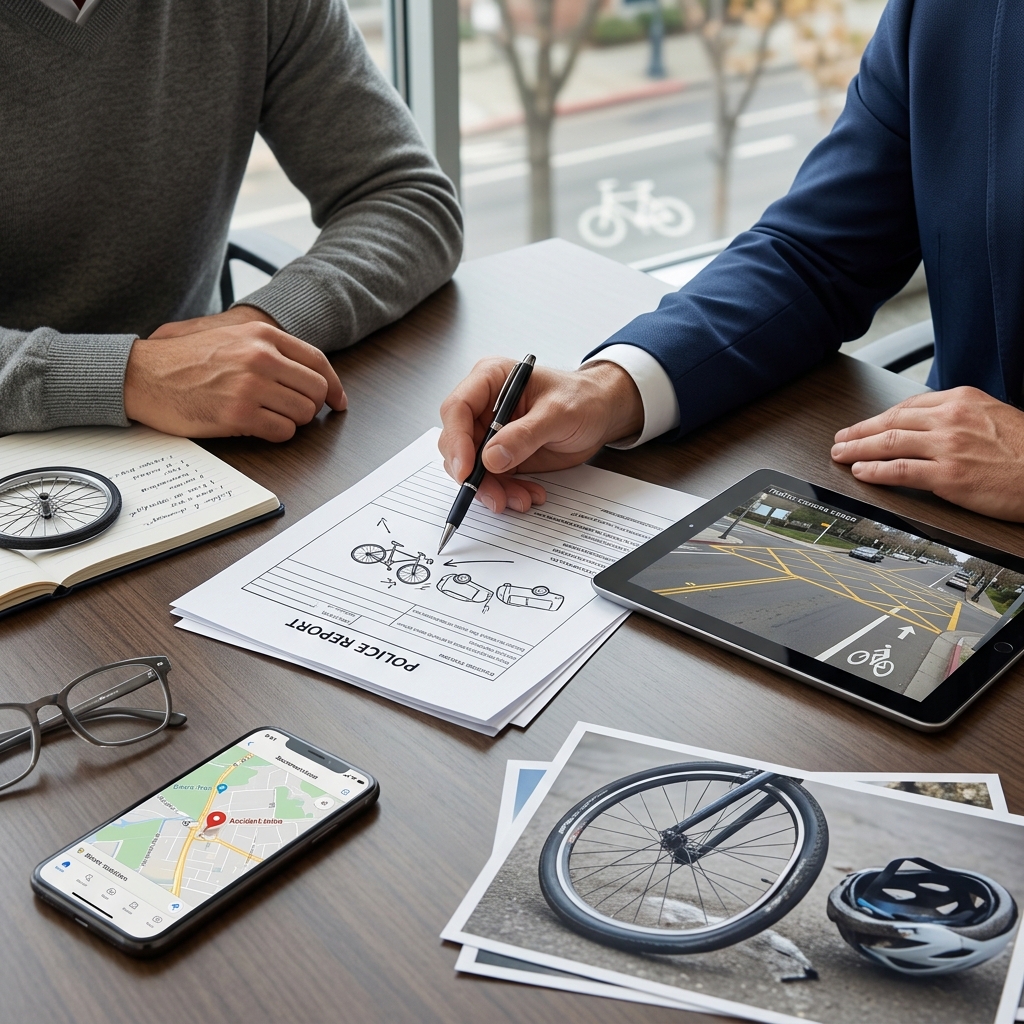
Our process includes several key steps:
- Scene documentation: We revisit the accident location to photograph conditions, sight lines, traffic control devices, and road hazards.
- Witness interviews: We speak with anyone who observed the accident, asking detailed questions about visibility, speed, traffic signals, and both parties’ actions.
- Medical record review: We gather your medical records to connect specific injuries to the impact and accident forces.
- Police and regulatory records: We obtain the official police report, traffic citations, and any municipal records about prior accidents at that location.
- Expert consultation: We engage accident reconstruction experts or medical specialists if needed to counter false claims about comparative fault.
This systematic approach protects you by building an objective record. Insurance adjusters cannot cherry-pick facts when we present a complete, evidence-based narrative.
Calculating Your Compensation Under Comparative Fault Laws
Calculating damages under California’s comparative negligence rule requires precision. Your total recovery includes past and future medical bills, lost wages, pain and suffering, permanent disability, and other economic and non-economic losses.
Suppose you suffered a fractured collarbone with six weeks of medical treatment, two months lost from work, and chronic pain that limits your cycling. Your medical expenses total $22,000, lost wages are $18,000, and pain and suffering damages are fairly valued at $35,000—a total of $75,000. If the jury finds you 15 percent at fault and the driver 85 percent at fault, you recover $63,750 (85 percent of $75,000).
The comparative fault percentage directly multiplies your total damages, making the liability determination highly consequential. We pursue full and fair compensation by ensuring the jury understands that your injuries stem primarily from the defendant’s negligence, not from minor actions you took before impact.
The Critical Importance of Acting Before Deadlines Pass
California’s statute of limitations—the filing deadline—gives you two years from the date of your bicycle accident to file a personal injury lawsuit. This deadline applies whether you’re pursuing a settlement or litigating your case. Two years sounds like plenty of time, but it evaporates quickly when you’re focused on medical recovery and managing financial hardship.
Insurance companies count on delay. As months pass, memories fade, witnesses become harder to locate, and evidence disappears. A lawsuit filed near the deadline is weaker than one filed promptly because you’ve lost leverage in settlement negotiations and investigation becomes rushed.
We recommend moving quickly: contact us for a free consultation within days or weeks of your accident. No fee unless we recover for you—we handle everything, and you pay nothing upfront. Early action protects your evidence, strengthens our negotiating position, and ensures we have time to prepare thoroughly before any statute of limitations deadline.
Why You Need Experienced Representation for Bicycle Cases
Bicycle accident cases involve unique legal and factual challenges. Judges and juries sometimes harbor implicit bias against cyclists, assuming you should have seen the danger or ridden more defensively. Insurance adjusters apply different standards to bicycle claims than to car accidents, often demanding higher burdens of proof for your liability claims against drivers.
Our Sacramento bicycle attorney team understands these dynamics because we’ve negotiated and litigated bicycle accident cases repeatedly. We counter bias with evidence. We cross-examine insurance adjusters who rely on stereotype instead of facts. We present your case to judges and juries in ways that humanize your experience and hold responsible parties accountable.
Experienced representation also means knowing which experts to hire, which evidence to prioritize, and how to navigate comparative fault disagreements. We work with accident reconstructionists, medical specialists, and other professionals who strengthen your position. You deserve an advocate who treats your case as seriously as you do and who understands California bicycle law thoroughly.
Contact Weinberger Law Firm for Your Free Consultation
You have rights after an accident. Whether comparative fault complicates your case or liability seems clear, you deserve skilled legal guidance and honest evaluation of your claim. We offer a free, no-obligation consultation where we listen to your story, answer your questions, and explain your options plainly.
During your consultation, we’ll review the facts of your accident, discuss how California comparative negligence law applies to you, and outline our investigation and negotiation strategy. You’ll understand what we can pursue, what timeline we’re working with, and why you have rights to full and fair compensation.
Contact Weinberger Law Firm today. Time is limited—act now to protect your rights and your recovery. No fee unless we recover for you. We’re ready to fight for you.
Contact us today for a Free Case Consultation!
Frequently Asked Questions (FAQ)
If I’m partially at fault for my bicycle accident, can I still recover compensation in California?
Yes, you have rights even if you share some responsibility for the accident. We operate under California’s pure comparative negligence system, which means you can recover compensation as long as you’re not more than 100% at fault. Your recovery amount will be reduced by your percentage of fault, so if you’re 20% responsible, we’ll help you recover 80% of your damages including medical bills and lost wages.
What should I do immediately after a bicycle accident to protect my case?
Preserve any evidence and get medical care right away, as both steps are critical for your claim. We recommend documenting the accident scene with photos, collecting witness contact information, and keeping records of all medical treatment and expenses. Time is limited under California’s statute of limitations, so contact us promptly so we can launch our investigation before evidence becomes harder to locate or memories fade.
How do insurance companies try to challenge bicycle accident claims?
Insurance companies often dispute bike accident claims by arguing the cyclist was partially or fully at fault, minimizing injury severity, or claiming pre-existing conditions. We will investigate all available evidence and handle negotiations with insurers on your behalf, presenting the facts clearly so you receive full and fair compensation rather than an artificially low settlement offer.