
California Truck Accident Lawyer: How to Win Your Claim
A semi-truck collision can change your health, work, and finances in seconds. While you arrange medical care, a trucking company and its insurer may collect evidence and evaluate fault. If you were injured in California, protect your health first. Preserve information you can safely obtain. Get advice before giving a recorded statement or accepting an offer. This guide explains how a California truck accident lawyer can investigate liability and pursue compensation. For the larger claims framework, read the Car, Truck, and Motorcycle Accident Claims in California guide.
Call Weinberger Law Firm at 916-357-6767 for a free consultation.
A California truck accident lawyer can strengthen a claim by preserving electronic logging data, maintenance records, cargo documents, onboard video, and other evidence before it disappears. A careful investigation may identify the driver, carrier, vehicle owner, shipper, maintenance provider, manufacturer, or another responsible party. The potential recovery depends on proven fault, documented losses, comparative fault, and available coverage.
Why a California Truck Accident Lawyer Treats These Claims Differently
Truck accident claims differ from car claims because one commercial trip can involve multiple companies, specialized safety records, and overlapping responsibilities. A California truck accident lawyer examines who controlled the driver, vehicle, cargo, route, and maintenance, then connects that evidence to the crash and injuries.
A commercial truck is not always owned and operated by one business. The driver may work for a motor carrier. The tractor may be leased from another company, and the trailer may belong to a separate owner. A shipper or loader may control how freight was placed and secured. A broker may have arranged transportation without operating the vehicle. These relationships matter because each party’s duty must be tied to the conduct that caused the collision.
Commercial vehicles create a broader evidence trail
A car investigation may focus on photographs, witness accounts, traffic signals, vehicle damage, and the police report. A truck investigation may also require electronic logging device data, dispatch messages, and GPS information. It may include delivery schedules, inspection reports, repair invoices, onboard video, bills of lading, weight tickets, and cargo securement records. Different businesses may possess different pieces of the story.
Some electronic records can be overwritten or become harder to retrieve as time passes. A prompt preservation request can tell a carrier and other record holders to protect relevant material. It does not guarantee that a claim will succeed, but it can reduce the risk that a useful record disappears before it is reviewed.
Commercial insurance investigations can begin quickly
Commercial insurers may contact an injured person soon after a crash. An adjuster may request a recorded statement, medical authorization, inspection access, or a release. Answer questions truthfully, but do not guess about speed, distance, symptoms, or fault. Do not sign a settlement release until you understand which injuries, expenses, and future claims it would resolve.
The California personal injury claims process guide explains the general path from investigation through negotiation and litigation. A truck claim may follow those stages, but the number of parties and records can make the investigation more demanding.
| Issue | Why it matters |
|---|---|
| Multiple businesses | The driver, carrier, owner, shipper, broker, or contractor may have different duties. |
| Commercial records | Logs, dispatch data, maintenance files, video, and cargo records may explain the collision. |
| Regulatory duties | Federal and state rules can identify safety practices and records for review. |
| Long-term harm | Serious injuries may affect treatment, income, family responsibilities, and daily activities. |
Who Is Liable in a California Semi-Truck Accident?
Liability in a California semi-truck accident depends on evidence connecting a party’s duty and conduct to the collision and resulting injuries. Potentially responsible parties may include the driver, motor carrier, truck or trailer owner, shipper, loader, broker, maintenance provider, manufacturer, roadway contractor, property owner, or public entity.
The driver and motor carrier
A driver may be responsible for speeding, distraction, impairment, an unsafe lane change, following too closely, fatigue, or another failure to use reasonable care. A traffic citation can be relevant, but it does not answer every question about civil liability.
A carrier may face responsibility for conduct within an employment or agency relationship. It may also face direct allegations concerning hiring, training, supervision, retention, dispatch, inspection, or maintenance. Each allegation must be supported by facts.
Owners, shippers, brokers, and maintenance providers
The carrier may not own the tractor or trailer. A leasing company or separate owner may have inspection or repair responsibilities. If a mechanical problem contributed to the crash, physical inspection and maintenance records may help identify who controlled the work and whether a defect was known.
Cargo can create a separate line of inquiry. Overloaded or unsecured freight can shift a truck’s balance, increase stopping distance, or fall from the trailer. The driver, carrier, shipper, loader, broker, or freight company may have different responsibilities. A manufacturer or distributor may also be relevant if a defective component caused a mechanical failure.
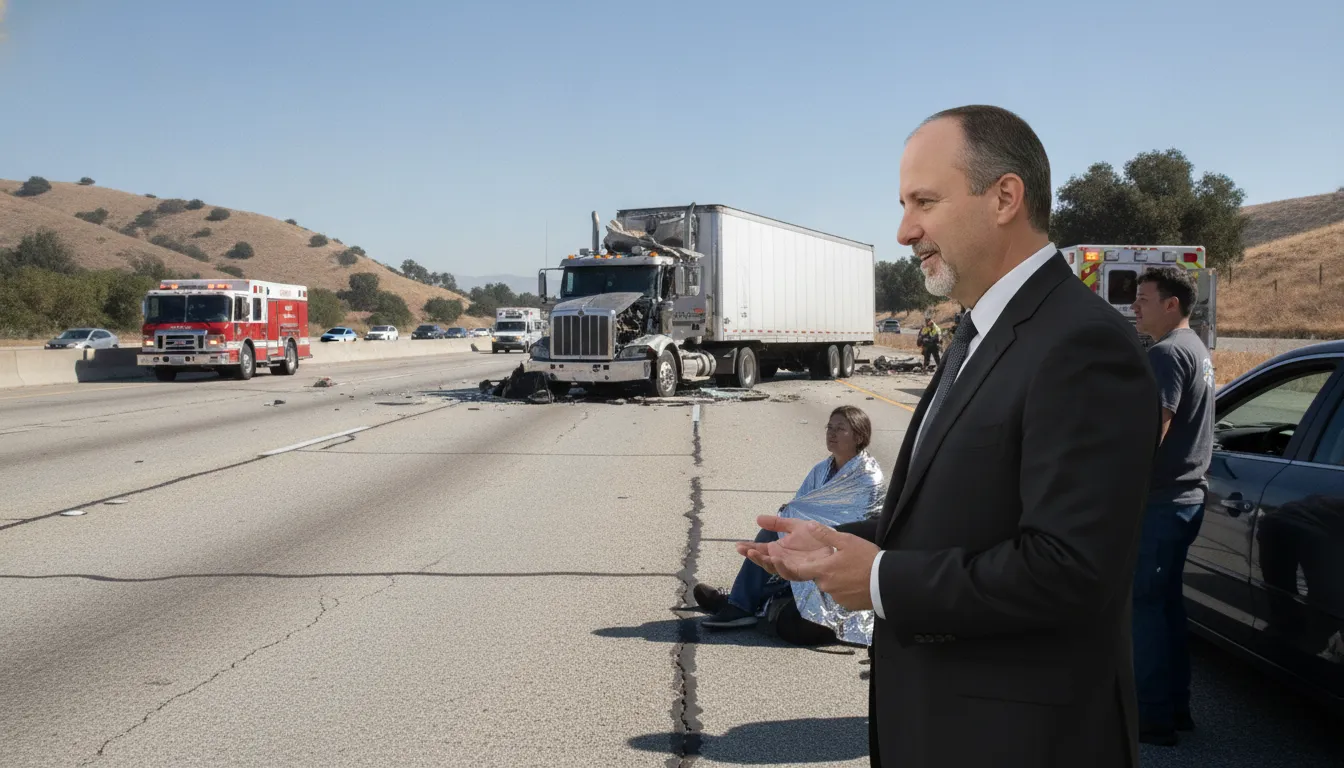
Roadway, property, and public actors
A dangerous roadway, loading area, construction zone, inadequate warning, or obstruction may contribute to a truck collision. Public-entity claims can have special notice requirements and shorter deadlines. Do not assume that the ordinary personal injury deadline applies to every potential defendant.
A disciplined investigation connects each party’s duty and conduct to the collision, injury, and damages. Read the firm’s commercial truck accident article for additional context about trucking risks.
How Do Federal Trucking Regulations Affect a California Claim?
Federal trucking regulations provide a framework for examining driver qualifications, hours of service, vehicle inspection, maintenance, and cargo securement. A violation does not automatically establish negligence. The evidence must still show what duty applied, whether it was breached, and whether the conduct contributed to the crash and resulting harm.
The Federal Motor Carrier Safety Administration regulations page is an official starting point for federal materials. A lawyer can use the applicable rules to identify records and questions for witnesses, company representatives, and experts.
Hours of service and fatigue evidence
Hours-of-service requirements address driving time and rest. Investigators may compare electronic logging data with dispatch messages, toll records, fuel receipts, delivery deadlines, GPS information, and witness accounts. An inconsistency can warrant further review, but it does not by itself prove that fatigue caused a collision.
Qualifications, inspection, and cargo compliance
Driver qualification materials may include licensing, endorsements, medical qualification, training, and employment records. Vehicle materials may include inspection reports, defect reports, repair invoices, and out-of-service notices. Weight tickets, bills of lading, loading documents, photographs, and inspection records may show what the truck carried and how freight was secured.
Regulations are evidence tools, not shortcuts around proof. The strongest analysis explains how a rule, unsafe practice, or missing record fits with physical and medical evidence.
What Evidence Should You Preserve After a Truck Crash?
After a truck crash, preserve medical records, photographs, witness details, reports, insurance communications, and financial-loss records. Ask counsel to request commercial evidence such as electronic logs, dispatch messages, video, maintenance files, inspection records, driver qualification materials, and cargo documents before routine retention practices overwrite it.
Preserve evidence without risking your safety or delaying medical care. Start with information you can lawfully and safely obtain, then ask counsel to pursue records held by the trucking operation. Keep original digital files when possible and avoid posting sensitive information publicly.
- Medical records and bills. Keep treatment instructions, diagnostic results, prescriptions, bills, receipts, and follow-up records.
- Scene photographs and video. If safe, photograph vehicle damage, road conditions, traffic controls, debris, skid marks, weather, and visible injuries.
- Witness details. Record names and contact information for people who saw the crash or its aftermath.
- Police and incident reports. Request available reports and preserve related emergency, roadway, property, or inspection records.
- Insurance communications. Keep letters, emails, texts, estimates, offers, and notes of calls.
- Trucking records. Ask a lawyer to send a preservation request for ELD data, driver logs, dispatch records, onboard video, inspection and maintenance files, and cargo records.
- Financial and daily-impact records. Track medical travel, equipment, home help, lost wages, missed work, pain, sleep disruption, and daily limitations.
The firm’s guide to getting medical bills paid after a California truck accident provides related information.
Call Weinberger Law Firm at 916-357-6767 to discuss preserving your truck accident claim.
How Much Is a Truck Accident Claim Worth in California?
No average settlement can predict the value of a California truck accident claim. Potential recovery depends on provable liability, injury duration, medical evidence, lost income, future care, pain and suffering, comparative fault, available coverage, and supporting records.
A claim evaluation should begin with the facts rather than a promised result or formula. A large commercial policy does not eliminate the need to prove fault, causation, injury, and damages.
Economic and non-economic losses
Economic losses may include emergency care, rehabilitation, medication, equipment, transportation, lost wages, and reduced future earning capacity. Non-economic losses may include pain, emotional distress, loss of enjoyment, and limits on ordinary activities. The California Courts personal injury guidance describes general categories.
Future care and lasting impairment
Spinal injuries, traumatic brain injuries, amputations, fractures, and other catastrophic injuries can require long-term treatment or assistance. A claim may need evidence about future care, rehabilitation, home modifications, personal care, and work capacity.
Comparative fault and available coverage
California comparative-fault rules can reduce a recovery by the percentage of fault assigned to the injured person. Other responsible parties may have separate coverage. See the firm’s discussion of damages in California personal injury lawsuits for additional background.
Why Hire a California Truck Accident Lawyer?
A California truck accident lawyer can coordinate evidence preservation, insurer communications, technical records, expert review, and damages evaluation while an injured person focuses on treatment. Counsel can investigate every company connected to the trip and prepare the claim for negotiation or litigation.
Truck claims often develop while medical treatment is underway. A lawyer can organize the investigation, communicate with commercial insurers, and identify records that may be difficult to obtain alone.
- Identify businesses, policies, contracts, and people connected to the trip.
- Send preservation requests for records that may be deleted or overwritten.
- Review photographs, reports, vehicle damage, witnesses, and roadway conditions.
- Analyze medical treatment, lost income, future needs, and daily limitations.
- Handle insurer communications and evaluate settlement proposals.
- Prepare for litigation when the evidence, deadline, or offer requires it.
Joseph B. Weinberger’s attorney profile describes his California personal injury practice and experience as a judge pro tem, mediator, and arbitrator. The firm’s case results provide examples of substantial settlements and verdicts. Past results do not guarantee an outcome.
Weinberger Law Firm represents injury victims throughout California, with a local emphasis on Roseville, Sacramento, and Folsom. The firm works on a contingency-fee basis, so clients pay nothing upfront and pay a fee only if the firm recovers compensation. Review the contact page to request a free consultation.
Call Weinberger Law Firm at 916-357-6767 for a free consultation.
Frequently Asked Questions
Who can be liable for a California semi-truck accident?
Potentially responsible parties may include the driver, motor carrier, truck or trailer owner, shipper, loader, broker, maintenance provider, manufacturer, property owner, roadway contractor, or public entity. Liability depends on each party’s duty, conduct, relationship to the trip, and connection to the collision and injuries.
What should I do after a truck accident?
Get medical care, contact the appropriate authorities, document the scene only if safe, identify witnesses, preserve reports and bills, and keep insurance communications. Ask a lawyer to send a preservation request for commercial records.
Do federal trucking rules prove negligence?
Not automatically. Federal rules can identify duties, records, and investigation questions. A claim still requires evidence connecting unsafe conduct to the collision and resulting injuries.
How much is a semi-truck accident claim worth?
No average settlement can predict a particular result. Value depends on liability, medical evidence, lost income, future care, pain and suffering, comparative fault, available coverage, and proof.
How long do I have to file a California truck accident lawsuit?
California personal injury lawsuits generally have a two-year filing period, but exceptions apply. Public-entity claims may have shorter notice requirements. Get case-specific advice promptly.