Table of Contents
- Why Motorcycle Accidents Present Unique Liability Challenges
- Understanding California’s Comparative Negligence Rules
- Determining Fault in Motorcycle Accident Cases
- Common Causes of Motorcycle Accidents and Liability
- How We Investigate to Establish Liability
- Insurance Company Tactics and How We Counter Them
- Preserving Evidence That Proves Liability
- Calculating Full Compensation for Your Damages
- The Statute of Limitations: Why Time Matters
- Our Process for Pursuing Your Claim
- Why You Need Dedicated Motorcycle Accident Legal Support
- Frequently Asked Questions (FAQ)
Why Motorcycle Accidents Present Unique Liability Challenges
If you were injured in a motorcycle accident, you have rights after an accident. California law gives you clear pathways to pursue fair compensation from the at-fault party. Understanding motorcycle accident liability in California is essential, especially because motorcycles involve unique risk factors that courts and insurance companies evaluate differently than car accidents. We help injured riders navigate these complexities and secure the compensation they deserve.
Motorcycle accidents carry distinct liability complications that differ from passenger vehicle collisions. Motorcycles offer no protective shell, airbags, or crumple zones, making injuries far more severe even at modest impact speeds. Insurance companies and juries sometimes hold biased assumptions about motorcycle riders, falsely assuming riders take unnecessary risks or lack safety awareness.
These misconceptions can unfairly shift blame onto the rider, even when another driver caused the accident. We investigate aggressively to counter these assumptions and establish clear liability based on facts, not stereotypes. Evidence like traffic camera footage, witness statements, and accident reconstruction becomes crucial in proving that the other party’s negligence caused your injuries.
Another challenge is that motorcycle accidents often involve split-second decisions and visibility issues. When a car driver fails to see a motorcycle in their blind spot, determining liability hinges on proving the driver’s duty to look and their failure to do so. We will investigate all available evidence to build a compelling case that demonstrates the other driver’s breach of duty.
Understanding California’s Comparative Negligence Rules
California follows pure comparative negligence, a legal framework that allows you to recover damages even if you bear partial fault for the accident. If you were 30% responsible and the other driver was 70% responsible, you can recover 70% of your total damages. This rule protects injured riders who may have made a minor error but were far less at fault than the driver who caused the collision.
The key is proving the extent of the other party’s negligence versus your own. Insurance adjusters will argue you share more fault than you do, using this argument to lower settlement offers. We counter these tactics by documenting exactly what happened, establishing clear timelines, and presenting evidence that shows the other driver’s primary responsibility for the crash.
Your percentage of fault does not bar your right to compensation. Many riders settle for far less than they deserve because they believe one small action on their part eliminates their claim entirely. Understanding comparative negligence empowers you to recognize that even if you made a mistake, you still deserve fair recovery for your injuries and losses.
Determining Fault in Motorcycle Accident Cases
Fault determination requires examining each party’s duty of care, whether that duty was breached, and whether the breach caused your injuries. California law holds every driver accountable for operating their vehicle safely and responsibly. When a driver fails to maintain a safe speed, check their mirrors, or follow traffic laws, they breach that duty.
We establish fault by answering three core questions: What was the other driver’s legal duty? Did they violate that duty? Did their violation directly cause your accident and injuries? Evidence like police reports, traffic citations, witness testimony, and vehicle damage patterns all contribute to building a strong fault narrative.

In motorcycle cases, fault is especially clear when the other driver admits fault, receives a traffic citation, or demonstrates obvious negligence like texting while driving or running a red light. When fault is disputed, we rely on expert accident reconstruction and medical evidence to connect the driver’s negligent conduct directly to your injuries.
Common Causes of Motorcycle Accidents and Liability
Left-turn collisions top the list of motorcycle accidents, occurring when an oncoming vehicle turns left in front of a motorcycle, cutting off the rider’s path. The turning driver typically holds clear liability because they failed to yield the right-of-way. Lane-change accidents happen when a vehicle changes lanes without checking blind spots, striking a motorcycle traveling alongside.
Rear-end collisions expose the following driver’s failure to maintain safe distance or pay attention. Drivers distracted by phones, eating, or adjusting controls may not react in time to stop before hitting a motorcycle. Unsafe road conditions caused by negligent property owners, such as gravel, potholes, or debris, may also trigger liability claims.
Speed and impairment accidents involve drivers exceeding safe speeds for conditions or operating vehicles under the influence of alcohol or drugs. These cases typically establish liability clearly because the driver’s conduct was inherently reckless. We investigate toxicology reports, traffic records, and witness observations to prove the driver’s impaired or reckless state at the time of the accident.
How We Investigate to Establish Liability
Our investigation begins immediately after you retain us. We will investigate all available evidence, including police reports, medical records, scene photographs, and witness contact information. Time is critical because evidence fades, witnesses relocate, and camera footage gets overwritten.
We secure traffic camera footage from nearby businesses, traffic lights, and government cameras that may have recorded the accident. We interview witnesses while their memories remain fresh and obtain detailed statements about what they observed. We engage accident reconstruction experts who analyze vehicle damage, road markings, and physics to determine pre-impact speeds and vehicle positions.
We also review the at-fault driver’s vehicle maintenance records, insurance history, and prior violations to identify patterns of negligence. If the other driver had a history of reckless citations or previous accidents, that history strengthens our argument that their conduct was dangerous and foreseeable. Medical records connect your injuries directly to the collision’s impact and force, establishing causation.
Insurance Company Tactics and How We Counter Them
Insurance companies minimize payouts by questioning your credibility, suggesting pre-existing injuries, or arguing you shared significant fault. Adjusters may pressure you to accept quick settlement offers before you fully understand your injuries or long-term needs. They document every statement you make, searching for inconsistencies they can use against you.
We handle all communication with insurance companies on your behalf, preventing statements that weaken your claim. We demand comprehensive investigations before accepting lowball offers and stand firm on evidence-based damage calculations. When insurers refuse fair settlements, we file lawsuits and prepare for litigation, signaling that we will not accept unreasonable positions.
Our experience with insurance tactics means we recognize when offers fall far short of your actual damages. We pursue full and fair compensation by presenting organized medical evidence, lost-wage documentation, and expert testimony on pain and suffering. We also explain how California law supports your damage claims, educating adjusters about their exposure if the case goes to trial.
Preserving Evidence That Proves Liability
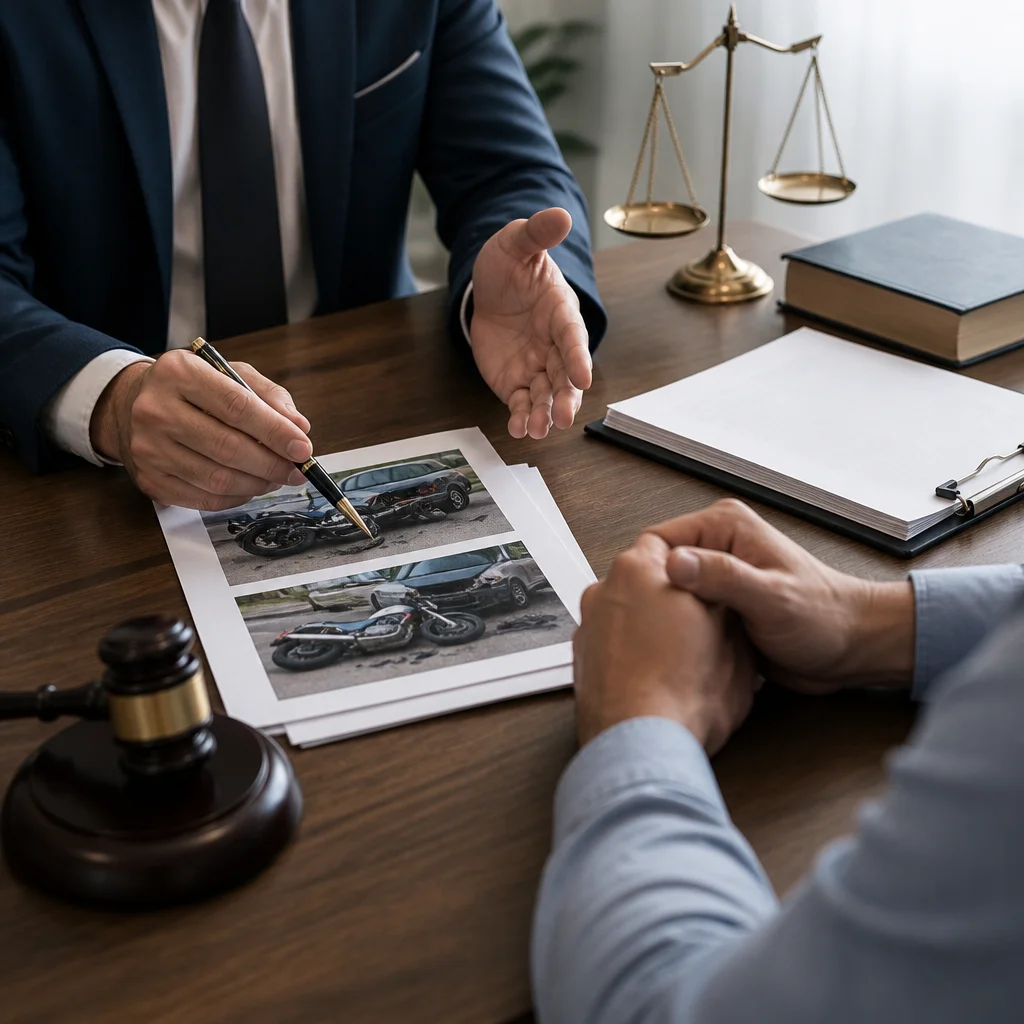
Preserve any evidence and get medical care immediately after an accident. This dual action protects both your health and your legal claim. Seek medical attention even if you feel temporarily okay; adrenaline masks serious injuries, and delays in diagnosis weaken your credibility.
Document the accident scene with photographs or videos showing vehicle positions, road conditions, traffic signals, and environmental factors. Photograph your injuries from the day of the accident onward, as these images powerfully demonstrate the impact’s severity. Collect contact information from witnesses before they leave the scene, as locating them later becomes exponentially harder.
Preserve your motorcycle and any damaged clothing or protective gear; these physical items show the force and angle of impact. Keep all medical records, bills, and receipts related to your injuries. Save text messages, emails, and notes documenting your pain, recovery progress, and missed work days. Insurance companies challenge intangible damages like pain and suffering, so contemporaneous documentation is invaluable.
Calculating Full Compensation for Your Damages
Your compensation includes economic damages (medical bills, lost wages, property damage) and non-economic damages (pain and suffering, emotional distress, loss of enjoyment of life). We evaluate your immediate medical costs and project future healthcare expenses if ongoing treatment is necessary.
Lost wages cover income you missed while recovering and unable to work. If your injuries reduce your earning capacity permanently, we calculate the lifetime impact on your income. For self-employed riders, we reconstruct income using tax returns and business records to establish what you would have earned.