
Table of Contents
- Why Motorcycle Accidents Demand Specialized Legal Protection
- How Insurance Companies Undervalue Motorcycle Claims
- What You Have Rights To After a Motorcycle Accident
- Evidence Preservation Steps We Take Immediately
- Our Comprehensive Case Evaluation Process
- Negotiating Maximum Compensation for Your Damages
- Medical Documentation and Lost Wage Recovery
- California Statute of Limitations for Motorcycle Accidents
- How Our Investigation Process Differs
- Litigation Readiness and Settlement Strategy
- Why Direct Legal Representation Outperforms DIY Claims
- Your Free Consultation and No-Fee Guarantee
- Frequently Asked Questions (FAQ)
Why Motorcycle Accidents Demand Specialized Legal Protection
If you were injured in a motorcycle accident, you know the physical and financial toll is immediate and severe. Medical bills pile up. Work stops. Insurance companies circle. What you may not realize is that motorcycle accident claims face unique obstacles—and you have legal rights designed to protect you. We understand the stakes, and we’re here to guide you through every step.
Motorcycle accidents differ fundamentally from car crashes. Riders have no protective shell, no airbags, no crumple zones. The injuries are typically catastrophic: spinal cord damage, traumatic brain injury, severe fractures, road rash covering large portions of skin. Insurance adjusters know this, and they also know that many riders lack representation.
Bikers also face bias in claims. Adjusters may assume the rider was speeding, showing off, or otherwise at fault—even when evidence contradicts this. Without specialized legal guidance, these prejudgments can cost you thousands in lost compensation. We investigate motorcycle accidents with the same rigor we apply to any personal injury case, but we also understand the specific medical, mechanical, and liability angles unique to two-wheeled vehicles.
Your case deserves an attorney who knows how motorcycle dynamics affect liability and injury severity. That focused expertise makes a measurable difference in outcome.
How Insurance Companies Undervalue Motorcycle Claims
Insurance companies use predictable tactics to minimize payouts on motorcycle injury claims. Here’s what we typically see:
- Suggesting the rider was at fault or contributed to the accident
- Offering quick settlement amounts that cover only immediate medical bills, not ongoing care
- Questioning the severity of injuries because “you could have been killed”
- Delaying response to claim documentation or requesting excessive medical records
- Using the rider’s lack of representation to justify lowball offers
We’ve negotiated hundreds of claims. When riders accept these initial offers without counsel, they regularly leave 50 to 70 percent of their rightful compensation on the table. Insurance companies count on this. They budget for settlement amounts far below what a case is actually worth—and they bank on injured riders being desperate, exhausted, or unfamiliar with their legal options.
Our job is to shift that power dynamic. We document injuries thoroughly, gather evidence that establishes liability clearly, and present a demand backed by facts—not emotion. Insurance adjusters respond to strength and preparation.
What You Have Rights To After a Motorcycle Accident
You have rights after an accident. California law entitles you to recover compensation for:
- All medical expenses: emergency care, surgery, hospital stays, rehabilitation, ongoing treatment, and future medical needs related to your injury
- Lost wages: income you lost while recovering, and diminished earning capacity if your injuries affect your ability to work long-term
- Pain and suffering: compensation for physical pain, emotional distress, and reduced quality of life
- Property damage: replacement or repair of your motorcycle and gear
- Punitive damages: in cases of gross negligence or intentional misconduct (rare but significant when applicable)
This right to compensation exists regardless of whether the other driver carried adequate insurance. We pursue full and fair compensation through every available avenue: the at-fault driver’s liability insurance, underinsured motorist coverage on your own policy, or litigation against the responsible party directly.
Understanding these categories prevents you from accepting inadequate settlements. Many injured riders don’t realize they can recover for pain and suffering or lost earning capacity—they think only of medical bills. That knowledge gap costs them dearly.
Evidence Preservation Steps We Take Immediately
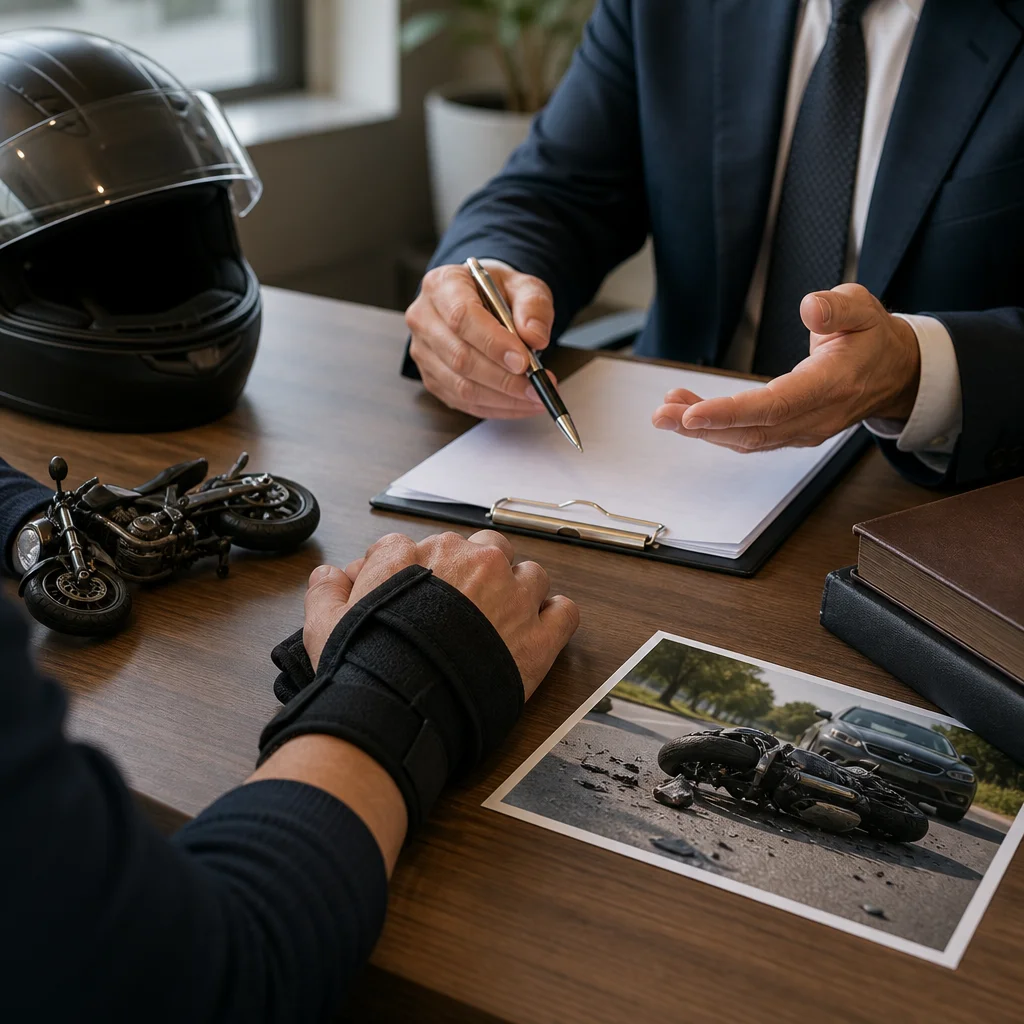
Time erodes evidence. Security camera footage gets overwritten. Witnesses move or forget details. Skid marks fade. The first hours and days after an accident are critical. We move fast.
When you contact us, here’s what we do immediately:
- Secure police reports and photograph evidence from the accident scene
- Issue preservation notices to nearby businesses, traffic departments, and property owners requesting they maintain video footage and records
- Interview witnesses while memories are fresh, documenting their accounts in detail
- Photograph your injuries, motorcycle damage, and any scene conditions that show liability
- Obtain medical records from your initial treatment and coordinate ongoing documentation
- Request traffic camera footage, dash cam recordings, and phone records that may show the other driver’s negligence
Preserve any evidence you have access to. Take photographs of your injuries as they heal. Keep all medical records, receipts, and communication with insurers. Document your lost work hours. These details become the foundation of your case.
Our investigation process differs because we begin preservation immediately and pursue evidence comprehensively rather than waiting for the insurance company to request it.
Our Comprehensive Case Evaluation Process
We evaluate every motorcycle accident claim systematically. This isn’t a checkbox exercise—it’s a thorough analysis that determines case value, identifies all liable parties, and shapes our negotiation strategy.
During case evaluation, we review:
- The accident timeline and contributing factors (weather, visibility, road conditions, traffic flow)
- Liability assessment: who bears fault under California law, and whether comparative negligence applies
- Injury severity and prognosis: current and future medical needs, expert medical opinions on long-term effects
- Damages quantification: medical bills to date, projected costs, lost income documentation, and pain and suffering multipliers
- Insurance coverage available: policy limits, underinsured motorist protection, uninsured motorist coverage
- Settlement value range: comparable cases in California, jury award patterns, and litigation risk assessment
This evaluation takes time. We don’t rush to settlement offers. Instead, we build a clear picture of what your case is worth and what we need to prove to get there. You receive a detailed explanation of our findings and our recommended strategy—whether that’s direct negotiation, demand and settlement, or preparation for trial.
Negotiating Maximum Compensation for Your Damages
Insurance companies respect preparation and evidence. Vague demands backed by emotion get rejected. Clear, fact-based demands with supporting documentation get serious consideration. We negotiate on that foundation.
Our negotiation process includes:
- Compiling a demand package: medical records, expert opinions, wage loss documentation, photographs, and liability analysis
- Calculating damages using recognized valuation methods, not guesswork
- Presenting the demand strategically, with clear explanation of how we arrived at each number
- Responding to insurer counteroffers with factual rebuttals and revised demands
- Knowing when settlement terms are fair and when litigation strengthens our position
We pursue full and fair compensation through this process. If the insurance company’s offer remains inadequate, we don’t hesitate to file suit. Insurance adjusters know this—and it changes how they negotiate. Your attorney’s willingness to litigate creates leverage.
Medical Documentation and Lost Wage Recovery
Medical bills and lost wages form the concrete foundation of your damages claim. Unlike pain and suffering—which requires argumentation—these are objective, documentable losses. Yet many injured riders lose these claims through poor documentation.
We ensure your claim captures every relevant expense:

- Coordinating with your medical providers to obtain complete records, imaging, surgical reports, and treatment plans
- Calculating lost wages using pay stubs, tax returns, and employer letters documenting your work status before and after injury
- Identifying future medical needs through expert testimony, ensuring your settlement covers ongoing care
- Documenting time lost to medical appointments and recovery beyond work hours
- Capturing ancillary costs: transportation to appointments, medication, home modifications for disability access
Insurance companies sometimes argue that certain expenses are unrelated to the accident or are inflated. We counter with organized documentation that establishes the clear connection between your injury and each expense claimed. This methodical approach prevents disputes that derail settlements.
California Statute of Limitations for Motorcycle Accidents
Time is limited—act now. California gives you two years from the accident date to file a personal injury lawsuit. This is the statute of limitations—the filing deadline set by law. Miss it, and your right to sue expires permanently, regardless of the strength of your claim.
This deadline applies to your claim against the at-fault driver. Insurance claims outside litigation have their own timelines, but those can be extended through negotiation. The two-year litigation window cannot. We recommend pursuing a claim well before this deadline, both because it pressures insurance companies and because it gives us time to investigate thoroughly if litigation becomes necessary.
Don’t wait. Contact us for a free consultation now. The sooner we begin work on your case, the better.
How Our Investigation Process Differs
Many injury attorneys rely on police reports and insurance company investigation. We do much more. We treat motorcycle accident claims as investigations requiring expert-level attention to mechanical, medical, and forensic detail.
Our investigation goes deeper:
- Reviewing vehicle maintenance records and manufacturer data on the motorcycle to rule out equipment failure
- Consulting accident reconstruction experts who can analyze velocity, point of impact, and causation based on physics
- Examining traffic patterns, road defects, and visibility conditions on the accident date and time
- Interviewing not just eyewitnesses but business owners, security staff, and neighbors who may have observed conditions
- Obtaining complete cell phone records showing whether the other driver was distracted at impact
- Researching the other driver’s history: prior accidents, traffic violations, or insurance claims that show a pattern of negligence
This comprehensive approach identifies evidence that strengthens your negotiating position and, if needed, trial readiness. We’re not simply reviewing what others found; we’re uncovering what was overlooked or hidden.
Litigation Readiness and Settlement Strategy
Strong settlements begin with litigation readiness. Insurance companies offer fair terms only when they know you’ll pursue trial if necessary. We prepare every case for court from day one, even if settlement comes before trial.
Litigation readiness means:
- Organizing evidence in a format that’s admissible in court and easy for a jury to follow
- Preparing you as a witness, coaching you through deposition and testimony
- Engaging expert witnesses: medical specialists, accident reconstructionists, economists who testify on damages
- Developing a compelling narrative that a jury understands and believes
- Understanding local court rules, judge tendencies, and jury demographics in Sacramento and surrounding counties
When we’re genuinely ready for trial, settlement leverage multiplies. Insurance adjusters know the difference between bluffing and preparation. Our litigation readiness is genuine—not posturing—and insurance companies respond accordingly.
Learn more about litigation strategy for settlements to understand how we navigate this balance.
Why Direct Legal Representation Outperforms DIY Claims

Handling your claim alone is possible. It’s also costly. Self-represented injury victims consistently recover 40 to 60 percent less than those with attorneys—not because their injuries are different, but because they lack negotiating leverage, miss legal deadlines, and accept the first offer without understanding its adequacy.
Here’s what goes wrong without representation:
- You don’t know what your case is worth, so you accept whatever the insurance company offers
- You miss procedural deadlines or fail to preserve evidence, weakening your claim
- You communicate directly with adjusters who are trained negotiators working against your interests
- You lack expert witnesses to testify about injury severity and future needs
- You face litigation risk without understanding court procedures or trial strategy
We level the playing field. Insurance companies fear competent attorneys because we know their playbook and we have the resources to overcome it. That fear translates into better settlements for you. Our fee structure—no fee unless we recover for you—aligns our interests perfectly with yours. We don’t get paid unless you win.
Your Free Consultation and No-Fee Guarantee
You have rights after an accident. Understanding those rights costs nothing. We offer a free consultation where we review the facts of your case, explain your legal options, and give you a frank assessment of what your claim is worth and how we’d pursue it.
During this consultation, you’ll learn:
- Whether you have a viable claim and against whom
- What damages you’re entitled to pursue
- Our recommended strategy and timeline
- What our representation would look like
- Your next steps, with or without our firm
Our no-fee guarantee removes the financial barrier to legal representation. We take cases on contingency, meaning we advance all investigation and litigation costs. You pay us only when we recover compensation for you—through settlement or judgment. This arrangement is common in personal injury law precisely because it aligns attorney and client interests.
If you were injured in a motorcycle accident in California, reach out today. Contact us for a free consultation. We’ll investigate all available evidence, document your injuries and losses, and pursue full and fair compensation. You don’t face this alone.
Contact us today for a Free Case Consultation!
Frequently Asked Questions (FAQ)
What rights do I have after a motorcycle accident in California?
You have the right to pursue compensation for all damages resulting from another party’s negligence, including medical bills, lost wages, pain and suffering, and property damage. We help you understand these rights and hold responsible parties accountable through insurance claims or litigation. California law protects injured riders, and we ensure you receive every dollar you’re entitled to recover.
Why do insurance companies often undervalue motorcycle injury claims?
Insurance companies frequently treat motorcycle claims differently than car accidents, sometimes minimizing injuries or arguing the rider was at fault. We aggressively counter their tactics through thorough evidence collection and expert negotiation, ensuring your claim reflects the true extent of your damages. Our investigation process uncovers facts that protect your interests against company strategies designed to reduce payouts.
How quickly do I need to take action after a motorcycle accident?
Time is limited because California’s statute of limitations sets a filing deadline for your claim. We recommend preserving evidence immediately and getting medical care right away, as delays can weaken your case and bar recovery altogether. Contact us for a free consultation so we can begin protecting your rights without delay.