
Table of Contents
- When an Injury on Someone Else's Property Changes Everything
- Understanding Premises Liability in California
- What is Comparative Negligence and How It Affects Your Case
- How California's Comparative Negligence Rules Apply to Premises Cases
- Common Premises Liability Scenarios and Negligence Questions
- Evidence We Investigate to Prove Liability and Negligence
- How Comparative Negligence Impacts Your Compensation
- Statute of Limitations: Why Time Matters in Premises Cases
- Why Professional Legal Guidance Protects Your Rights
- How We Help You Navigate Comparative Negligence Claims
- Contact Weinberger Law Firm for Your Free Consultation
- Frequently Asked Questions (FAQ)
When an Injury on Someone Else’s Property Changes Everything
If you were injured on someone else’s property, you understand how quickly circumstances shift. One moment you’re shopping, visiting a business, or walking on private land. The next, a fall, accident, or hazard leaves you with pain, medical bills, and lost income. Beyond the physical recovery, questions flood in: Who is responsible? Will I be blamed for my own injury? Can I actually recover compensation?
You have rights after an accident, even when the situation feels complicated. California law recognizes that property owners have a duty to maintain safe premises and warn visitors of known hazards. At the same time, California also applies a principle called comparative negligence, which can affect how much compensation you ultimately receive. Understanding these two concepts together is essential to protecting your claim.
We help injured individuals navigate this intersection every day. Our role is to investigate all available evidence, document negligence, and fight for the compensation you deserve despite any claims that you shared fault.
Understanding Premises Liability in California
Premises liability is a legal principle that holds property owners and occupants responsible for injuries that occur on their property due to negligence. In California, this applies to homeowners, business owners, landlords, and anyone else in control of a property.
Property owners owe a duty of care to their visitors. This duty includes:
- Maintaining the property in reasonably safe condition
- Repairing or warning about known hazards
- Inspecting the property for dangerous conditions
- Taking reasonable steps to prevent foreseeable injuries
The level of duty depends on the visitor’s status. An invited customer at a retail store, a guest at a home, or a patient at a medical office all have certain legal protections. Even trespassers have some protection in certain situations, though the duty is lower.
Common premises liability cases we handle include slip-and-fall accidents, inadequate security leading to assault, defective stairs or railings, negligent maintenance, and injuries from falling objects or debris. In each scenario, the question is whether the property owner knew or should have known about the danger and failed to act.
We pursue full and fair compensation by demonstrating that the property owner breached their duty of care and that breach caused your injury. Establishing this foundation is critical before comparative negligence enters the picture.
What is Comparative Negligence and How It Affects Your Case
Comparative negligence is California’s rule for distributing fault when both parties share responsibility for an accident. Unlike some states with “all or nothing” rules, California allows you to recover compensation even if you are partially at fault, as long as you are not more than 50% responsible for the injury.
Here’s how it works: If a jury determines you are 30% at fault and the defendant is 70% at fault, you can recover 70% of your damages. If you are found 51% or more at fault, however, you cannot recover anything under California law.
This “modified comparative negligence” rule creates real complexity in premises cases. A property owner may argue that you were careless or inattentive, and that your own actions contributed to the injury. Understanding how courts and juries evaluate your conduct is crucial to your case outcome.
Comparative negligence doesn’t mean you lose your rights. It means we must carefully document your actions and show that any carelessness on your part was minor or understandable given the circumstances. We will investigate all available evidence to support your position and counter any unfair allegations against you.
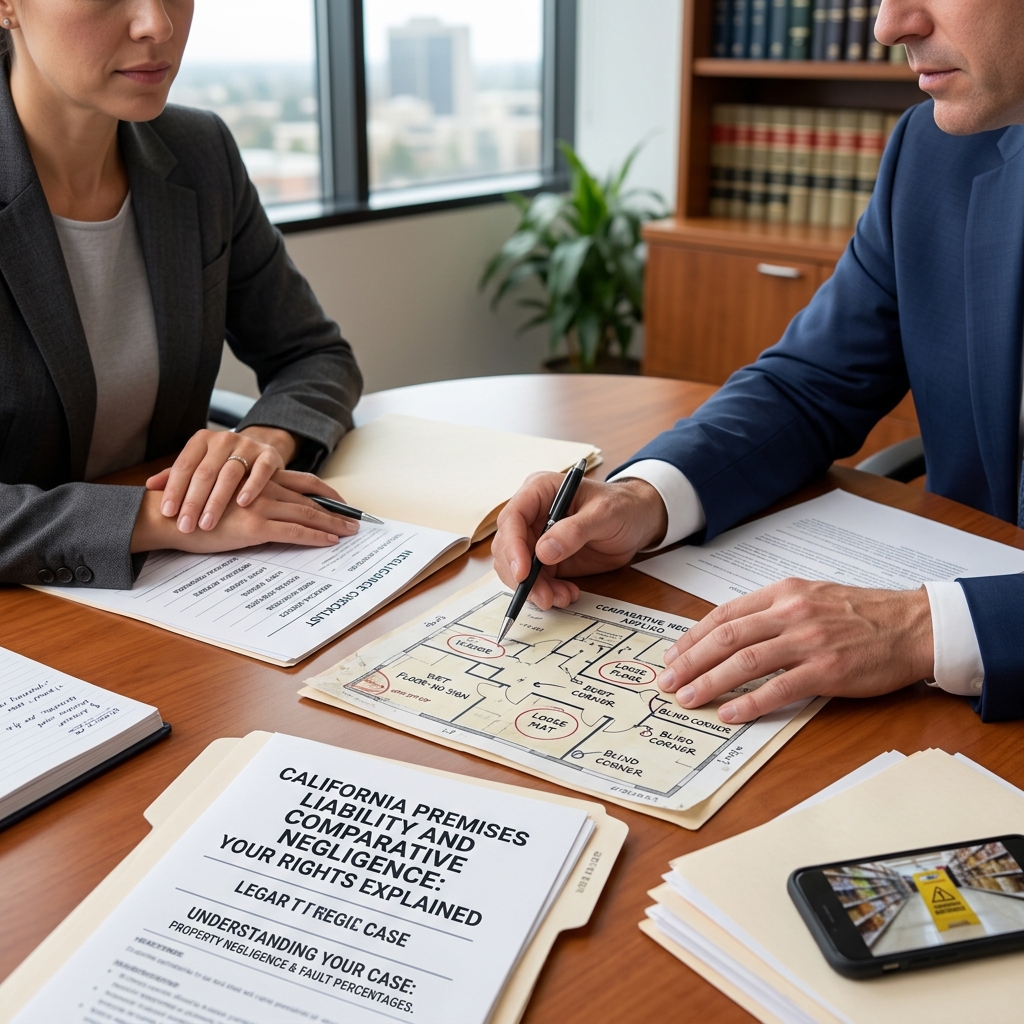
How California’s Comparative Negligence Rules Apply to Premises Cases
In premises liability cases, comparative negligence often becomes a central battleground. A property owner’s insurance company will frequently claim that you were not paying attention, were rushing, wore inappropriate footwear, or ignored warning signs. These arguments attempt to shift blame away from the property owner’s negligence.
California courts examine whether your conduct was reasonable under the circumstances. If you slipped on a recently spilled liquid with no wet floor sign in a grocery store, your distraction is less relevant than if you ignored a clearly marked, obvious wet floor warning placed hours earlier.
Key factors courts consider:
- How visible or obvious was the hazard?
- Did the property owner provide warnings?
- How much time did the property owner have to discover and address the danger?
- Was your conduct reasonable for that type of property and situation?
- Did the property owner’s negligence make the harm more likely?
We document these factors thoroughly because they directly impact how a jury weighs your conduct against the property owner’s. A mother distracted by her children at a playground is operating more reasonably than someone ignoring a large, bright warning sign. Context matters, and we ensure that context reaches the decision-maker.
Common Premises Liability Scenarios and Negligence Questions
Different premises scenarios raise different comparative negligence issues. Let’s walk through real-world examples.
Slip-and-Fall at a Retail Store
You slip on a puddle near the entrance. The property owner claims you should have been more careful or seen the wet floor. We investigate: When was the floor last cleaned? Were there warning signs? How long had the water been there? If the hazard existed for hours without notice or care, your momentary inattention becomes secondary to the owner’s neglect.
Trip on Broken Pavement at a Restaurant
You trip on a cracked sidewalk outside a restaurant. The owner argues the crack was obvious. We examine: How severe was the crack? Was it marked? Had customers previously reported the hazard? If the owner knew or should have known and did nothing, comparative negligence leans heavily in your favor.
Fall at a Rental Property
You fall down stairs due to a missing handrail. The landlord claims you were careless. We review: Building codes require handrails for safety. Did the landlord fail to install required safety features? Your caution cannot overcome a landlord’s failure to meet legal safety standards.
Injury from Inadequate Security
You are assaulted in a parking garage due to poor lighting and no security measures. The property owner suggests you should have stayed in your car. We analyze: Was the assault foreseeable given the location and prior incidents? Did the owner’s negligence make you vulnerable? Your reasonable use of the property matters more than hindsight criticism.
Each scenario has different evidence profiles and different ways comparative negligence plays out. We assess your specific situation with this nuance in mind.
Evidence We Investigate to Prove Liability and Negligence
Winning a premises liability case despite comparative negligence claims requires thorough evidence collection and presentation. We investigate systematically to document the property owner’s breach of duty while supporting your reasonable conduct.

Evidence we pursue includes:
- Security and surveillance footage: Traffic camera footage, doorbell cameras, and security recordings often capture the exact moment of injury and the hazard’s visibility or absence of warnings.
- Photographs and site inspection: We document the hazard, warning signage, lighting, and physical layout at the time of injury and afterward.
- Maintenance records: Property owner records show whether inspections were conducted, repairs made, or complaints ignored.
- Witness statements: Customers, staff, or bystanders often saw the hazard or lack of warnings before your injury.
- Medical documentation: Your injury records establish causation and damages.
- Prior incidents: If others were injured similarly, it shows the owner knew or should have known about the danger.
- Expert analysis: Safety experts and engineers can testify about industry standards, foreseeability, and the property owner’s breach.
- Building code compliance: We verify whether the property met legal safety requirements.
We pursue full and fair compensation by building a compelling, evidence-based narrative that shows the property owner’s responsibility. Strong evidence also discourages unreasonable comparative negligence arguments.
How Comparative Negligence Impacts Your Compensation
Comparative negligence directly affects your final recovery amount. If a jury awards you $100,000 in damages but finds you 20% at fault, your recovery is $80,000. At 40% fault, you receive $60,000. Understanding this impact helps you evaluate settlement offers and decide whether litigation is necessary.
Insurance companies often inflame comparative negligence claims during settlement negotiations. They may offer a low settlement based on exaggerated allegations of your carelessness. This is a negotiating tactic, not the law.
We counter by presenting the evidence methodically. A clear timeline showing the property owner’s failure to inspect or warn undermines claims about your carelessness. Witness statements and surveillance footage showing a non-obvious hazard strengthen your position. Medical evidence linking your reasonable conduct to the injury reinforces causation.
Comparative negligence also influences litigation strategy. If evidence suggests you bear some responsibility, we may focus on minimizing that percentage through expert testimony and credible narrative. If the hazard was truly obvious or your conduct genuinely careless, we may negotiate a settlement rather than risk an unfavorable jury verdict. Transparency and realistic assessment guide these decisions.
Your final compensation depends on both the strength of your case and the damages you suffered. Medical bills, lost wages, pain and suffering, and long-term effects all factor into the total. We quantify these carefully and pursue every dollar you are entitled to under California law.
Statute of Limitations: Why Time Matters in Premises Cases
Time is limited — act now. California’s statute of limitations gives you two years from the date of injury to file a premises liability lawsuit. This deadline is strict and applies regardless of circumstances.
Missing the statute of limitations bar closes your case entirely. You cannot recover compensation, and the property owner faces no legal consequence for their negligence. The law prioritizes finality and fair notice, which is why the deadline is absolute.
Beyond the filing deadline, time also affects evidence preservation. Surveillance footage is recorded over, property is repaired or altered, witnesses move away or forget details, and memories fade. Early investigation preserves critical evidence and strengthens your case immensely.
We recommend you contact us immediately after injury. Initial consultation is free, and we can explain your specific timeline and the evidence we need to preserve. Preserve any evidence and get medical care immediately, including photographs of the scene and hazard, contact information for witnesses, and thorough medical documentation. Early action protects your rights and your claim.
Why Professional Legal Guidance Protects Your Rights
Navigating premises liability and comparative negligence without legal guidance is risky. Insurance adjusters are trained to minimize liability and maximize the company’s profit. They will use comparative negligence arguments aggressively, even when unfounded. You have rights after an accident, but protecting those rights requires knowledge of California law and negotiation skill.
Professional representation changes the dynamic. We handle all communication with insurance companies, preventing you from making statements that might be misinterpreted. We investigate thoroughly, building evidence before negotiating or litigating. We quantify your damages accurately, ensuring nothing is overlooked.
Legal representation also provides emotional relief. Injury recovery is demanding enough without managing legal details, correspondence, and negotiation. We handle that burden, allowing you to focus on healing. Our compassionate, authoritative approach ensures you understand each step and feel supported throughout.
No fee unless we recover for you means your financial risk is zero. We advance costs for investigation, expert witnesses, and litigation, recovering our fee only when you win. This aligns our interests with yours completely.
How We Help You Navigate Comparative Negligence Claims
At Weinberger Law Firm, we approach comparative negligence claims with systematic precision. We begin by analyzing your conduct objectively, identifying potential weaknesses and strengths in how a jury might view your actions.
Our investigation process includes:
- Thorough case evaluation: We assess the property owner’s duty, their breach, the hazard’s visibility, and your reasonable conduct given the circumstances.
- Evidence investigation: We document, preserve, and present the facts through photographs, surveillance footage, witness statements, and expert analysis.
- Comparative negligence strategy: We develop a narrative that contextualizes your conduct and emphasizes the property owner’s preventable breach.
- Expert coordination: We engage safety experts, engineers, or medical professionals who testify about industry standards and foreseeability.
- Negotiation and litigation: We pursue full and fair compensation through skilled negotiation or courtroom advocacy.
Throughout this process, we communicate clearly and responsively, keeping you informed and involved. You understand your case, the law, and your options at every stage.
Contact Weinberger Law Firm for Your Free Consultation
If you were injured on someone else’s property in California, we are here to help. Our expertise in premises liability and California’s comparative negligence law ensures your rights are protected and your claim is pursued aggressively.
Contact us today for a free consultation. We will review your case, explain your rights, and outline a path forward. Time is limited — act now to preserve evidence and meet the statute of limitations deadline. We are ready to fight for the compensation you deserve.
Call Weinberger Law Firm or visit our website to schedule your free consultation. No fee unless we recover for you.
For further reading: Injury claim timeline.).
Contact us today for a Free Case Consultation!
Frequently Asked Questions (FAQ)
What rights do I have if I’m injured on someone else’s property in California?
You have the right to hold property owners accountable when their negligence causes your injury. We help you understand that California law requires property owners to maintain safe conditions and warn visitors of known hazards. You can pursue compensation for your medical bills, lost wages, and pain and suffering if we can prove the property owner failed in their duty of care.
How does comparative negligence affect my compensation if I was partially at fault for my injury?
Under California’s comparative negligence rule, we can still recover compensation even if you share some responsibility for the accident. However, any compensation we recover for you will be reduced by your percentage of fault. For example, if you’re 20% responsible and your damages total $100,000, we would pursue $80,000. We investigate all available evidence to minimize your assigned fault and maximize what you receive.
Why is the statute of limitations critical for my premises liability claim?
You have a limited time window to file your claim, and missing this deadline means you lose your right to pursue compensation entirely. In California, you typically have two years from your injury date to file a premises liability lawsuit. We urge you to contact us immediately so we can preserve evidence, gather witness statements, and protect your claim before time runs out.