
Table of Contents
- Why Negotiation Matters in Motorcycle Accident Cases
- The Hidden Costs Insurance Companies Count On
- How We Investigate and Build Your Claim's Value
- Understanding Your Rights Under California Law
- Documenting Evidence That Strengthens Your Position
- Strategic Communication with Insurance Adjusters
- When to Hold Firm and Reject Low Offers
- Calculating Full Compensation for All Damages
- The Statute of Limitations and Why Time Matters
- Litigation as Your Negotiation Leverage
- Your Free Consultation and Next Steps
- Frequently Asked Questions (FAQ)
Why Negotiation Matters in Motorcycle Accident Cases
If you were injured in a motorcycle accident, you have rights. Negotiating with insurance companies is rarely straightforward, and adjusters are trained to minimize what they pay. We understand the financial and emotional weight you’re carrying, and we want you to know that skillful negotiation can mean the difference between a settlement that barely covers your bills and one that fully compensates you for your losses.
Motorcycle accidents often result in severe injuries because riders lack the protective shell of a vehicle. Your claim’s value extends far beyond immediate medical costs. Insurance companies know this, and they also know that most injured people lack the time, knowledge, and leverage to push back effectively.
Strong negotiation isn’t about being aggressive or confrontational. It’s about presenting your case so clearly and persuasively that the insurance company recognizes the real cost of disputing your claim. When we negotiate on your behalf, we’re demonstrating that you have documentation, evidence, and the willingness to litigate if necessary.
The outcome matters tremendously. A poorly negotiated settlement can leave you struggling to cover ongoing physical therapy, vehicle repair costs, and months of lost income. Effective negotiation secures compensation that reflects your actual damages and your pain and suffering. Your next step: contact us to discuss how we approach settlement talks in your specific situation.
The Hidden Costs Insurance Companies Count On
Insurance adjusters operate under assumptions about injured claimants. They expect you to be unfamiliar with claim valuation, emotionally vulnerable, and eager to settle quickly to pay medical bills. They also count on you not having legal representation, which significantly weakens your negotiating position.
Many adjusters make a first offer that’s deliberately low, hoping you’ll accept it without understanding what your claim is truly worth. They calculate that a percentage of injured people will accept 30-50% of fair market value simply because they don’t know better or need money immediately.
What they don’t count on is a claimant armed with solid evidence and a skilled attorney. When we represent you, the dynamics shift. The insurance company can no longer rely on your uncertainty. We investigate all available evidence, document damages thoroughly, and present a settlement demand backed by facts. This transforms the negotiation from a one-sided conversation into a genuine discussion between professionals who respect each other’s leverage.
How We Investigate and Build Your Claim’s Value
Our investigation begins immediately after you contact us. We secure police reports, obtain traffic camera footage, and identify eyewitnesses. We also gather your medical records, treatment notes, and bills to establish the full scope of your injuries.
We work with medical experts to understand the long-term impact of your injuries. Some motorcycle accident victims face permanent scarring, reduced range of motion, or chronic pain that affects their earning capacity for years. Insurance companies may try to dismiss these as minor concerns; our investigation documents them comprehensively.
We also reconstruct the accident itself. We review the other driver’s insurance company’s investigation, check traffic laws and road conditions, and determine who bears legal responsibility. This reconstruction is crucial because it establishes liability clearly, which strengthens your negotiating position enormously.
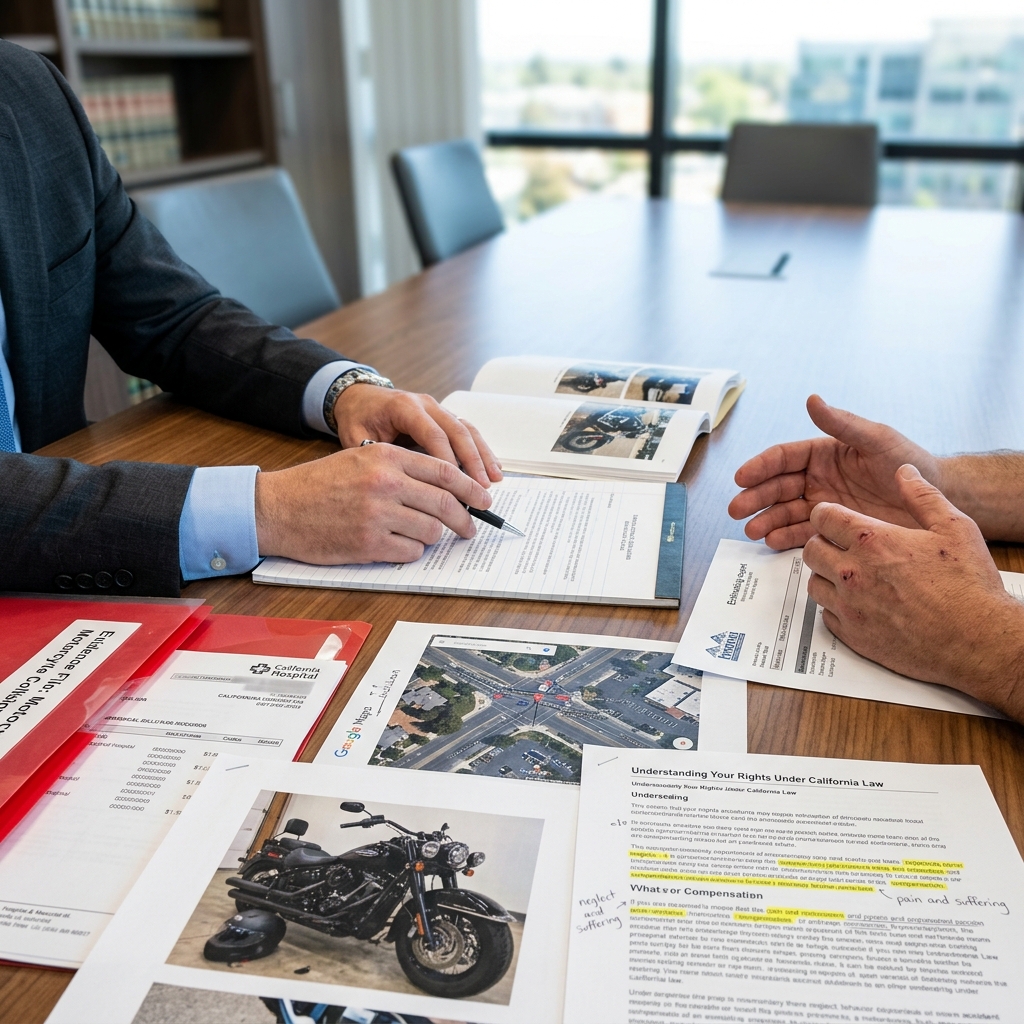
Evidence collection also includes documenting your pre-accident life: your income, your job responsibilities, and your everyday activities. When we show how the accident disrupted all of this, the insurance company can no longer pretend the impact was minimal. Your action: preserve any evidence you have, including photos of the accident scene, vehicle damage, and your injuries.
Understanding Your Rights Under California Law
California law gives you the right to pursue compensation for all damages caused by another’s negligence. This includes economic damages (medical bills, lost wages, vehicle repair) and non-economic damages (pain and suffering, emotional distress, loss of enjoyment of life).
The law also recognizes that motorcycle accidents are particularly serious. Juries in California understand the vulnerability of motorcycle riders, and this understanding influences settlement negotiations. When an insurance adjuster knows your case could go to trial before a jury sympathetic to motorcycle riders, they become more motivated to settle fairly.
You also have the right to refuse a settlement offer at any time. If an adjuster presents an offer that doesn’t reflect your actual losses, you can reject it. This right is powerful because it gives you genuine leverage during negotiations. The insurance company knows you’re willing to litigate if they don’t meet you fairly.
California’s pure comparative negligence rule also works in your favor if the accident involved some degree of shared fault. Even if you were partially at fault, you can still recover damages minus your percentage of fault. This means settlements don’t require you to be 100% blameless.
Documenting Evidence That Strengthens Your Position
Documentation is your foundation in any negotiation. The clearest, most organized evidence wins credibility and persuades adjusters that you’re serious and prepared.
Start with the accident scene itself. Photos of vehicle damage, road conditions, traffic signals, and weather create an objective record. Traffic camera footage is exceptionally powerful because it removes opinion from the equation. If you can obtain dashcam footage from your motorcycle or a nearby vehicle, secure it immediately and share it with us.
Medical documentation carries enormous weight. Keep every medical record, prescription, receipt for pain medication, and note about your treatment plan. Document your symptoms, your recovery timeline, and any setbacks. If you’re unable to work, get your employer to confirm lost wages in writing. If you need ongoing therapy or equipment, gather estimates and medical advice supporting these needs.
Witness statements are valuable because they provide independent corroboration of what happened. We will contact witnesses and obtain formal statements that can be used during settlement negotiations or litigation.
Personal documentation matters too. Keep a journal describing your pain levels, physical limitations, and how the accident has affected your daily life. Insurance companies understand that damages aren’t just medical bills; they include your reduced quality of life. Your journal provides concrete evidence of this impact.
Strategic Communication with Insurance Adjusters
How you communicate with insurance adjusters significantly influences the negotiation outcome. We handle all direct communication with insurance companies on your behalf, which protects you and strengthens your position.
Never accept the first offer or agree to anything without legal review. Adjusters are trained to create urgency and pressure, suggesting that your “unique” offer expires soon or that the company is being generous. These are negotiating tactics, not facts. We evaluate every offer in the context of your full damages and your case’s strength.
We also avoid making emotional appeals. While your suffering is real and deserves compensation, adjusters respond to evidence and legal arguments, not emotional stories. Our communication is professional, factual, and focused on the law and the evidence. This approach commands respect and demonstrates that you have professional representation.
We also avoid admitting fault or providing statements that could be misused later. Insurance companies record calls and document everything. Every word can become evidence. By handling communication professionally, we prevent missteps that could undermine your negotiating position.
When to Hold Firm and Reject Low Offers

Not every offer deserves acceptance. Part of our role is helping you recognize when an offer falls short and when walking away strengthens your position.
We reject low offers when the evidence supports a higher valuation. If our investigation shows clear liability, significant medical expenses, and lasting injury, an offer that covers only medical bills and minimal pain and suffering is unacceptable. Insurance companies make low offers partly to test whether you’ll accept them. Rejecting a low offer signals that you’re serious and prepared to litigate.
Holding firm is easier when you understand your case’s value. We provide you with a detailed valuation that explains why your claim is worth what we believe it is. This knowledge gives you confidence to reject inadequate offers and to understand why we recommend waiting for a better settlement.
There’s also a strategic element to rejection. When you reject an offer, the insurance company must recalculate its risk. They may increase their offer in the next round, recognizing that you’re not going away quietly. Sometimes, holding firm for a few weeks or months results in a significantly better settlement than accepting an early lowball offer.
Calculating Full Compensation for All Damages
Your compensation should cover every financial and non-financial loss caused by the accident. Insurance companies sometimes try to separate damages into categories to make certain amounts seem high and negotiable.
Economic damages are straightforward: medical bills, lost wages, vehicle repair, medical equipment, and future medical care. We gather itemized bills and receipts to establish these precisely. If your injuries require ongoing treatment, we obtain medical evidence supporting the cost and necessity of future care.
Non-economic damages are more complex but equally important. Pain and suffering compensates you for the physical and emotional distress you’ve endured. Lost earning capacity accounts for reduced ability to earn in the future if your injuries are permanent. Loss of enjoyment of life recognizes that you can no longer do activities you loved, like motorcycling or playing sports.
We calculate these damages using established formulas and comparable case outcomes. We research similar motorcycle accident settlements in California to show what juries and insurance companies typically award for injuries like yours. This data-driven approach removes guesswork and gives you confidence in the settlement demands we present.
We also anticipate future costs. If your injuries require ongoing physical therapy, we factor that into the calculation. If scarring requires future cosmetic procedures, we include those costs. Comprehensive damage calculation is what separates a fair settlement from an inadequate one.
The Statute of Limitations and Why Time Matters
California law imposes strict deadlines for filing personal injury claims. The statute of limitations for most personal injury cases is two years from the date of injury. This means you have two years to file a lawsuit if settlement negotiations don’t succeed.
Two years might sound like a long time, but it passes quickly, especially when you’re recovering from injuries and managing medical care. Evidence also degrades over time. Witnesses’ memories fade, traffic camera footage gets deleted, and the accident scene changes. Early investigation preserves the strongest evidence.
More practically, insurance companies negotiate differently when a deadline approaches. Early in the two-year window, they may lowball you because they know they have time. As the statute of limitations approaches, their settlement offers typically improve because the cost of litigation becomes more real.
We manage these deadlines carefully for you. We investigate early, negotiate actively, and file lawsuits promptly if necessary. You won’t miss a deadline on our watch. Time is limited, so acting now to secure legal representation protects your rights and strengthens your negotiating position.
Litigation as Your Negotiation Leverage
The credible threat of litigation is one of the most powerful negotiation tools available. Insurance companies know that if your case goes to trial, they face a jury of California residents who understand motorcycle accidents and the vulnerability of riders.

We prepare every case as if it will go to trial. This means we conduct thorough discovery, depose witnesses, hire expert witnesses if necessary, and develop a compelling trial strategy. Insurance adjusters recognize this preparation, and it influences their settlement thinking significantly.
A jury trial is expensive and unpredictable for insurance companies. They know that a sympathetic jury might award you more than their current settlement offer. This risk motivates them to settle fairly before trial becomes inevitable. When we demonstrate that we’re ready to litigate and confident in our case, settlement negotiations often accelerate and improve dramatically.
We also understand when litigation makes sense. If an insurance company refuses to negotiate fairly despite strong evidence, filing a lawsuit may be necessary. We’ll advise you on whether settlement or litigation better serves your interests, but we ensure you’re never trapped in endless negotiation with an unreasonable adjuster.
Your Free Consultation and Next Steps
If you’ve been injured in a motorcycle accident, the first step is understanding your legal rights and your claim’s potential value. We offer a free consultation where we listen to your story, review the facts, and explain exactly how we approach your case.
During the consultation, we assess liability, identify the evidence we need to gather, and provide a preliminary valuation of your claim. We also explain the negotiation process and what to expect. This gives you the information you need to decide whether legal representation makes sense for your situation.
We work on a no-fee basis unless we recover compensation for you. This means you have nothing to lose by consulting with us, and our financial interest aligns with yours: we succeed when you receive full and fair compensation.
Document, preserve, and present the facts. Contact us today for your free consultation and learn how we pursue full and fair compensation for motorcycle accident victims in California. You have rights after an accident, and we’re here to help you secure them.
For further reading: Filing a motorcycle claim.
Contact us today for a Free Case Consultation!
Frequently Asked Questions (FAQ)
How do we approach negotiating motorcycle accident settlements?
We investigate all available evidence to build a strong foundation for your claim, then present a comprehensive demand to the insurance company backed by documentation of your medical bills, lost wages, and other damages. Our team negotiates strategically with adjusters, knowing exactly when to push back against low offers and when litigation becomes necessary to maximize your compensation. We pursue full and fair compensation for everything you’ve suffered, not just what insurers initially offer.
What is the statute of limitations for filing a motorcycle accident claim in California?
We understand that time is limited when pursuing your claim. California law sets strict filing deadlines, and the longer you wait, the more difficult it becomes to preserve evidence and support your case. We recommend contacting us immediately after your accident so we can protect your rights and ensure all deadlines are met.
What damages can we recover beyond medical bills and lost wages?
We calculate compensation for all damages you’ve experienced, including pain and suffering, emotional distress, permanent scarring or disability, and future medical care needs related to your injury. Insurance companies often underestimate these broader impacts, which is why we document and present the full scope of your losses to secure fair settlement amounts.