
Table of Contents
- When a Bus Accident Changes Everything: Understanding Your Situation
- Why Public Transit Cases Differ from Standard Personal Injury Claims
- California's Strict Deadlines for Filing Transit Accident Claims
- Preserving Evidence After a Public Transit Accident
- How We Navigate Governmental Immunity and Special Rules
- Building Your Case Against Transit Authorities
- What Compensation You Can Recover for Your Injuries
- Common Obstacles in Public Transit Claims and How We Overcome Them
- Why Acting Quickly Protects Your Legal Rights
- Our Approach to Maximizing Your Transit Accident Settlement
- Contact Weinberger Law Firm for Your Free Consultation
- Frequently Asked Questions (FAQ)
When a Bus Accident Changes Everything: Understanding Your Situation
If you were injured on a public transit bus, light rail, or similar vehicle in California, you’re likely facing medical bills, lost wages, and emotional strain all at once. Public transit accidents happen more often than many people realize, and they leave victims with serious injuries and real financial consequences.
You have rights after an accident. The transit agency and its insurance carrier have a legal obligation to respond fairly to your claim. The challenge is knowing how to pursue compensation when the rules are different from typical car accident cases.
An injury on public transit doesn’t have to derail your recovery. With the right legal guidance, you can understand your options, meet all critical deadlines, and pursue the full compensation you deserve. We help injured riders navigate this process from start to finish.
Why Public Transit Cases Differ from Standard Personal Injury Claims
Public transit claims involve unique legal complexities that don’t apply to ordinary personal injury cases. Transit agencies are government entities, which means they operate under special immunity protections and procedural rules that can work against injured riders if you don’t know how to handle them.
For example, you cannot sue a public transit agency the same way you’d sue a private company or individual driver. You must follow a formal administrative claim process first, submitting a written notice of claim to the transit agency before filing a lawsuit. This is a mandatory step with tight deadlines that many injured people miss entirely.
Transit agencies also have different insurance coverage and settlement practices than private defendants. They employ specialized defense attorneys familiar with these cases, and they understand how to negotiate within governmental frameworks. We investigate all available evidence and apply expertise specific to transit liability to level the playing field.
California’s Strict Deadlines for Filing Transit Accident Claims
Time is limited — act now. California law sets rigid filing deadlines that vary depending on whether the transit agency is a city, county, or special district. These deadlines are much shorter than the statute of limitations (the filing deadline) for regular personal injury cases.
Most public transit agencies require you to file a notice of claim within 100 days of your accident. Some agencies have 90-day windows or different rules, and missing this deadline can eliminate your right to sue entirely. There is no grace period and no second chance.
After filing your notice of claim, the agency has 45 days to respond. If they deny your claim or fail to respond, you then have six months to file a lawsuit. This entire sequence must unfold perfectly, or your case may be barred forever.
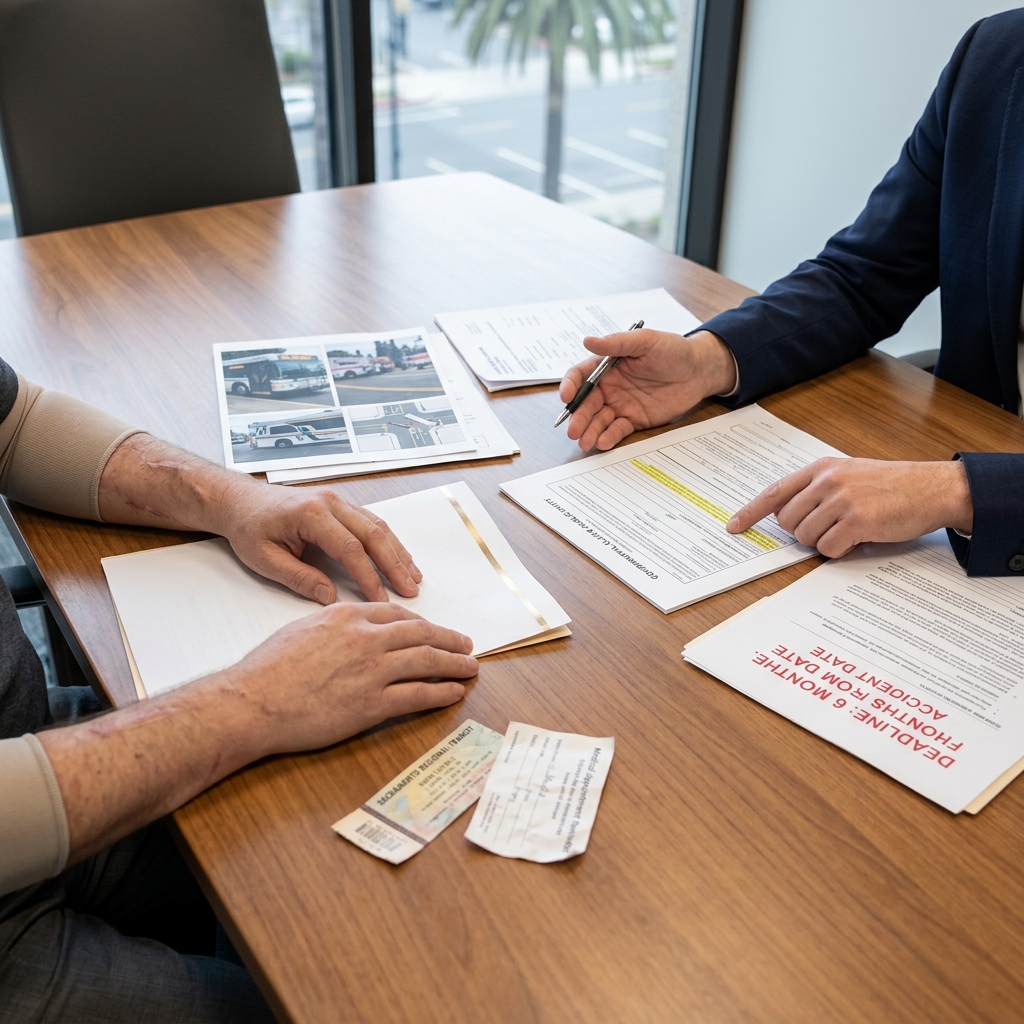
We track every deadline and ensure your paperwork is filed correctly and on time. Statute of limitations complications are serious — we don’t let procedural technicalities cost you your claim.
Preserving Evidence After a Public Transit Accident
Evidence preservation is critical in transit cases because transit agencies control crucial documentation that can disappear or be altered. Immediately after your accident, preserve any evidence and get medical care.
Document the accident scene with photographs or video if you’re able. Capture the bus, surrounding area, road conditions, and any visible damage. Collect contact information from witnesses who saw what happened, and request their written statements if possible.
The transit agency maintains video surveillance footage from onboard cameras, which often provides the most compelling evidence of what occurred. This footage must be preserved immediately — we file preservation notices and demand this recording before it can be deleted or overwritten. Traffic camera footage from nearby intersections can also be decisive.
Preserve all medical records, treatment notes, and receipts related to your injuries. Keep records of lost wages, missed work time, and any impact on your daily activities. We investigate all available evidence thoroughly to build your strongest case.
How We Navigate Governmental Immunity and Special Rules
Governmental immunity is a major protection that shields public transit agencies from certain types of liability. However, this immunity is not absolute, and we know how to identify the specific exceptions that apply to your situation.
Transit agencies are liable when their employees were negligent, including drivers who operated vehicles unsafely, maintenance personnel who failed to repair defects, or supervisors who created dangerous conditions. They are also liable for premises liability — injuries caused by unsafe conditions on buses or at transit stations.
We analyze the accident against California’s governmental immunity statutes to find the legal pathway forward. For instance, if the driver failed to maintain control of the bus or didn’t operate it safely, that negligence pierces immunity. If a passenger was injured due to a missing handrail or inadequate warning, that premise defect may support liability.
Our understanding of these legal nuances allows us to overcome immunity arguments and pursue full and fair compensation even when a government entity is involved.
Building Your Case Against Transit Authorities
We build transit accident cases through systematic evidence collection and strategic investigation. We obtain police reports, transit agency records, driver logs, and maintenance histories that reveal how the accident happened and who bears responsibility.
Expert analysis strengthens our cases considerably. We work with accident reconstruction specialists who can demonstrate how the bus was operated negligently, and with medical experts who establish the severity and permanence of your injuries. These professional opinions carry significant weight during settlement negotiations and at trial.
We also investigate the transit agency’s safety history. Has this route had previous accidents? Were there known hazards the agency failed to address? Did the driver have a history of safety violations? This broader context helps prove negligence and often supports higher compensation.

What Compensation You Can Recover for Your Injuries
You can recover compensation for multiple categories of loss resulting from your transit accident. Medical bills and lost wages are foundational — we pursue reimbursement for all treatment expenses, hospital stays, surgery, rehabilitation, and ongoing medical care.
Lost income and diminished earning capacity are recoverable when injuries prevent you from working or force you into lower-wage positions. If your injuries are permanent, we calculate the lifetime impact on your earning potential.
You also have the right to recover for pain and suffering, emotional distress, and reduced quality of life. This non-economic compensation acknowledges the real human cost of serious injuries — chronic pain, scarring, mobility loss, or psychological trauma that persists long after medical treatment ends.
In cases of severe negligence, we may pursue punitive damages designed to penalize the transit agency and deter future unsafe conduct. We pursue full and fair compensation across all available categories.
Common Obstacles in Public Transit Claims and How We Overcome Them
Transit agencies frequently deny claims by arguing that the injured rider was partially responsible for the accident. They may claim you weren’t holding a handrail, didn’t brace yourself properly, or contributed somehow to your own injury. California’s comparative negligence rules can reduce your recovery if you bear some fault, but we challenge these arguments aggressively.
Another common defense involves disputes over the severity of injuries. Insurance adjusters often minimize what happened, arguing your injuries are minor or pre-existing. We counter with thorough medical documentation and expert testimony that establishes the true extent of harm.
Procedural mistakes also trip up unrepresented injured people. Missing a deadline, filing paperwork with the wrong agency, or neglecting required notices can destroy a valid claim. We navigate these procedural requirements flawlessly to protect your rights.
Why Acting Quickly Protects Your Legal Rights
Acting quickly does more than meet deadlines — it maximizes the quality of your evidence and strengthens your negotiating position. Witness memories fade, surveillance footage gets deleted, and accident scenes change. The sooner we begin our investigation, the more evidence we can preserve and secure.
Early action also signals to the transit agency that you’re serious about your claim and willing to litigate if necessary. This credibility supports our settlement negotiations and often produces better offers.
Medical documentation is also fresher and more credible when treatment begins immediately after the accident. Delays between the injury and medical care create doubt about causation that weakens your claim considerably.
Our Approach to Maximizing Your Transit Accident Settlement
We treat your case as the individual matter it is. We don’t use cookie-cutter settlement strategies or rush you toward a quick deal that undervalues your injuries. Instead, we conduct thorough case evaluation, develop a litigation-ready file, and negotiate from a position of genuine strength.

Our strategy includes multiple parallel efforts: investigating the accident thoroughly, documenting your injuries and damages comprehensively, understanding the transit agency’s insurance coverage and settlement authority, and preparing to litigate if the agency won’t offer fair compensation.
We communicate clearly and keep you informed at every step. You’ll understand your options, the strength of your case, and the realistic range of outcomes before any decision is made. We pursue maximum compensation for you, but the settlement choice is always yours.
Contact Weinberger Law Firm for Your Free Consultation
You don’t have to navigate a public transit claim alone, and you shouldn’t delay seeking advice. Contact us for a free consultation where we’ll review your accident, discuss your injuries and damages, and explain your legal options in clear, practical terms.
No fee unless we recover for you. Our contingency fee arrangement means you pay nothing upfront and no attorney fees if we don’t secure compensation on your behalf.
Call us today or visit our website to schedule your free case review. We understand this is a difficult time, and we’re ready to help you move forward.
For further reading: California personal injury guide.
Contact us today for a Free Case Consultation!
Frequently Asked Questions (FAQ)
What deadlines do I need to know about for filing a public transit accident claim in California?
You have rights after a public transit accident, but California’s statute of limitations gives you strict deadlines to act. Most personal injury claims have two years from the injury date to file a lawsuit, but claims against government transit agencies require a government claim notice within six months. We strongly recommend contacting us immediately because missing these deadlines will eliminate your ability to pursue compensation entirely.
How is suing a public transit agency different from suing a private party?
Public transit agencies like Sacramento Regional Transit operate under governmental immunity, which means they have special protections and different legal requirements than private businesses. We navigate these complex rules by filing proper government claims, identifying viable legal pathways, and building cases that hold transit authorities accountable despite their special status. Our experience with transit cases means we understand exactly what evidence and documentation we need to overcome these barriers.
What compensation can I recover if I’m injured on public transit?
We pursue full and fair compensation for your medical bills, lost wages, pain and suffering, and other damages caused by the transit agency’s negligence. The amount depends on your specific injuries, treatment needs, and how the accident has impacted your life. Contact us for a free consultation so we can evaluate your case and explain what compensation potential exists for your situation.