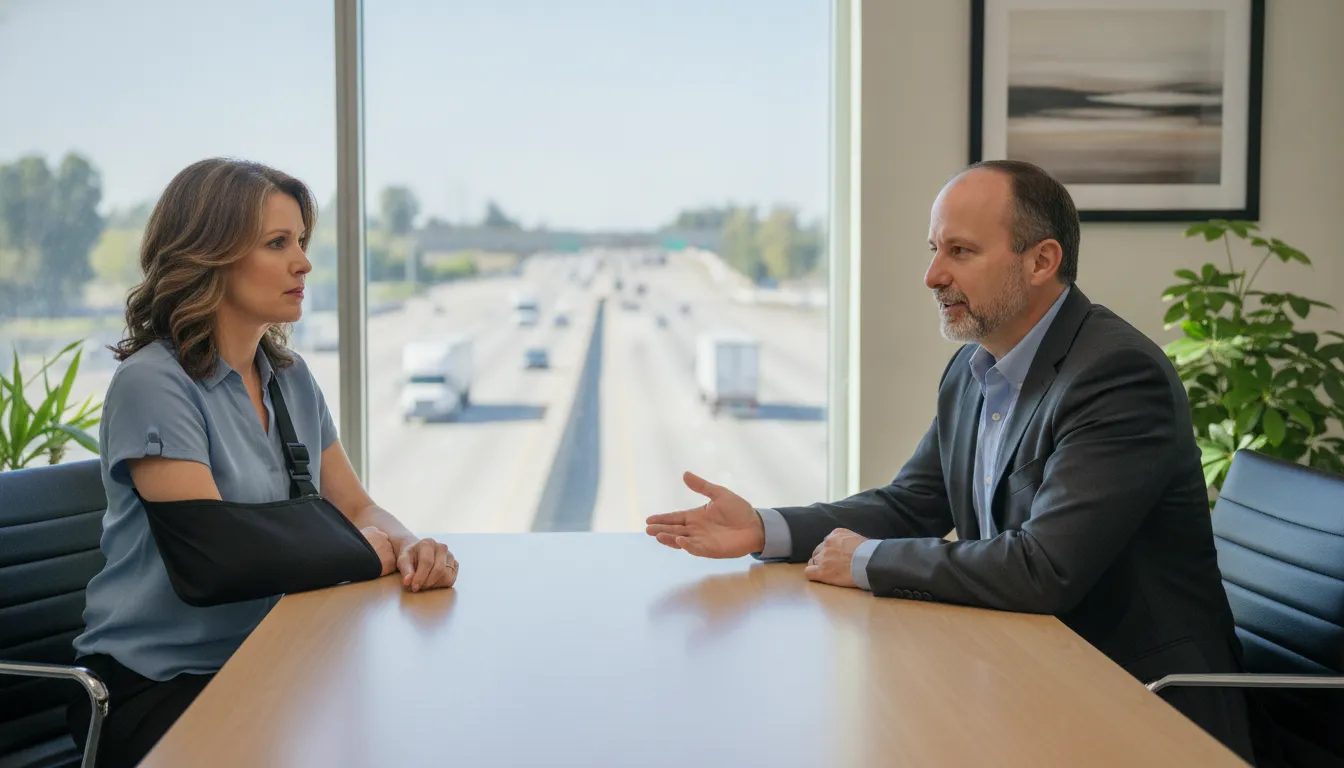
A commercial truck crash can leave you injured while several businesses point responsibility in different directions. The name on the truck may not identify every company involved in the trip. The driver, motor carrier, owner, broker, loader, maintenance provider, or another business may hold important evidence.
Call Weinberger Law Firm at 916-357-6767 for a free consultation.
Trucking company liability after a California accident depends on what caused the collision. It also depends on who controlled the work and which parties had a legal duty connected to the harm. California injury victims in Roseville, Sacramento, Folsom, and throughout the state should preserve photos, reports, medical records, and communications promptly.
For broader background on vehicle claims, review Car, Truck, and Motorcycle Accident Claims in California. This article focuses on the narrower question of who may be responsible when a commercial truck crash involves several companies.
Can You Sue a Trucking Company After a California Truck Accident?
You may be able to pursue a claim against a trucking company when its driver caused a crash while working or when the company’s own conduct contributed to the injuries. The evidence may support claims involving negligent driving, hiring, training, supervision, maintenance, scheduling, or other business decisions.
A truck’s involvement does not automatically make its carrier liable. A liability analysis must connect a particular party’s conduct or legal responsibility to the collision and the resulting harm. More than one defendant may be appropriate, while a company associated with the shipment may ultimately have no liability.
California’s general negligence statute, California Civil Code section 1714, states the general duty to use ordinary care and addresses responsibility for a person’s acts and omissions. Applying that rule to a commercial truck crash requires a fact-specific review. Federal motor carrier safety requirements may provide additional context, but a safety-rule issue alone does not prove that a particular company caused a particular injury.
Potential losses can include emergency care, hospital treatment, rehabilitation, and future medical needs. They can also include lost wages, reduced earning ability, property damage, physical pain, emotional distress, and loss of enjoyment of life. Wrongful death claims may involve separate damages and parties. The available categories depend on the facts, proof, and type of claim.
| Potential party | Questions the investigation may ask |
|---|---|
| Driver | What driving decision or violation contributed to the crash? |
| Motor carrier | Who hired, trained, dispatched, supervised, and maintained the operation? |
| Vehicle owner or lessor | Who owned, inspected, repaired, or controlled the truck or trailer? |
| Broker, shipper, or loader | Who arranged, loaded, weighed, or secured the cargo? |
Prompt investigation matters because different companies may hold dispatch records, electronic data, inspection documents, video, contracts, and insurance information. A person injured in a crash may not know which entity has each record. A lawyer can help send preservation requests and evaluate the parties before a claim is filed.
What Does Trucking Company Liability After a California Accident Mean?
Trucking company liability means a carrier may be legally responsible for a person’s injuries because of its relationship with the driver or because the company made its own negligent decision. It does not mean every carrier is liable whenever one of its trucks is involved. Responsibility turns on evidence, duties, causation, and the parties’ actual roles.
Two different theories often require separate analysis. Vicarious liability focuses on whether an employee acted within the scope of work. Direct negligence focuses on what the company itself did or failed to do, such as hiring an unsafe driver, ignoring known problems, or failing to maintain equipment.
Respondeat superior and the driver’s work
Respondeat superior is a legal principle that may make an employer responsible for an employee’s negligent conduct when the employee was acting within the scope of employment. If a driver causes a collision while carrying out assigned work, the employer may be included in the claim along with the driver. Assigned work can include making a delivery or following a dispatch route.
The employment relationship and the driver’s activity at the time of the crash are important. Records may show who assigned the trip, who paid the driver, whether the driver was traveling for work. And whether the conduct occurred during a personal departure from the job. The company may dispute these facts, so the analysis cannot be based only on a logo or a driver’s statement.
When the company may have its own negligence
A company can also face a direct negligence theory based on its own decisions. The investigation may examine whether the carrier hired or retained a driver without reviewing qualifications. Failed to provide appropriate training, ignored safety complaints, allowed unsafe scheduling, or neglected inspection and repair responsibilities.
- Driver qualification and safety-history materials.
- Training, supervision, discipline, and complaint records.
- Dispatch messages, schedules, route instructions, and delivery deadlines.
- Inspection, repair, maintenance, and out-of-service records.
- Policies and communications addressing fatigue, speed, cargo, or equipment.
A record problem or rule violation is not automatically proof of causation. The evidence must show how the alleged failure related to the crash or injuries. This distinction helps separate a supported liability theory from speculation about a company that simply happened to be connected to the truck.
Does an Independent Contractor Driver Change Your Claim?
Yes, a driver’s independent-contractor label can change the legal theories and records that deserve attention, but the label alone does not resolve responsibility. The contract, the parties’ day-to-day conduct, and the company’s practical control over dispatch, equipment, scheduling, and safety may all matter when evaluating a California truck accident claim.
A review commonly begins with agreements between the driver, carrier, broker, and vehicle owner. Investigators may compare those documents with what happened in practice. Who assigned the load? Who selected the route? Who set delivery expectations? Who supplied the truck or trailer? Who required safety procedures? Answers may identify separate parties with different roles.
Records that can clarify the relationship
- Contracts and load documents: Agreements, load tenders, bills of lading, and delivery records may identify the entities arranging the trip.
- Dispatch and communications: Messages, route instructions, and dispatch software may show who directed the work.
- Equipment records: Truck markings, unit numbers, lease documents, and trailer records may connect the vehicle to more than one business.
- Payment and operating records: Fuel accounts, mileage arrangements, invoices, and payment records may clarify who operated the service.
- Supervision and training materials: Policies, training documents, performance records, and safety communications may show who exercised control.
These records may reveal issues beyond employee classification. They can also point toward negligent hiring, retention, supervision, maintenance, cargo handling, or a separate carrier’s involvement. An attorney can compare the evidence against each party’s actual duties rather than relying on a single contract description.
Why insurance evidence matters
Insurance and financial-responsibility records may identify the motor carrier, vehicle owner, contracted operator, broker, or other entities connected to the truck. The FMCSA explains that insurance requirements vary by entity type, operating authority, cargo, and vehicle type.
Insurance evidence does not establish fault or guarantee recovery. It helps identify possible sources of coverage and the businesses that should be investigated. The policy language, ownership structure, and facts of the collision still require careful review.
Can Cargo, Loading, or Maintenance Companies Be Liable?
Yes, a cargo, loading, repair, or maintenance company may require investigation when a specific act or omission contributed to the crash. Improperly secured or distributed cargo can affect steering, braking, and stability. A negligent repair or missed inspection may matter when a failed component played a role in the collision.
The goal is not to name every business connected to a shipment. It is to identify who controlled a specific safety decision and whether that decision caused or contributed to the injuries. A shipper, warehouse operator, broker, loader, trailer owner, or repair business may hold records needed to answer that question.
Cargo and loading evidence
Useful materials may include the bill of lading, weight tickets, loading diagrams, seal records, cargo photographs, securement documentation, and communications about the shipment. Those records may show who selected the loading method, who inspected the load, and who released the truck.
Maintenance and equipment evidence
When brakes, tires, lights, coupling equipment, steering, or another component may have failed, request inspection reports, repair invoices, service histories, warranty records, and communications about the condition. The evidence must connect an equipment problem to the crash. A maintenance company is not liable merely because it worked on the vehicle at some point.
The FMCSA publishes motor carrier safety regulations and guidance. Those materials can provide context for an investigation, but they do not replace California legal analysis or prove that a particular business caused an injury.
How Do You Identify the Right Defendants in a California Truck Accident Lawsuit?
Identifying the right defendants requires tracing the truck, driver, shipment, equipment, contracts, and insurance from the crash back through the companies involved. The process should connect each proposed defendant to a specific duty, act, omission, or relationship. The largest company name on the truck is not necessarily the only or correct defendant.
- Preserve the scene: Save original photographs, video, dashcam files, witness information, vehicle data, and medical records. Photograph company names, unit numbers, plates, cargo, roadway conditions, debris, and visible equipment damage.
- Obtain reports: Request the collision report, supplemental materials, photographs, diagrams, citations, and available commercial-vehicle investigative records. The California Highway Patrol describes its traffic-accident-report process, but a report does not replace a civil investigation.
- Record identifiers: Preserve the USDOT number, MC number, tractor and trailer numbers, license plates, VIN if visible, carrier name, broker, shipper, and unit number. These details help connect the physical truck to business records.
- Identify the work relationship: Determine whether the driver was an employee, contractor, leased operator, or working through another carrier. Preserve statements about who assigned the trip, dispatched the driver, and supplied the equipment.
- Trace contracts and control: Review bills of lading, load tenders, dispatch messages, delivery instructions, lease agreements, and carrier-broker contracts. Look for evidence showing who controlled the route, schedule, cargo, or safety instructions.
- Investigate cargo and maintenance: Request loading documentation, weight records, inspection materials, repair invoices, maintenance schedules, and vendor communications when those issues may have contributed.
- Locate insurance records: Identify the carrier’s commercial policy, vehicle-owner coverage, excess coverage, and other potentially applicable policies. Do not assume the first policy found is the only source of coverage.
- Send preservation requests: Ask involved businesses to preserve electronic logs, GPS data, onboard camera footage, driver messages, dispatch records, inspection files, maintenance documents, and personnel records. Preservation requests do not guarantee production, but they document the need to retain relevant evidence.
California truck accident claims also have deadlines that can depend on the claim and parties involved. Review Weinberger Law Firm’s California truck accident deadline information as general information. A deadline review should happen alongside evidence preservation, not after the investigation is complete.
Weinberger Law Firm represents California injury victims in Roseville, Sacramento, Folsom, and throughout the state. The firm works on a contingency fee basis, so clients pay nothing upfront and only pay if the firm recovers compensation. Past settlements and verdicts, including multi-million-dollar results, do not predict the outcome of a specific claim, but they reflect the firm’s experience handling personal injury matters. See the firm’s case results for general background.
Call Weinberger Law Firm at 916-357-6767 for a free consultation before important evidence or deadlines become harder to address.
Frequently Asked Questions
What can you sue a trucking company for?
A claim may involve a truck driver’s negligent driving or company conduct such as inadequate hiring, training, supervision, scheduling, or maintenance. The evidence must connect the conduct to the collision and injuries. In some crashes, a carrier, owner, loader, broker, or maintenance business may also share responsibility.
Who is liable for an accident in a company vehicle?
The driver and a company that employs or controls the driver may be potential defendants, but liability depends on the facts. The investigation may also examine the vehicle owner, carrier, broker, shipper, loader, or maintenance provider. Contracts, dispatch records, equipment evidence, and reports help clarify each party’s role.
What is general liability for truckers?
General liability coverage is an insurance issue, not a finding that a specific party caused a crash. Commercial-trucking coverage may involve different policies, entities, and regulatory filings. The applicable policy language and facts determine what coverage may respond. Insurance information can help identify parties, but it does not prove negligence.
How long do I have to file a California truck accident claim?
The deadline depends on the type of claim and the parties involved. Different rules may apply when a public entity, a wrongful death, or another special circumstance is part of the case. Do not rely on a general deadline statement. Have the facts reviewed promptly while evidence and records can still be located.
Call Weinberger Law Firm at 916-357-6767 to discuss your California truck accident claim in a free consultation.