
Table of Contents
- 1. Seek Immediate Medical Attention and Document Your Injuries
- 2. Report the Accident to Local Authorities and Obtain the Police Report
- 3. Gather and Preserve Evidence at the Scene
- 4. Photograph Accident Scene, Vehicle Damage, and Injuries
- 5. Understand California Statute of Limitations for Motorcycle Accident Claims
- 6. Avoid Costly Mistakes by Refusing Early Insurance Settlement Offers
- 7. Partner with Dedicated Motorcycle Accident Attorneys for Maximum Compensation
- Frequently Asked Questions (FAQ)
1. Seek Immediate Medical Attention and Document Your Injuries
If you were injured in a motorcycle accident, we understand this is an overwhelming time. You’re facing medical bills, lost income, and uncertainty about your legal rights. The decisions you make in the days and weeks following your crash directly impact how much compensation you can recover. We’ve helped countless motorcycle accident victims in California navigate this process, and we want to share the critical steps that make the difference between a minimal settlement and the full compensation you deserve.
Your health comes first, but medical records also form the foundation of your injury claim. Even if you feel “okay” immediately after the crash, adrenaline and shock can mask serious injuries. Internal bleeding, spinal damage, and head trauma often don’t show symptoms right away.
Go to an emergency room or urgent care facility as soon as possible after your accident. Be thorough and honest with medical providers about all pain, numbness, or unusual sensations. Ask for copies of every medical report, imaging study, and doctor’s note. These documents are the evidence that proves the severity of your injuries and links them directly to the accident.
Keep a detailed record of your recovery journey. Document each medical appointment, treatment, physical therapy session, and any medications prescribed. If your injury prevents you from working, note the days you missed. If you experience ongoing pain or limitations, write them down with dates. This running log becomes powerful evidence when we negotiate with insurance companies or prepare for trial.
Beyond immediate care, follow your doctor’s treatment plan consistently. Insurance adjusters scrutinize gaps in medical treatment as an excuse to devalue claims. When you follow through with recommended care, you demonstrate the genuine severity of your injuries and strengthen your compensation case.
What to do next: Get medical attention today if you haven’t already. Request all medical records in writing and create a folder to organize them.
2. Report the Accident to Local Authorities and Obtain the Police Report
California law requires you to report any accident involving injury or property damage. Call local police or the California Highway Patrol immediately if officers haven’t already arrived at the scene. Providing a statement to police creates an official record that protects you and establishes the facts early.
The police report documents the officer’s observations, damage assessment, and sometimes witness statements. It often includes a diagram of the accident scene and the officer’s preliminary determination of fault. Insurance companies and courts rely heavily on these reports. Without one, you lose crucial corroborating evidence and make your claim significantly weaker.
When speaking with police, stick to the facts. Describe what happened clearly and factually, but avoid speculation about what the other driver was thinking or admissions of shared fault. If you’re injured or in shock, it’s acceptable to say you need medical attention first and offer to provide a full statement later. Never leave the scene without obtaining the responding officer’s name, badge number, and the police report number.
After the report is filed, request a copy within days. Police reports are public records, and you’re entitled to obtain yours. We can also help you retrieve it if you’re unable to do so yourself. This document becomes central evidence in your claim.
What to do next: Call police to report the accident if you haven’t already. Once the report is filed, obtain a copy and store it safely with your medical records.
3. Gather and Preserve Evidence at the Scene
Evidence vanishes quickly after an accident. Road conditions change, debris is cleared, vehicles are repaired or scrapped, and witnesses move on or forget details. The immediate aftermath is your only chance to preserve the facts as they existed at the moment of impact.
If you’re physically able and safe to do so, remain at the scene long enough to gather critical evidence. Identify every witness present and ask for their name, phone number, and email. Explain that you’re documenting the accident for your insurance claim. Most people will cooperate. Witness statements often prove decisive when liability is disputed.
Look for surveillance cameras in nearby buildings, traffic lights, or businesses. Note the addresses and camera locations so we can contact property owners and request footage. Traffic camera footage can be decisive, but these recordings are often retained for only 30 to 90 days. Prompt action is essential.
Preserve the physical scene in your memory and in detail. Note weather conditions, time of day, traffic patterns, road surface, lighting, visibility, and any relevant signs or road markings. Document whether skid marks are visible, debris is scattered, or other physical evidence remains. This context matters when reconstructing what happened.
Collect the other driver’s insurance information, license plate, vehicle description, and driver’s license details. Obtain contact information for all passengers in both vehicles. Get business card details from police officers and any other first responders present.
What to do next: If you’re still at the accident scene and able, take written notes of witness names, addresses, and phone numbers. Document camera locations and specific observations about conditions and vehicle positions.
4. Photograph Accident Scene, Vehicle Damage, and Injuries
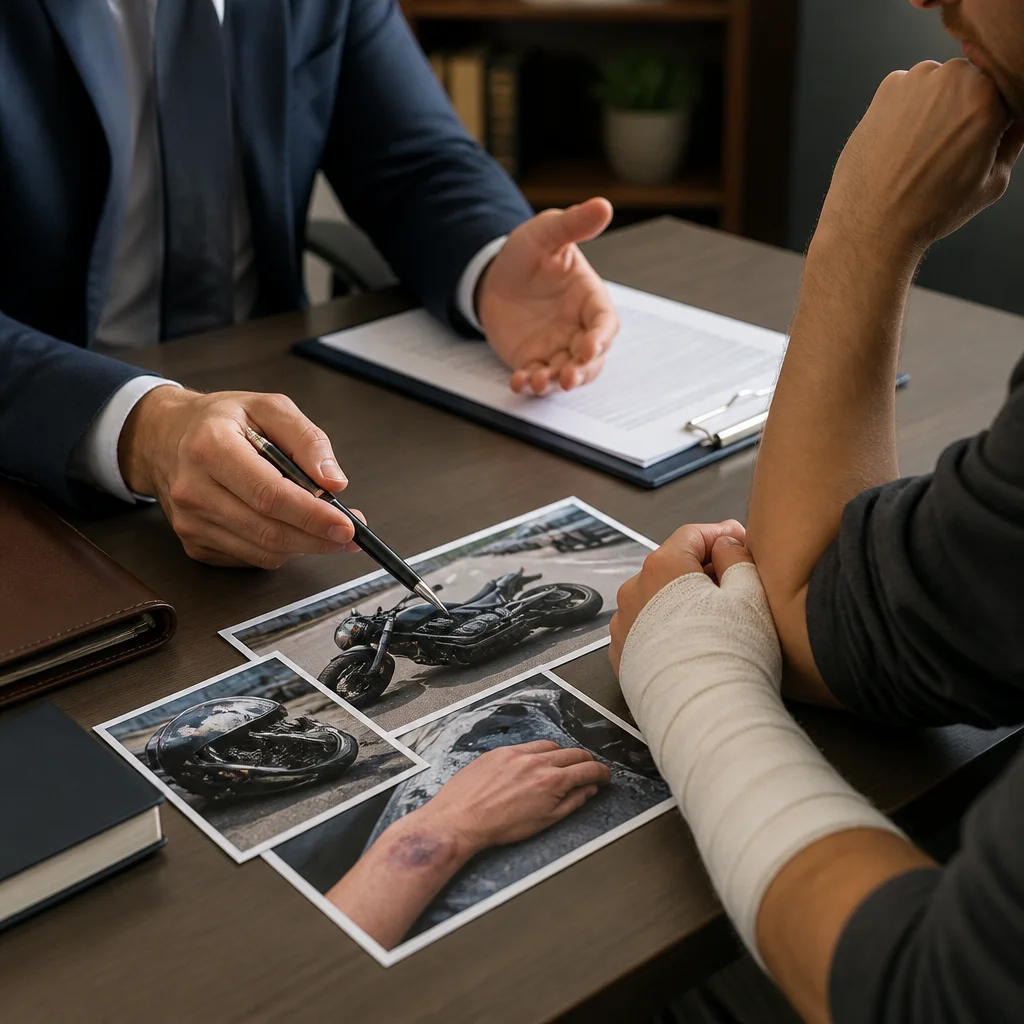
Visual documentation is powerful evidence. Photos and video create an objective record that words alone cannot convey. Insurance adjusters, juries, and attorneys rely on images to understand the severity of the crash and the extent of resulting injuries.
Photograph your motorcycle from multiple angles, capturing overall vehicle condition and specific damage points. Take close-up shots of dents, breaks, torn parts, and undercarriage damage. Include the other vehicle in images that show relative positioning and the point of impact. Photograph the surrounding scene: road surface, weather conditions, visibility, traffic signs, and any hazards that contributed to the crash.
Document your visible injuries as soon as possible. Take photos of cuts, bruises, bandages, and swelling. Continue photographing your injuries as they heal and evolve. Severe bruising often worsens over the first few days before improving. A photo series demonstrating this progression is compelling evidence of impact severity.
If a family member, friend, or witness took photos at the scene, ask them to send copies to you immediately. Similarly, request any video footage captured by other drivers’ dash cams or surveillance systems. We will investigate all available evidence systematically, but initial preservation depends on you acting quickly.
Store all photos and videos in multiple locations: on your phone, in cloud storage, and on a backup drive. This redundancy ensures evidence survives accidental phone loss or damage. Organize files by category (scene, vehicle damage, injuries, medical records) for easy reference later.

What to do next: If you haven’t yet, take photos and videos of your damaged motorcycle, vehicle damage on the other vehicle, the accident scene, and any visible injuries. Back them up to cloud storage today.
5. Understand California Statute of Limitations for Motorcycle Accident Claims
Time is limited when pursuing compensation. California’s statute of limitations sets the legal deadline for filing a personal injury claim. Understanding this critical deadline prevents you from losing your right to recover entirely.
For most personal injury cases, including motorcycle accidents, California allows two years from the date of injury to file a lawsuit. This two-year window may feel distant if you’re injured immediately after your crash. In reality, investigations take time, negotiations can stall, and court schedules move slowly. Two years passes faster than you expect.
The statute of limitations applies strictly. If you miss the filing deadline by even one day, the court will dismiss your case, and you forfeit all compensation rights permanently. There are narrow exceptions for minors or individuals declared legally incompetent, but these are rare and carry their own deadlines.
This is why we recommend acting quickly. We can file a claim with the at-fault party’s insurance company within days of your accident, which demonstrates your intent and begins negotiation. We can also conduct California statute of limitations research and prepare for litigation well before the deadline approaches.
What to do next: Note the date of your accident and mark two years forward on your calendar. Contact us immediately so we can begin protecting your rights and ensure no deadline is missed.
6. Avoid Costly Mistakes by Refusing Early Insurance Settlement Offers
Insurance companies move quickly after accidents, but their speed serves their interests, not yours. Within days of filing a claim, you may receive a settlement offer. The amount is almost always far below what your case is actually worth.
Here’s why: the adjuster doesn’t yet know the full extent of your injuries. You haven’t completed all medical treatment, so your total medical expenses remain unknown. You haven’t determined whether you can return to work or face permanent disability. Lost income projections are impossible to calculate. The insurance company seizes this uncertainty to offer a low settlement before you understand your claim’s true value.
Early settlement offers also require you to sign a release. Once you sign, you cannot pursue additional compensation, even if your injuries worsen or new complications emerge. This is a permanent, binding decision. We have seen clients regret settling early when they developed complications like chronic pain, requiring additional treatment and lost wages they couldn’t claim.
Insurance adjusters are skilled negotiators trained to minimize payouts. You have rights after an accident, and we pursue full and fair compensation by investigating thoroughly, gathering complete medical documentation, calculating all damages accurately, and negotiating strategically. We will not settle prematurely.
If an insurance company contacts you directly, do not discuss your case or admit fault. Politely provide only your contact information and refer the adjuster to us. We handle all communication with insurance companies, protecting you from unintended statements that could weaken your claim.
What to do next: If you’ve received an early settlement offer, do not sign anything. Send us the letter or email today so we can review it and advise you properly.

7. Partner with Dedicated Motorcycle Accident Attorneys for Maximum Compensation
Navigating a personal injury claim alone is risky and time-consuming. Insurance companies employ teams of adjusters and lawyers specifically trained to minimize what they pay. You shouldn’t face them without experienced legal representation on your side.
We specialize in motorcycle accident claims throughout California. We understand the unique dynamics of motorcycle crashes: the severe injuries that result, the bias some adjusters hold against motorcycle riders, and the investigation strategies that prove fault conclusively. We will investigate all available evidence, preserve crucial documents and recordings, communicate with insurance companies strategically, and prepare your case for trial if settlement negotiations stall.
Our approach is straightforward: no fee unless we recover for you. You pay nothing upfront, and we don’t get paid until we secure compensation on your behalf. This aligns our interests with yours completely. We succeed only when you recover the maximum compensation possible.
A free consultation lets us evaluate your case, explain your rights, and outline our strategy to maximize your recovery. We’ll answer all your questions clearly and help you understand what to expect moving forward. You’ll know exactly what we can pursue and why.
Reach out to us today. Time is limited — act now. The sooner we begin our investigation and start protecting your rights, the stronger your position becomes.
What to do next: Contact Weinberger Law Firm for a free consultation. Call us today or visit our website to begin your claim. We’re here to guide you through every step and secure the compensation you deserve.
Contact us today for a Free Case Consultation!
Frequently Asked Questions (FAQ)
What should we do immediately after a motorcycle accident in California?
You have rights after an accident, and the first step is to seek immediate medical attention, even if injuries seem minor. We recommend calling 911 to report the accident and document your condition right away. Preserve any evidence at the scene by taking photographs of vehicle damage, injuries, road conditions, and the accident location. Get the police report number and contact information from witnesses, as this documentation becomes critical when we investigate all available evidence for your claim.
How long do we have to file a motorcycle accident claim in California?
Time is limited, and California’s statute of limitations gives you two years from your accident date to file a personal injury lawsuit. We strongly encourage you to contact us well before this deadline because evidence can disappear and witness memories fade quickly. Insurance companies often pressure accident victims into early settlements that undervalue their claims, but we pursue full and fair compensation when you have adequate time for a thorough case evaluation.
Why should we avoid accepting the insurance company’s first settlement offer?
Insurance companies typically offer lowball settlements designed to close claims quickly, not to cover your actual losses including medical bills, lost wages, and ongoing care needs. We negotiate aggressively with insurers because we understand how to document and present the facts that support the full value of your claim. Our fee structure means we only recover when you do, so we’re motivated to maximize your compensation rather than accept inadequate offers.